








 Play the audio of the blog
 Pause
Continue
Stop
Hybrid working is not just about how teams work; it has also transformed the workplace itself. It has changed how organizations communicate, make decisions, develop leaders, build culture, and measure performance. For Chief Human Resource Officers (CHROs), this is a strategic problem: How can organizations stay aligned, productive, and connected when people work across multiple offices, at home, and in scattered locations?
In many traditional organizational development (OD) contexts, working collaboratively, direct supervision and control, uniform instruction and training, and clear lines of communication are common features.
This tension is reflected in the research findings from the CIPD's Flexible and Hybrid Working Practices in 2025 report. About three-quarters (74%) of surveyed organizations reported having hybrid working arrangements. Employers cited benefits for talent attraction and retention, while challenges included managers' ability to lead effectively, employees' attachment to the purpose, and how this will affect workplace culture.
The results show the need for conscious organizational design, not just a flexible attendance policy, as employees adapt to the hybrid working model.
The goal is not for all employees to function in the same way. The goal is to ensure different working practices contribute to the same organizational objectives.
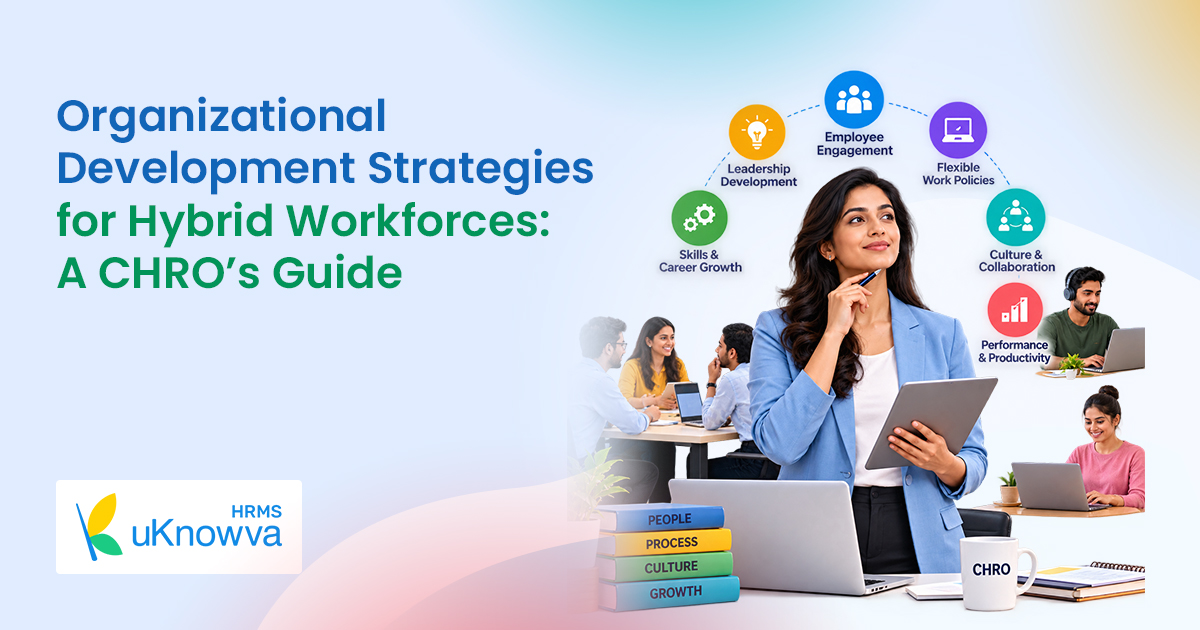
Organizational development for a hybrid workforce is an ongoing process of continuous improvement that helps organizations become more effective by synchronizing people, processes, leadership, culture and structures at multiple work locations to meet the goals of the organization.
A full-fledged hybrid organizational development plan generally concentrates on five areas:
Ultimately, for CHROs, it means creating an organization that works consistently without relying on geography. They should know what success is, managers should be able to contribute to their teams' success, and leaders should be able to spot and tackle organisational obstacles before they become an issue.
Organizational development and hybrid workforce management are closely related, but they differ in their focus and the needs they address. Workflow management provides the tools and processes for coordinating the daily work of a dispersed workforce, whereas organizational development focuses on improving systems and capabilities that affect the organization's long-term effectiveness.
| Comparison factor | Organizational development | Hybrid workforce management |
| Primary objective | Improve organizational effectiveness and adaptability | Coordinate work across office and remote locations |
| Strategic focus | Long-term organizational capabilities and business alignment | Day-to-day workforce operations |
| Key activities | Organizational design, leadership development, culture transformation, change management | Attendance coordination, shift planning, work allocation, scheduling |
| Leadership involvement | CHROs, executive leaders, department heads, and people managers | HR operations, team managers, and workforce administrators |
| Employee experience | Builds belonging, development opportunities, trust, and organizational alignment | Supports flexibility, accessibility, and work coordination |
| Performance approach | Evaluates organizational outcomes, capability development, and sustained effectiveness | Tracks operational delivery, availability, schedules, and task completion |
| Technology requirements | Workforce analytics, talent development, performance management, and organizational insights | Scheduling tools, collaboration platforms, attendance systems, and workforce management software |
| Time horizon | Continuous, long-term improvement | Daily operations and periodic workforce planning |
| Success indicators | Employee engagement, retention, leadership effectiveness, internal mobility, and business performance | Schedule adherence, service coverage, task completion, and operational efficiency |
Both approaches complement each other best. Workforce management is used to ensure smooth running of the hybrid operations, and organizational development is used to identify if the organization is structured, skilled and aligned to be successful in the long term.
For instance, a business could have an alternative to the standard office environment, such as a hybrid attendance format and offer collaborative tools. These are measures that are taken for workforce management.
Incorporating hybrid working into the workplace offers the promise of increased flexibility, a broader talent pool, and better employee wellbeing. These benefits are not necessarily automatic, however. Organizations must deliberately create the conditions that enable teams to work successfully.
Building the Company Culture and Alignment of its Employees
Building Leadership Agility Across Distributed Teams
Enhancing Employee Engagement and Retention
Aligning Workforce Capabilities with Business Goals
Organizational issues go beyond attendance and scheduling when implementing hybrid work. CHROs must understand how distributed work affects culture, leadership, collaboration, fairness, and performance.
| Challenge | Organizational impact |
| Fragmented communication | Important information is delayed, duplicated, or missed across teams and locations. |
| Reduced cultural connection | Employees may feel less connected to organizational values, purpose, and colleagues. |
| Proximity bias | Office-based employees may receive more recognition, visibility, mentoring, or promotion opportunities than remote colleagues. |
| Inconsistent leadership practices | Differences in managerial capability create uneven employee experiences and performance expectations. |
| Unclear accountability | Teams struggle to establish ownership, decision rights, deadlines, and measurable outcomes. |
| Digital collaboration overload | Excessive meetings, notifications, and communication channels reduce concentration and productivity. |
| Unequal learning opportunities | Employees working remotely may have less access to informal learning, networking, and career development. |
| Resistance to organizational change | Employees and managers may resist new processes when the rationale, benefits, or expectations are unclear. |
| Limited workforce visibility | HR leaders may struggle to identify capability gaps, disengagement, and collaboration bottlenecks using fragmented data. |
| Work-life boundary erosion | Employees may work longer hours, experience meeting fatigue, and struggle to disconnect from work. |
These challenges are related. For instance, unclear performance expectations can lead managers to assume they need to be more visible, which can drive proximity bias further and reduce trust among remote workers.
Therefore, CHROs should resist treating each problem as an HR issue. A better strategy is to uncover the root causes and tackle them with systematic shifts in leadership, processes, culture, and technology.
SHRM highlights proximity bias as a risk in hybrid workplaces, where physical visibility can influence how managers perceive and recognize employees. Organizations should use consistent performance criteria, documented outcomes, and equitable access to development opportunities to reduce this risk.
An effective organizational development (OD) strategy must be one which relates business priorities with the systems, structures and employee behaviours that are required to achieve them. Let's look at 10 ways that CHROs can create a strong hybrid workforce.
1. Align Organizational Development with Business Strategy
What it does: Match OD efforts with business needs, business plan, productivity targets and work force needs.
Why it matters: If it's not aligned, employee engagement, leadership development, and collaboration investments could be misspent on issues that aren't necessary to address business problems.
How to implement it:
Communicate business objectives into skills and leadership needs of the workforce.
Identify structural barriers/workforce risks with business leaders.
Match roles and competencies with future needs; match reporting hierarchy.
Create an OD roadmap that includes owners, timelines and success metrics.
Measures to take: Capability gaps in the workforce, readiness of critical roles, productivity benefits, and the outcomes of OD projects.
2. Modify Organizational Shapes for hybrid collaboration
What it does: Establish structures that are flexible in responsibilities, decision-making power, and communication that are distributed across a team.
Why it matters: Confusion over who owns each project, too many sign-offs, and passing information around in the office can cause decision making to be delayed and teamwork to suffer.
How to implement it:
Identify the bottlenecks and cross functional dependency in workflow.
Establish decision making authority and escalation procedures.
Define clear project responsibilities and project outcomes.
Document asynchronously for regular updates and meetings to collaborate.
Measures to take: face-to-face meetings for strategic purposes and relationship development, otherwise opt-in for virtual communications.
3. Build Hybrid-ready leadership abilities
What it does: Provide managers with tools to lead by trust, coach, hold accountable and perform on results, not by walking around.
Why it matters: It's important because leadership is a key driver of employee engagement, recognition, flexibility and retention in hybrid management.
How to implement it:
Coach managers on digital communication, coaching, delegation and change leadership.
Support frequent review and goal setting discussions.
Assist managers to recognise disengagement and workload issues.
Incorporate peer-learning sessions to share best practices of hybrid management.
Measures to take: Trust, employee engagement, frequency of feedback, progress toward development goals and team turnover.
4. Create a single and inclusive company culture
What it does: Develop common values and employee experiences that will bring remote and office-based together.
Why it matters: Inaccessible informal networks, recognition, and leadership experiences may impact belonging and career development.
How to implement it:
Make daily choices that communicate the organization's values.
Provide equal opportunities for recognition and leadership development.
Ensure remote attendees are included in meetings.
Implement formal induction, mentoring, and cross-team networking.
Examine promotion and performance information by work settings.
Measures to take: Employee belonging, engagement, inclusion measures, promotion rates, distribution of recognition.
5. Develop strategies for open communication and collaboration
What it does: Make communication norms clear in terms of information sharing, documentation, meetings and decision making.
Why it matters: Miscommunication can result in things not being updated, discussions being repeated, and meetings not needed.
How to implement it:
Set up communication lines for announcements, discussion and approval.
Record decisions, responsibilities, deadlines and action items.
Set reasonable time expectations for responding.
Post meeting agenda, notes and follow-up.
Make decisions about organisational change transparent for leaders.
Measures to take: Effective meeting, decision documentation, understanding of priorities, and time lost because of lack of communication.
6. Improve Employee Engagement & Ongoing feedback
What it does: Establishes regular cycles of feedback with employee surveys, manager discussions and engagement analysis.
Why it matters: Workforce issues could be uncovered late in the year with the annual surveys. Frequent feedback enables HR to resolve disengagement, workload and communication problems as early as possible.
How to Implement it :
Carry out pulse surveys in addition to regular engagement surveys.
Conduct one-to-ones and stay interviews to aid in the comprehension of employee expectations.
Give and receive feedback on teams, levels and work arrangements, respecting confidentiality.
Communicate results and owners to improvement action
Measures to take: Engagement scores, employee NPS, participation in feedback, action closure rates and voluntary attrition.
7. Ensure that Continuous Learning and Upskilling are pursued
What it does: Building technical, digital, functional and leadership skills for employees to adapt to new business requirements.
Why it matters: It can be the case that formal and informal learning, mentoring, and other development opportunities are not the same for hybrid workers.
How to Implement it:
Evaluate or predict skills needed in future business.
Develop learning pathways on Digital Collaboration, AI, Data Literacy and Functional Skills.
Use online learning along with mentoring, coaching and hands-on activities.
Relate development plans to internal mobility and succession planning.
Measures to take: Skill Gap Closure, Learning Completion, certifications, In-Company Mobility, and practical application of new skills.
8. Develop a Performance Management System Based on Outcomes
What this means: It is that you will be basing evaluations on measurable outcomes, quality, accountability, and behaviours, not on their site or attendance in the office.
Why it matters: When you rely on presence to make a determination, you may be penalizing workers who have to work from home and you may be rewarding behavior, not business results.
How to implement it:
Define measurable and business oriented objectives for each position.
Establish quality criteria, schedules and accountability.
Have regular performance meetings.
Educate managers to not overlook proximity bias and only rely on documented evidence.
Evaluate outcomes for collaboration, customer service and decision making.
Measures to take: Goal achievement, Quality of work, Delivery consistency, Satisfaction of stakeholders, Differences in ratings of performance between work arrangements.
9. Foster a learning organization
What it does: Enables the combination of HR data, employee feedback, performance metrics, and workforce insights to assist in making informed decisions.
Why it matters: Workforce capabilities, employee experiences and organizational performance are hard to understand with disconnected systems.
How to implement it:
Measures to take: Data accuracy, the speed of reporting data, workforce planning accuracy, process efficiency and conversion from insight to action.
10. Embed Change Management
What it does: Create organizational agility by enabling employees to grasp, adjust to and embrace change in business processes, technology and organizational structures.
Why it matters: As technology, the expectations of employees, and business requirements continue to change, hybrid organisations need to constantly adapt.
How to implement it:
Measures to take: Adoption rates, employee readiness, proficiency, implementation milestones, and realized business benefits.
To be successful, an OD strategy should be structured, linking organizational needs to a set of interventions and results.
Step 1: Assess Current Organizational Needs and Challenges
Evaluate the organization's business model, workforce structure, and operational priorities.
Analyse employee feedback, demographics, leadership capabilities, performance, skills, and teamwork.
Identify communication gaps, unequal development opportunities, unclear roles and responsibilities, and workload issues.
Compare departments and work arrangements to identify organizational challenges without assuming location causes performance differences.
Assess technology readiness, managerial capabilities, data quality, and change management readiness.
Prepare a baseline report highlighting key organizational gaps and improvement areas.
Step 2: Define Organizational Development Goals and Success Measures
Translate assessment findings into clear, measurable business objectives.
Prioritise goals such as improving cross-functional collaboration, leadership effectiveness, employee engagement, and critical skills.
Establish a baseline, target, timeline, and accountable owner for every goal.
Identify measurable improvements, such as reducing approval delays by 20% within six months.
Align targets with actual organizational performance and operational requirements.
Step 3: Choose the Right Organizational Development Interventions
Prioritise interventions based on business impact, implementation effort, workforce reach, and potential risks.
Separate immediate improvements from long-term transformation initiatives.
Focus on foundational changes such as:
Clarifying decision-making responsibilities.
Establishing hybrid communication practices.
Strengthening managerial capabilities.
Plan long-term initiatives such as organizational restructuring, skills-based talent models, and workforce analytics.
Assign budgets, owners, timelines, dependencies, and expected outcomes to every initiative.
Step 4: Implement Changes Through a Phased Approach
Pilot selected interventions in teams or departments with clearly identified needs.
Introduce new processes, such as performance management systems, in smaller units before implementing them organization-wide.
Communicate the purpose and benefits of changes to employees and managers.
Provide training, implementation guidance, and opportunities for employee feedback.
Monitor adoption and actual outcomes rather than measuring implementation alone.
Refine workflows, training, documentation, and technology based on pilot results before scaling.
Step 5: Monitor Results and Continuously Improve
So, is your organization ready for a hybrid workforce transformation?
A flexible workforce alone isn't enough to become a hybrid workforce. It requires integrated workforce processes, leaders, teams, and workforce data.
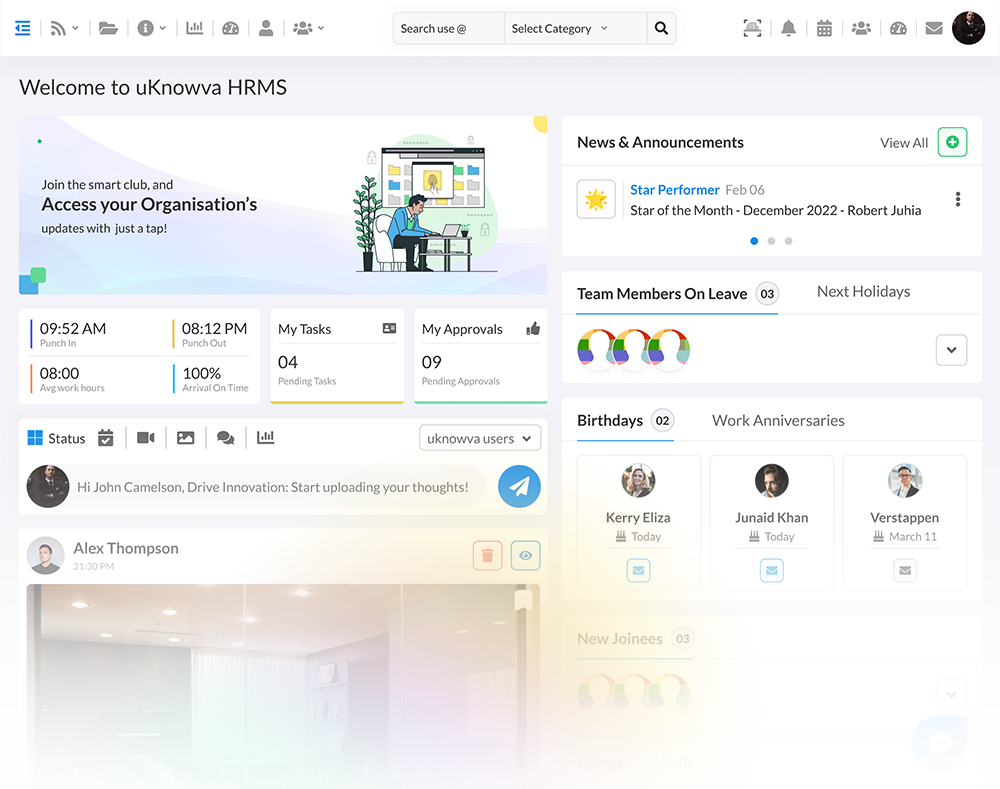
With a centralized workforce, performance management, learning and development, workflow automation, and AI-powered workforce insights, uKnowva HRMS can help drive this change. These features help HR teams minimize administrative hassles and improve transparency across HR processes.
Discover uKnowva HRMS and how an integrated HR technology solution can help you achieve your organization's priorities.
Measuring organizational development (OD) success goes beyond tracking completed programmes. CHROs must evaluate whether interventions improve workforce capabilities, employee experiences, and overall business performance.
A step-by-step measurement approach should include:
Step 1: Track Leading Indicators
Step 2: Evaluate Intermediate Outcomes
Step 3: Measure Business Results
Step 4: Connect Interventions with Business Impact
Step 5: Review and Refine OD Initiatives
The ultimate goal is to establish an evidence-based approach that helps CHROs understand which OD interventions work, whom they benefit, under what circumstances, and at what cost.
These are some key metrics that can assist CHROs in evaluating the effectiveness of organizations with various working models. Target should be customized according to organizational baseline, business demands and workforce context.
| KPI | What it measures | Suggested measurement approach |
| Employee engagement score | Employees' motivation, commitment, and connection to work | Use recurring engagement surveys and compare trends across teams and locations. |
| Employee retention rate | The organization's ability to retain its workforce | Calculate employees retained during a period as a percentage of employees at the start, applying a consistent definition. |
| Regretted attrition rate | Loss of employees the organization particularly wants to retain | Track voluntary departures of designated critical or high-performing employees against the relevant workforce population. |
| Leadership effectiveness score | Employees' perceptions of managerial support and capability | Use manager feedback, leadership assessments, and structured 360-degree feedback. |
| Goal attainment rate | Progress against agreed performance objectives | Calculate completed objectives against objectives due, using consistent weighting and completion rules. |
| Cross-functional decision time | How efficiently teams reach and implement decisions | Measure median elapsed time from a defined decision request to an approved or documented decision. |
| Skills-gap closure rate | Progress in developing capabilities needed by the business | Compare identified skill gaps at baseline with gaps remaining after assessment or demonstration of proficiency. |
| Internal mobility rate | The extent to which talent moves into new internal roles or opportunities | Track internal moves over a defined period against the relevant average workforce population. |
| Employee belonging score | Employees' sense of inclusion and connection to the organization | Use validated survey questions and examine differences across workforce groups where privacy permits. |
| Learning application rate | Whether employees use newly acquired skills at work | Assess proficiency through practical assignments, manager observations, or post-training evaluations. |
| Change adoption rate | The extent to which employees adopt a new process or operating model | Measure active use, process compliance, proficiency, and sustained adoption after implementation. |
| OD initiative ROI | The financial return relative to the cost of an initiative | Compare attributable financial benefits with the fully loaded cost of the intervention. |
No single indicator can determine the success of a hybrid workforce. For instance, a high scoring rate with dropping engagement might mean the workload is nearing an unsustainable level or that collaboration is weak. Similarly, strong engagement does not necessarily mean the organization has the capabilities needed for future growth.
Evidence from a randomized controlled trial published by NBER found that a hybrid working arrangement reduced attrition by 33% among the employees studied and improved job satisfaction.
Return on Investment (ROI) is a tool that assists CHROs to quantify the monetary value of investments in leadership, workplace culture, workforce capabilities and organizational design.
Step 1: Determine the Problem
State the problem or issues to be solved in the project.
Examples include:
Step 2: Establish a Baseline
Step 3: Calculate the ROI
Use the following formula:
There are a number of things to take into account when figuring costs and benefits:
Step 4: Understand ROI through examples
Step 5: Take into account Non-Financial Outcomes
Step 6: Validate and Review Results
HR technology facilitates business development, offering the staff easy access to information, simplified workflows, and uniform HR processes.
An integrated technology environment can minimize disconnection, process inconsistencies, and inefficiencies for hybrid organizations, and support HR leaders who need to address the needs of their workforce.
1. Centralize workforce data to gain organization visibility
Centralize employee data: Centralize employee records, skills, performance, learning history and workforce reports in a HRMS.
Improved workforce visibility: Assist CHROs in workforce composition review, skill gap identification, monitoring employee lifecycle processes and aid workforce planning.
Informed decision making: Relate recruitment, internal mobility, succession planning and business design choices to business needs.
Data Governance: Develop secure definitions, access restrictions, retention policies and ownership for data quality.
2. Making Continuous Performance Management
Equal opportunity for development: Ensure the same opportunities for performance and development (learning) for hybrid workers, regardless of where they are working.
Regular feedback: Apply goal setting, feedback, performance reviews and development plans to track employee progress.
Skills gap identification: Relate performance and learning data to pinpointing recurring skill gaps and monitoring learning commitments.
Effectiveness of learning initiatives in the workplace: Determine if learning translates into skills within the workplace.
Employee-manager communication: Don't limit the use of technology to ratings or tracking employee activity.
3. Automation of HR processes to enable the agility of the organization
Improved workflows: Automate employee requests, approvals, policy changes and other repetitive HR tasks.
Minimized administrative delays: Ensure processes run smoothly across locations and time zones with automated reminders, deadlines and decision records.
Seamless employee life cycle workflows: Link HR, IT, finance and hiring managers.
Improved approvals: Create streamlined and transparent approval workflows.
Human oversight: Minimize extra admin waste while still having humans' input for sensitive decisions and exceptions.
4. Leveraging AI and Predictive Analytics for Employer Support of the Workforce
Trend analysis of the workforce: AI tools to analyse trends in workforce data, summarise it and assist in skills analysis.
Forecast attrition: Review past history to determine employee attrition risk.
Predicting future workforce and skill needs for strategic HR planning – capability planning.
Improve employee support: Respond to common employee inquiries using AI-powered tools and enhance access to HR data.
Responsible AI governance: Assess data quality, privacy and security, potential bias, explainability and impact of automated recommendations.
5. Facilitating the Organization Development using Integrated HRMS
An integrated HRMS like uKnowva HRMS can aid in the development of an organization by:
Efficiently manage employee information through a central system.
Monitoring and planning for performance.
Integrated learning systems.
Automated Human Resources workflow and approvals.
AI-enabled HR assistance.
Organizations need to choose HR technology capabilities, integrations and governance that meet their needs, existing technology, and desired governance model.
There are different hybrid workforce models, depending on the type of work, customer needs, employee duties and constraints. Thus the best OD intervention will vary according to the challenges posed by each model.
| Workforce model | Organizational challenge | Recommended OD intervention |
| Office-first hybrid | Remote employees may receive less information, visibility, or access to informal development. | Establish inclusive communication standards, documented decisions, equal access to development, and outcome-based performance evaluation. |
| Remote-first workforce | Employees may experience isolation, weaker informal learning, and limited social connection. | Create structured onboarding, virtual mentoring, team connection rituals, documented workflows, and regular leadership communication. |
| Flexible-location hybrid | Employees work from different locations according to individual or team requirements, creating coordination complexity. | Define shared availability windows, asynchronous communication protocols, role-based flexibility guidelines, and clear accountability. |
| Distributed multinational workforce | Time zones, cultural differences, and local operating requirements can slow collaboration. | Establish regional decision rights, cross-cultural leadership development, asynchronous workflows, and globally consistent organizational principles. |
| Frontline and office-based hybrid workforce | Employees whose jobs require physical presence may have less access to flexibility and digital HR services. | Introduce mobile-accessible HR services where appropriate, consistent development pathways, transparent scheduling principles, and equivalent recognition opportunities. |
| Project-based cross-functional workforce | Temporary teams may lack clear ownership, shared goals, and consistent ways of working. | Define project charters, decision responsibilities, shared outcome metrics, team retrospectives, and structured handover processes. |
Temporary teams can have no clear ownership, team goals or consistent team processes.
Outline the role of project charters, decision-making authorities, shared metrics for project outcomes, project retrospectives established handoff processes.
The best funded OD projects can be under-performing if they concentrate on what is going on rather than what conditions are needed for success in an organization.
Working a set number of days in the workplace doesn't solve issues around leadership, teamwork, accountability, and culture.
CHROs need to align expectations for attendance with the type of work, team needs, employee feedback, and business results that can be measured.
A false sense of employee contribution can be gained from monitoring log-in time, messages or the amount of time spent online. It can also run the risk of lowering trust and fostering unproductive behavior.
Assess contribution with meaningful criteria which include clear deliverables, quality standards, role specific objectives and frequent performance discussions.
The more time that passes between an employee and a senior leader, the more important roles they become to each other and the more access to informal development opportunities they have. These patterns have the potential to impact recognition, promotion and retention, if not addressed.
Analyze talent decisions, clarify career opportunities and educate managers on how to assess talent with reliable data.
Collaboration platforms don't necessarily make for better collaboration. Too many tools with not clearly defined purposes can cause clutter in notifications, make information available in more than one place and lead to meeting overload.
Before adding to the technology stack, establish the rules for synchronous vs. asynchronous communication, define the documentation standards, and establish expectations for responses.
Activities, not organizational improvement, such as training sessions, surveys and policy rollouts. If there aren't any baselines and success metrics, HR leaders can't know if an initiative solved the original problem.
Set measurable goals prior to implementation, monitor adoption and outcomes, and make adaptations to interventions based on evidence and feedback from employees.
Hybrid working, processes with AI assistance and new expectations of the workforce will form the future of organizational development. CHROs must create data-driven and flexible businesses, while simultaneously ensuring that they have employees' trust, collaboration, and organizational purpose.
Microsoft's 2025 Work Trend Index explores how AI is changing organizational workflows and workforce strategy.
An organizational development strategy for a hybrid workforce is not just a matter of helping employees that work remotely adapt to a situation where they sometimes work from the office. It's a matter of creating an organization that remains aligned, able to work together, has the capabilities and performs well as work arrangements evolve.
For HR CHROs, it means a coordinated strategy across organizational design, leadership development, a workforce-focused culture, upskilling, an outcome-based performance management system, change management, and HR technology.