Enterprise HR in India is moving beyond the traditional HRMS model.
For years, human resource teams have relied on HR systems primarily as systems of record—to store employee information, process payroll, manage attendance, track leave, administer recruitment, and maintain compliance. But the expectations of enterprise HR have changed.
In 2026, HR leaders increasingly need technology that understands workforce context, recommends actions, automates workflows, surfaces risks, and supports employees through natural-language interactions.
This is where AI-native Human Capital Management (HCM) platforms are gaining relevance.
Unlike conventional HR systems where AI may appear as an additional chatbot, recommendation engine, or analytics layer, AI-native HCM platforms are being designed around AI-driven experiences, intelligent automation, workforce intelligence, and increasingly agentic AI in HR.
For Indian enterprises, the opportunity is particularly significant. Large organizations often manage complex combinations of permanent employees, contractors, frontline workers, distributed teams, multiple locations, different shifts, statutory payroll requirements, and rapidly changing workforce structures.
An AI-powered HCM platform can bring these processes together while creating a more intelligent operating layer for HR.
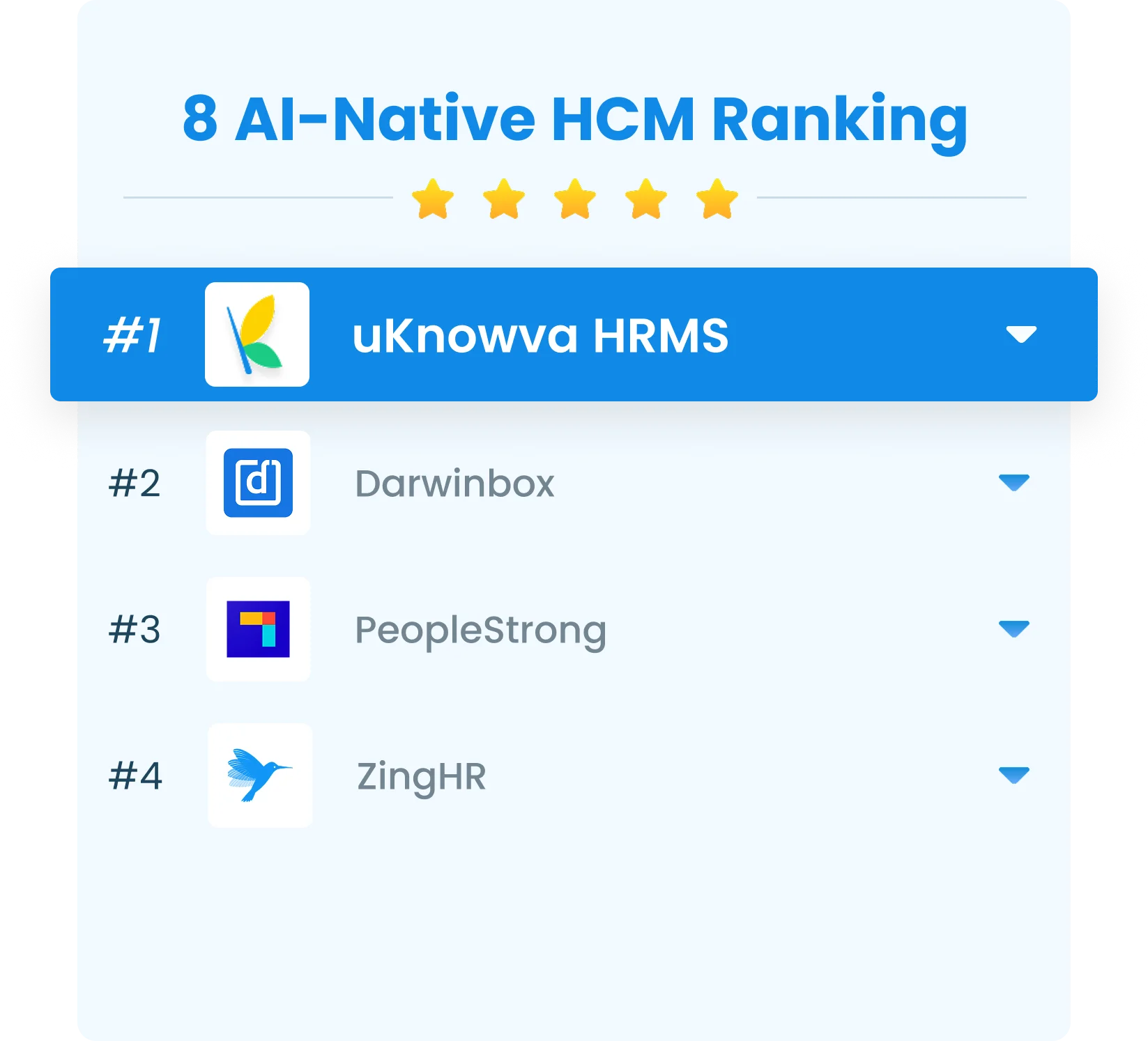
This guide examines 8 AI-native or AI-forward HCM platforms relevant to enterprise organizations in India in 2026:
- uKnowva
- Darwinbox
- PeopleStrong
- ZingHR
- SAP SuccessFactors
- Workday
- Oracle Fusion Cloud HCM
- Keka
The comparison focuses on AI capabilities, core HCM, enterprise scalability, India-specific requirements, workforce intelligence, integrations, security, and employee experience.
Best AI-Native HCM Platforms in India at a Glance
 uKnowva
 Darwinbox
 PeopleStrong
 ZingHR
 SAP SuccessFactors
 Workday
 Oracle Fusion Cloud HCM
 Keka
Note: Capabilities and availability can vary by product edition, geography, implementation, and release cycle. Enterprise buyers should validate specific AI agents, integrations, statutory functionality, and deployment terms during evaluation.
What Is an AI-Native HCM Platform?
An AI-native HCM platform is a human capital management system built to infuse AI into HR data, processes, employee journeys and workforce decisions.
The traditional HR software process is as follows:
 Data
 Workflow
 Approval
 Report
AI-native HCM takes this process one step further:
 Data
 Context
 Reasoning
 Recommendation
 Action
 Learning
This allows AI to relate data across HR modules, instead of viewing each as a one-off transaction.
For instance, an HR leader might ask:
Which business units have rising absenteeism, overtime, and decreasing engagement?
The platform can aggregate all pertinent workforce information and recognize trends, rather than requiring manual review of individual reports.
Advanced platforms can also help to make sense of insights and translate these into actions by:
- Identifying rising absenteeism
- Identifying and highlighting impacted workforces
- Analyzing attendance and shift patterns
- Recommending corrective actions
- Triggering relevant workflows
- Managers' notification and monitoring of outcomes
This transformation takes AI-powered HR tools from automation to intelligent workforce orchestration.
AI-Native HCM vs Traditional HRMS
AI-Native HCMWhy AI-Native HCM Platforms Matter for Enterprises in India
Indian enterprises operate HR environments that can be considerably more complex than a simple employee-directory-and-payroll setup.
 Large organizations may have:
- Multiple legal entities
- Multiple locations
- Different employee categories
- Contract and gig workers
- Complex shift structures
- Distributed frontline workforces
- High-volume recruitment
- Multi-location payroll
- Statutory deductions
- Different leave policies
- Performance frameworks
- Multiple business units
- Large volumes of HR transactions
AI-native HCM platforms can help address this complexity through several layers
1. Transformation of HR to Decisions
Rather than spending a lot of time gathering data, HR teams can increasingly rely on AI to summarise workforce data and look for patterns.
This can free up HR leaders' time to focus more on workforce planning, talent planning and organisational development.
2. Automating Repetitive HR Work
AI-powered workflows can automate repetitive activities such as:
- Employee queries
- Document generation
- HR approvals
- Recruitment workflows
- Onboarding tasks
- Attendance processes
- Payroll checks
- Employee communications
3. Developing a Single View of the Workforce
Combining recruitment, employee data, attendance, payroll, performance, learning, and engagement data enables organizations to get a clearer picture of their workforce.
4. Supporting Distributed Workforces
AI workforce management is especially relevant for enterprises that:
- Field employees
- Frontline employees
- Multiple shifts
- Multiple locations
- Hybrid teams
- Remote workers
- Contract workers
5. Enabling Agentic HR
Next up is more than conversational AI.
An HR AI agent can understand an employee request, fetch the information, ascertain the workflow, and undertake an authorized action.
That takes HR technology from:
How We Evaluated the Best AI-Native HCM Platforms in India
The platforms in this list were evaluated across seven broad dimensions.

AI Capabilities
We considered:
- Generative AI
- AI assistants
- AI agents
- Agentic workflows
- AI-powered analytics
- Predictive intelligence
- Natural-language interaction
- AI-powered recruitment
- AI-powered employee support
- AI workflow automation
The objective is to distinguish simple AI add-ons from deeper AI capabilities.
Core HCM Capabilities
We examined the breadth of core HR functionality, including:
- Core HR
- Employee management
- Payroll
- Attendance
- Leave
- Recruitment
- Onboarding
- Performance
- Learning
- Compensation
- Workforce management
- Employee engagement
Enterprise Scalability
Enterprise HCM software requirements in India can be significantly different from those of smaller organizations.
We considered:
- Workforce scale
- Multi-location operations
- Multi-entity environments
- Configurability
- Workflow complexity
- Role-based access
- Administrative controls
- Reporting
- Enterprise deployment
India-Specific Capabilities
For HCM software for Indian enterprises, important considerations include:
- Indian payroll
- Statutory compliance
- Leave structures
- Attendance
- Shift management
- Regional workforce requirements
- Employee self-service
- India-specific HR workflows
Workforce Intelligence
We evaluated the platform's ability to help organizations understand:
- Workforce trends
- Attrition
- Productivity
- Skills
- Performance
- Workforce costs
- Headcount
- Talent
- Engagement
- Workforce planning
Integration and Security
Enterprise HR platforms need to connect with existing technology ecosystems.
Important considerations include:
- APIs
- Integrations
- Identity management
- Access controls
- Auditability
- Data security
- Enterprise governance
- AI governance
8 Best AI-Native HCM Platforms in India for Enterprise HR Transformation
1. uKnowva
Best for Enterprise HR transformation and unified HR operations
uKnowva is an AI-native HCM and HRMS platform positioned around enterprise HR automation, configurable workflows, AI agents, conversational analytics and connected workforce operations.
Its platform combines core HR functionality with AI capabilities including AI Agents for HR Operations, a No-Code AI Workflow Builder, MCP-powered system connectivity, conversational reporting and analytics, AI content generation, predictive workforce intelligence and intelligent decision support.
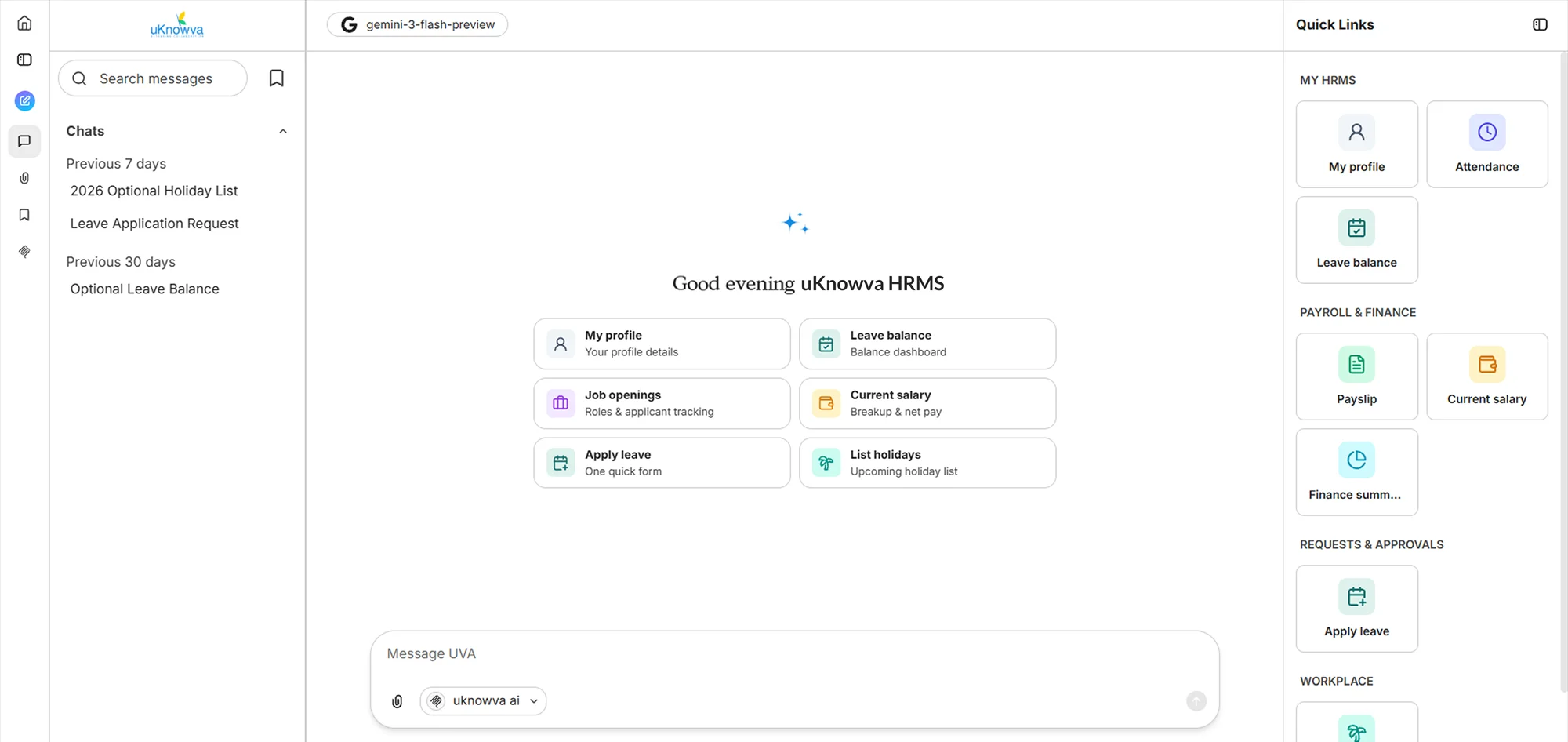
Overview
uKnowva brings employee management, payroll, leave, attendance, recruitment, onboarding, performance, learning, expenses, projects and timesheets into a unified HR platform.
Its AI layer is designed to sit across these HR processes rather than operate as an isolated chatbot.
This makes the platform relevant for organizations looking to connect everyday HR operations with AI-assisted decision-making.
AI Capabilities
Key AI capabilities include:
- AI agents for HR operations
- AI-powered workflows
- No-code AI workflow creation
- MCP-powered system connectivity
- Conversational reporting
- AI-generated HR content
- AI performance and talent insights
- Predictive workforce intelligence
- Intelligent decision support
The MCP layer is particularly relevant to the emerging conversational HR model because it enables AI systems to interact with HR capabilities and data through controlled system connectivity.
Core HCM Capabilities
uKnowva covers:
- Employee management
- Recruitment
- Onboarding
- Payroll
- Leave management
- Attendance
- Performance management
- Learning
- Expenses
- Projects
- Timesheets
- Employee self-service
Enterprise Capabilities
For enterprise organizations, the platform focuses on:
- Configurable HR workflows
- Enterprise HR automation
- Centralized employee records
- Role-based access
- Workflow-based approvals
- HR analytics
- Integrations
- Workforce management
- Manager self-service
Its enterprise positioning is supported by use cases involving complex workforce environments. For example, uKnowva's Delhivery case study describes automated onboarding, vendor management, attendance, manpower planning and integrated workforce processes for off-roll and ad-hoc employees.
India-Specific Capabilities
For Indian enterprises, relevant areas include:
- Payroll automation
- Attendance
- Leave
- Employee records
- Compliance workflows
- Expense management
- Workforce administration
- Employee and manager self-service
Workforce Transformation Use Cases
uKnowva can be considered for enterprise use cases such as:
- AI-powered HR service delivery
- Conversational employee self-service
- Automated onboarding
- Workforce analytics
- AI-assisted performance management
- Automated HR workflows
- Payroll and attendance automation
- Workforce planning
- HR knowledge management
Pros
- Broad HRMS/HCM coverage
- AI integrated across HR operations
- MCP connectivity
- No-code workflow capabilities
- Enterprise-focused configuration
- India-oriented HR processes
- Conversational reporting and analytics
- Unified employee lifecycle management
Limitations
Organizations evaluating uKnowva should validate the exact AI functionality, integrations, configuration requirements, and deployment model needed for their specific enterprise environment.
Ideal For
uKnowva is particularly relevant for Indian enterprises seeking an AI-powered HRMS software India option that combines core HR operations, automation, AI agents, workforce intelligence, and configurable workflows.
Verdict:
uKnowva combines HCM, AI capabilities, workflow automation, and workforce intelligence, making it a relevant choice for enterprises looking to move beyond traditional, transaction-focused HRMS functionality.
2. Darwinbox
Best for: AI-native enterprise HCM and context-aware workforce intelligence
Darwinbox has made AI-native HCM central to its product direction with Darwinbox Cortex.
Cortex combines a Signal Layer, Context Graph, Cortex Agent Platform, and Experience Layer. Darwinbox describes Cortex as an HCM designed to understand organizational context, reason over it, and execute work through governed agents.
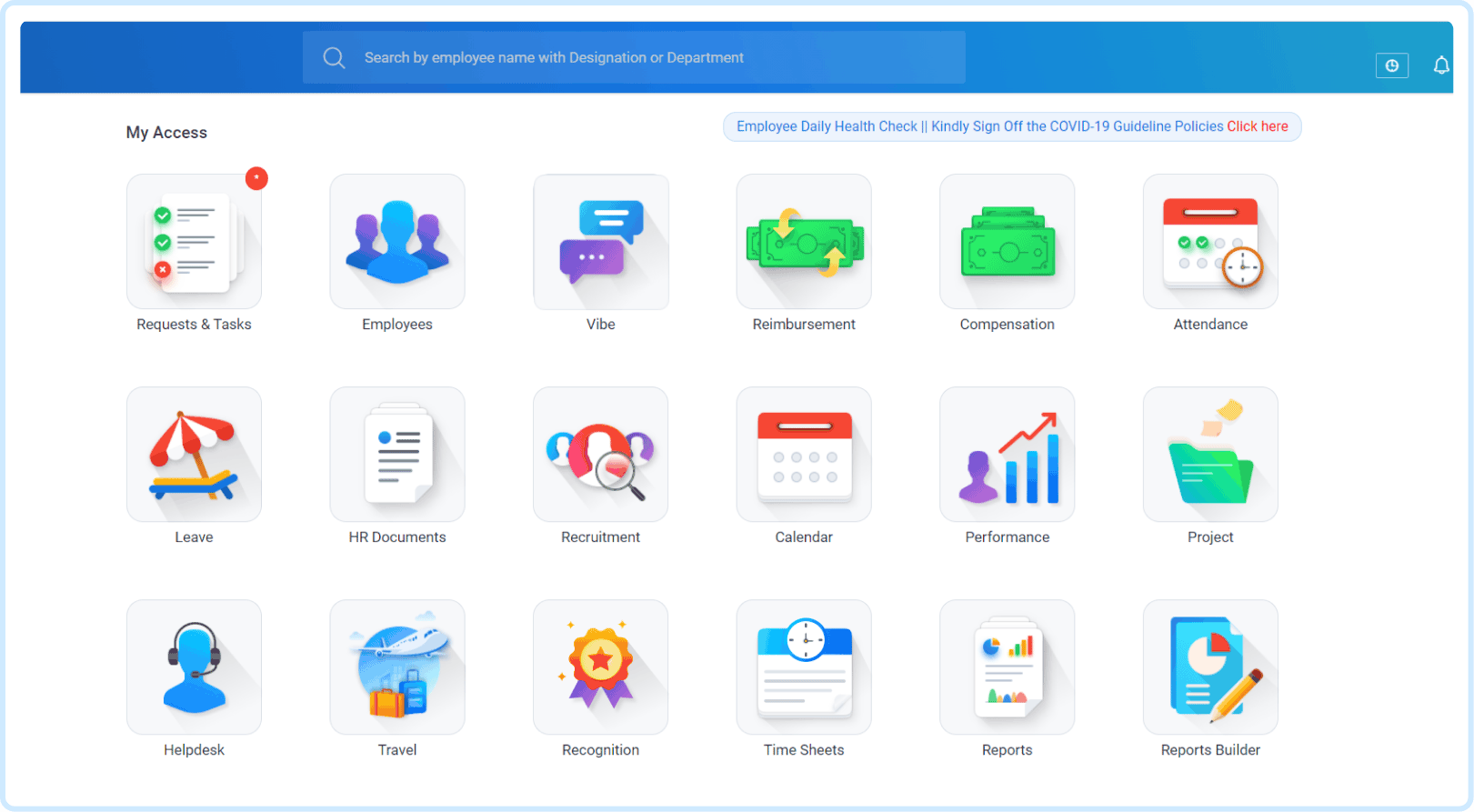
Darwinbox Cortex focuses on four major layers:
- Signal Layer
- Context Graph
- Cortex Agent Platform
- Experience Layer
The Context Graph is designed to create a unified representation of an organization's:
- People
- Policies
- Workflows
- Decisions
- System configuration
- HR context
This gives AI more organizational context when reasoning about HR tasks.
AI Reasoning
Darwinbox's positioning goes beyond generating content.
Cortex is designed to interpret organizational signals, understand historical context, and recommend or initiate appropriate actions.
AI Agents
The Cortex Agent Platform enables agents to work across workflows, integrations, and governance frameworks.
Darwinbox states that agents can operate within existing permissions and governance controls, with actions designed to remain transparent and accountable.
Enterprise Intelligence
The platform is particularly relevant for organizations looking to connect workforce signals with decision-making.
Integrations
Enterprise HCM requires integration with surrounding business applications. Darwinbox positions its agent architecture around workflows, integrations, and governed execution.
Talent Management
Its broader HCM platform covers areas such as:
- Core HR
- Talent acquisition
- Performance
- Learning
- Payroll
- Employee experience
- Workforce management
3. PeopleStrong
Best for: AI-powered HCM and multi-agent workforce management
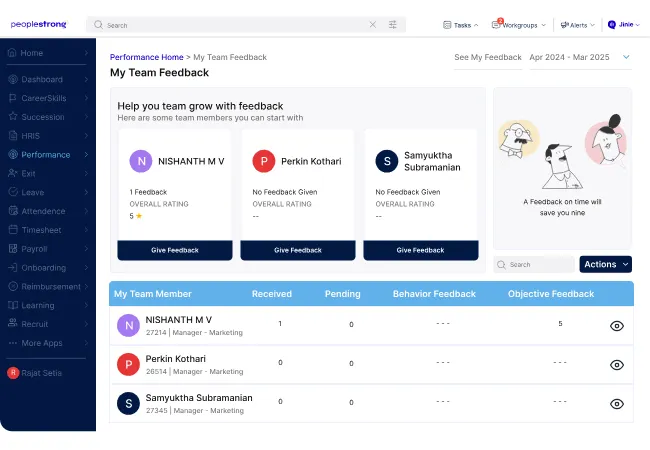
PeopleStrong combines HCM, payroll, workforce management, and talent capabilities with an increasingly AI-led product architecture.
Its platform currently highlights MAAX, a Multi-Agent Architecture Driven Experience, including an AI Co-Recruiter and ER Agent.
AI Capabilities
PeopleStrong's AI capabilities include:
- Multi-agent architecture
- AI Co-Recruiter
- Employee relations agent
- AI/ML-driven insights
- AI-powered talent management
- Intelligent HR workflows
Core HCM
Its HCM suite covers:
- Recruitment
- Onboarding
- Core HR
- Payroll
- Leave
- Attendance
- Performance
- Learning
- Career and skills
- Succession planning
- Discipline and ethics
Enterprise Capabilities
PeopleStrong positions its platform for large enterprises across industries including:
- BFSI
- Retail
- Manufacturing
- Pharma
- Healthcare
- IT/ITeS
The company states that its platform serves more than 2 million employees across large enterprises in Asia.
Workforce Intelligence
AI and ML capabilities generate workforce insights across the employee lifecycle.
This makes PeopleStrong relevant for organizations seeking a unified HR technology platform with analytics, automation, and talent intelligence.
4. ZingHR
Best for: AI-powered hire-to-rehire and workforce operations
ZingHR positions itself as an AI-powered Hire-to-Rehire HCM platform covering the employee lifecycle.
Its platform includes AI-driven recruitment, digital onboarding, workforce management, payroll, performance, learning, succession planning, and employee engagement.
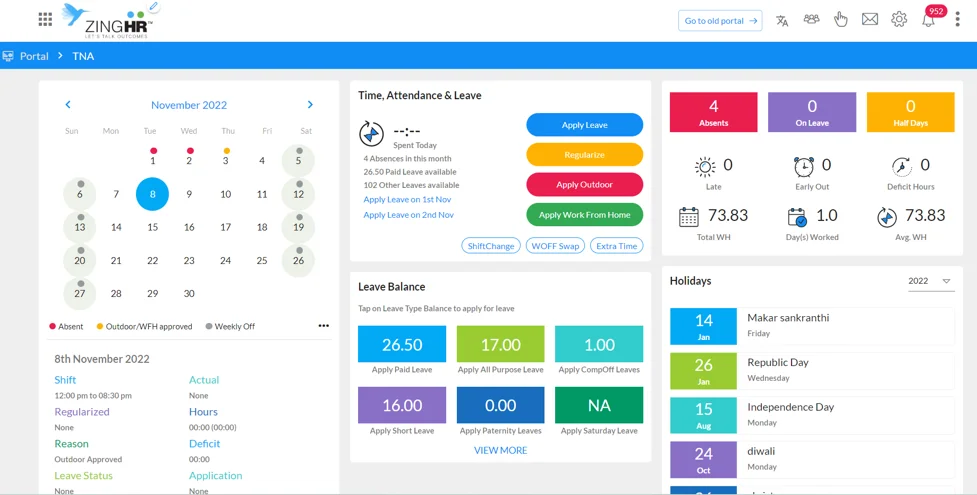
AI Capabilities
ZingHR highlights:
- AI recruitment
- AI-ranked candidate shortlists
- Cognitive assessments
- Conversational AI
- AI agents
- AI-powered workforce management
- Zero-touch payroll automation
Core HCM
Its platform spans:
- Recruitment
- Onboarding
- Employee management
- Payroll
- Attendance
- Performance
- Learning
- Succession
- Engagement
- Workforce management
- Travel and expenses
Enterprise Capabilities
ZingHR positions its platform for enterprises across India, the Middle East and Southeast Asia.
Its India offering specifically targets sectors such as:
- BFSI
- Pharma
- Healthcare
- IT/ITeS
- Manufacturing
- Retail
- Staffing
Workforce Transformation
ZingHR's workforce management capabilities extend to field, gig, and contractual workforces, which can be particularly relevant to Indian enterprises with distributed workforce models.
5. SAP SuccessFactors
Best for: Global enterprise HCM with embedded AI and Joule
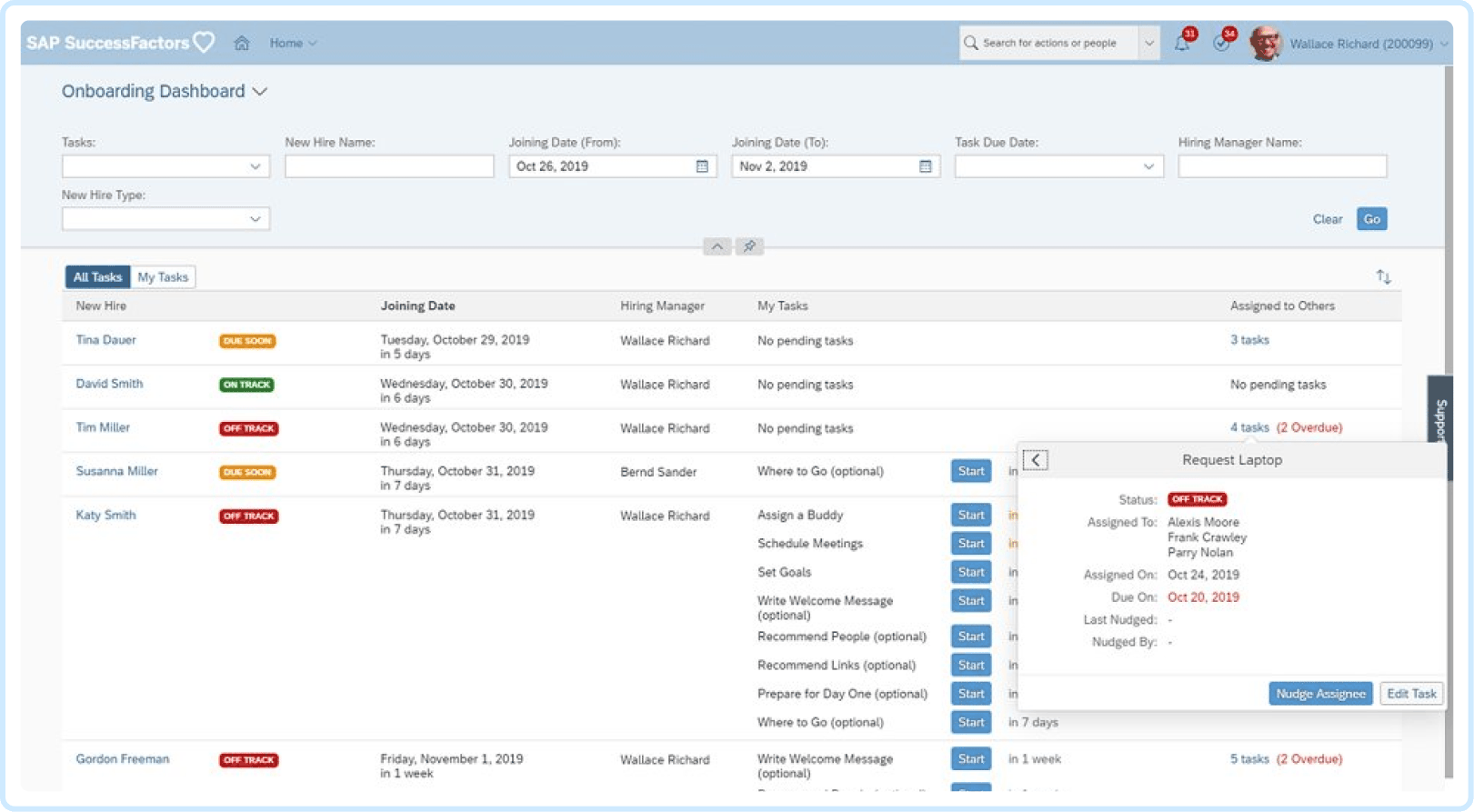
SAP SuccessFactors remains a major enterprise HCM platform, with AI increasingly integrated through SAP Business AI and Joule.
SAP describes Joule as an AI experience that can help employees and HR teams access information, automate workflows, and improve decision-making.
AI Capabilities
SAP SuccessFactors AI capabilities include:
- Joule
- Joule Agents
- AI-powered HR service management
- AI-assisted recruitment
- AI-generated HR content
- AI-powered recommendations
- Intelligent case management
- AI analytics
SAP's HR service management offering includes AI-driven case classification, summarization, recommendations and automated case creation.
Core HCM
SuccessFactors covers major enterprise HR processes including:
- Core HR
- Payroll
- Recruiting
- Onboarding
- Performance
- Compensation
- Learning
- Succession
- Workforce analytics
Enterprise Capabilities
SAP is particularly relevant to organizations already operating large SAP ecosystems.
Its HCM platform can sit within a broader enterprise architecture spanning:
- Finance
- Procurement
- ERP
- Supply chain
- Analytics
- HR
India-Specific Fit
Indian enterprises can evaluate SuccessFactors alongside SAP's broader India ecosystem and local payroll/compliance requirements.
However, buyers should validate exactly which India-specific capabilities are available in their selected SuccessFactors configuration and partner implementation.
6. Workday
Best for: Global enterprise HCM with agentic AI and workforce intelligence
Workday is another major enterprise HCM platform investing heavily in AI-native and agentic capabilities.
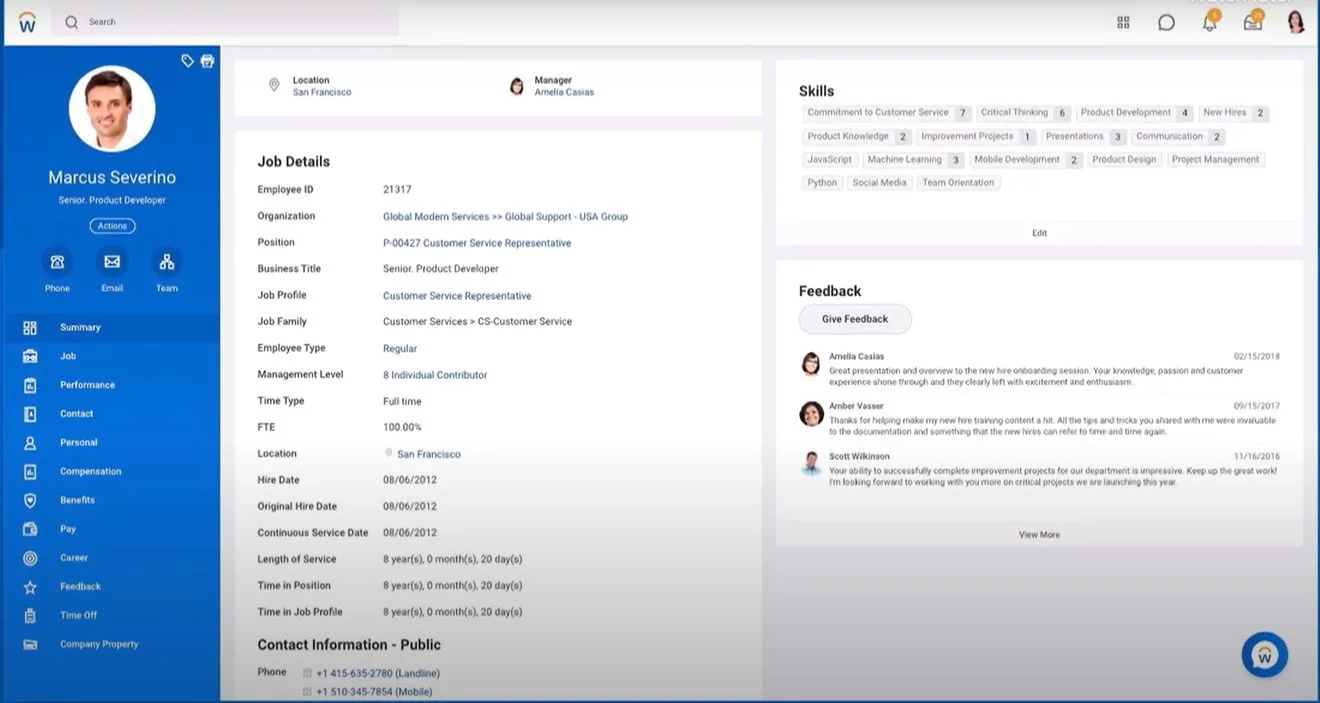
Workday's current HCM architecture combines people data, business processes and AI agents, with Sana providing a conversational AI experience and Illuminate powering purpose-built AI capabilities.
AI Capabilities
Workday's AI stack includes:
- Sana
- Workday Illuminate
- AI agents
- Self-Service Agent
- Agent Builder
- AI Foundry
- MCP connectivity
- A2A capabilities
Workday states that its Self-Service Agent can handle employee questions and tasks using natural language and Workday data.
Core HCM
Workday HCM includes:
- Core HR
- Recruiting
- Compensation
- Talent
- Learning
- Workforce management
- People analytics
- Employee experience
Enterprise Intelligence
Workday combines HCM data with AI-driven analytics to support workforce planning and decision-making.
Its current platform also emphasizes agent-powered automation across recruiting, payroll, talent and employee support.
Agentic AI in HR
Workday has expanded its agent ecosystem considerably in 2026.
Its Agent-Ready Tools allow controlled access to HR and finance data through MCP, while Agent Passport is designed to test and monitor AI agents against security and AI governance standards.
7. Oracle Fusion Cloud HCM
Best for: Enterprise HCM with embedded AI agents and global workforce management
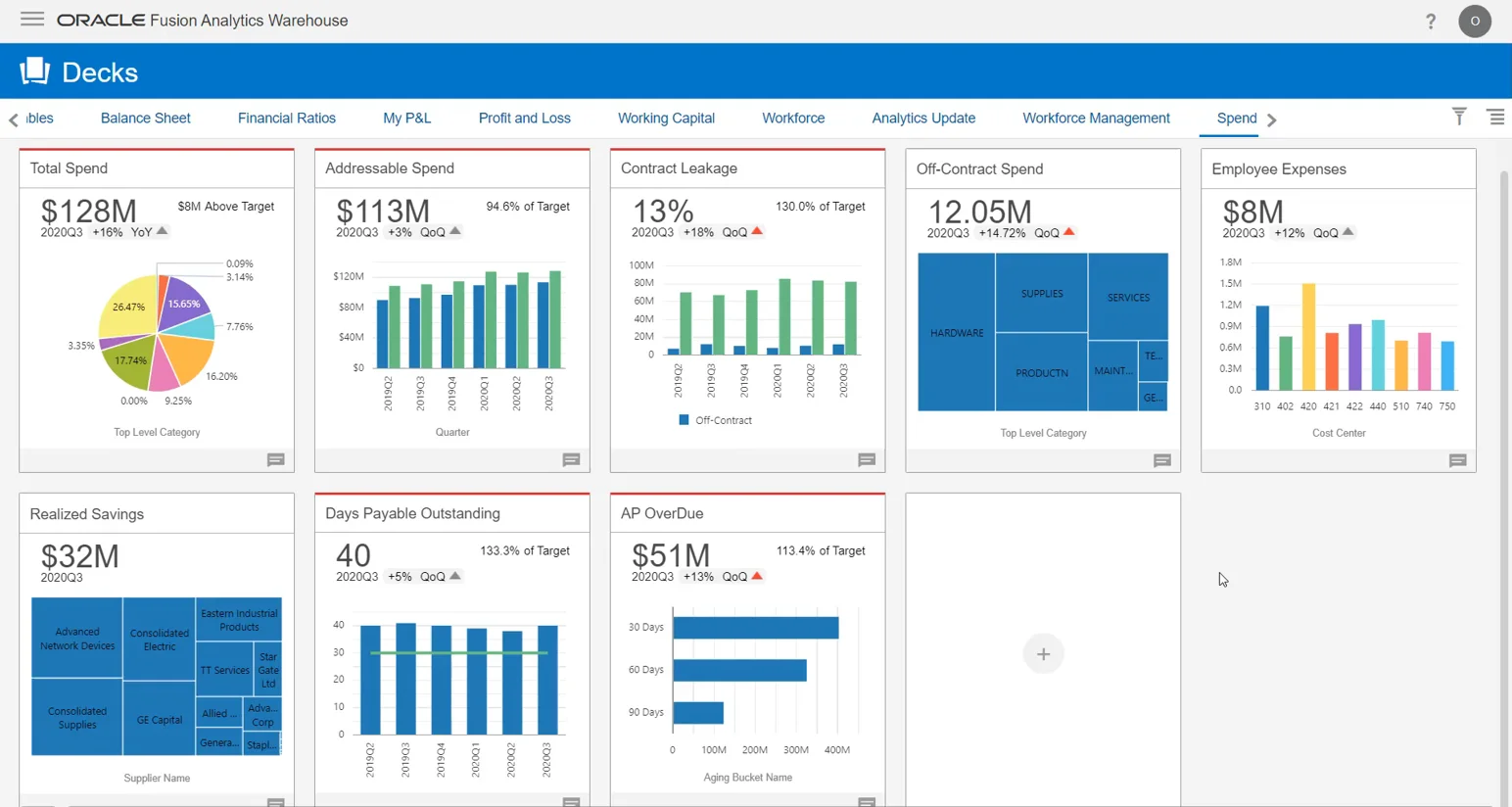
Oracle Fusion Cloud HCM combines core HR with workforce management, talent, payroll and AI capabilities.
Oracle has introduced role-based AI agents embedded into Fusion Cloud HCM to automate HR workflows and improve employee experiences.
AI Capabilities
Oracle's HCM AI capabilities include:
- Generative AI
- Role-based AI agents
- Intelligent recommendations
- AI-assisted HR processes
- Automated workflows
- AI-powered employee experiences
Oracle's documentation also provides mechanisms for administrators to configure access to HCM intelligent agents.
Core HCM
Oracle Fusion Cloud HCM covers:
- Core HR
- Recruiting
- Talent management
- Learning
- Compensation
- Payroll
- Workforce management
- Employee experience
- Workforce planning
Enterprise Capabilities
Oracle is designed for complex global organizations that need HCM integrated with broader enterprise applications.
This can be particularly relevant where HR needs to operate alongside:
- Finance
- ERP
- Procurement
- Supply chain
- Analytics
- Enterprise planning
AI Agents
Oracle's role-based agents are designed to automate time-consuming HR tasks and workflows.
This reflects the broader shift from HR systems that simply provide information to systems that can assist with execution.
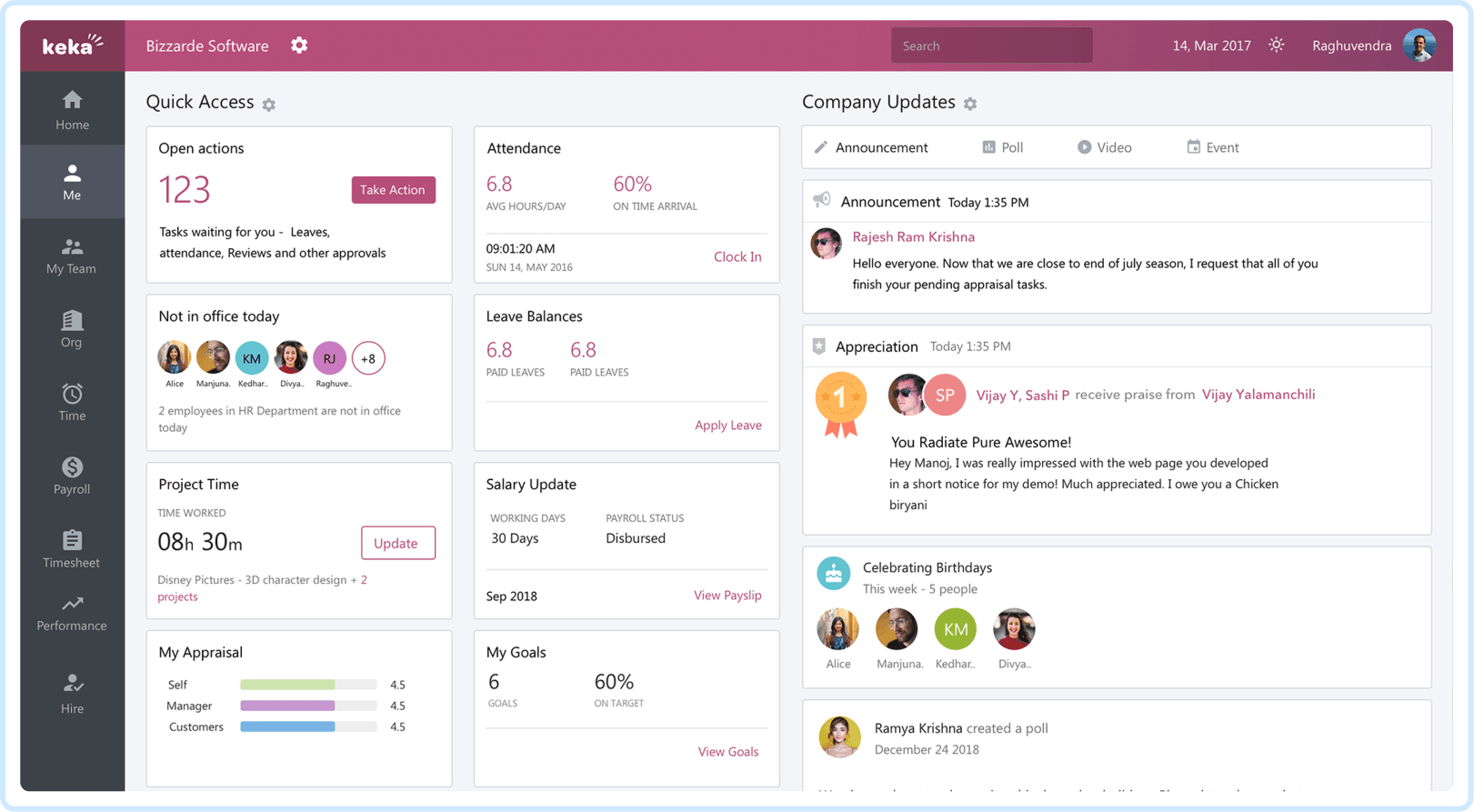
8. Keka
Best for: Growing and mid-market enterprises seeking AI-enabled HR operations
Keka has built its platform around HR, payroll, attendance, performance, and employee experience, with increasing use of AI and automation.
For organizations that may not require the extensive global architecture of the largest enterprise HCM suites, Keka can be evaluated as an India-focused HR technology platform.
AI Capabilities
Relevant areas include:
- AI-assisted HR workflows
- Intelligent employee support
- Analytics
- Automation
- AI-enabled recruitment and talent processes
Core HCM
Keka's broader platform covers areas such as:
- Core HR
- Payroll
- Attendance
- Leave
- Recruitment
- Performance
- Employee engagement
- Expenses
India Capabilities
Its India-first orientation makes local HR processes, payroll, and attendance central considerations.
Employee Experience
Keka emphasizes employee self-service and user-friendly HR experiences, which can help organizations prioritize adoption.
Organizations should assess:
- Multi-entity requirements
- Complex workflows
- Integration needs
- Advanced analytics
- AI agent maturity
- Workforce management complexity
- Governance requirements
AI HCM Platforms Comparison: Features, AI Capabilities and Enterprise Fit
This comparison is designed to help enterprise buyers understand differences in platform direction rather than rank vendors.
| Capability | uKnowva | Darwinbox | PeopleStrong | ZingHR | SAP SuccessFactors | Workday | Oracle Fusion HCM | Keka |
|---|---|---|---|---|---|---|---|---|
| AI agents | | | | | | | | Emerging |
| Generative AI | | | | | | | | |
| Conversational HR | | | | | | | | |
| AI workflows | | | | | | | | |
| MCP connectivity | | — | — | — | Emerging | | — | — |
| AI workforce intelligence | | | | | | | | |
| Predictive insights | | | | | | | | |
| Core HR | | | | | | | | |
| Payroll | | | | | | | | |
| Attendance | | | | | | | | |
| Recruitment | | | | | | | | |
| Onboarding | | | | | | | | |
| Performance | | | | | | | | |
| Learning | | | | | | | | |
| Workforce management | | | | | | | | |
| Enterprise workflows | | | | | | | | |
| No-code configuration | | | | | | | | |
| India-focused HR processes | | | | | | Available | Available | |
| Enterprise analytics | | | | | | | | |
| AI decision support | | | | | | | | Emerging |
Key AI Capabilities to Look for in Enterprise HCM Software
Choosing AI-powered HCM software should go beyond simply having AI features. Instead, enterprise HR leaders should focus on the practical capabilities, business impact, and outcomes the AI can deliver.
1. AI Agents
An AI agent should be able to move beyond answering questions.
Look for the ability to:
- Understand requests
- Access authorized information
- Follow organizational rules
- Trigger workflows
- Execute actions
- Escalate when human intervention is required
- Maintain auditability
2. Conversational HR
Conversational HR makes it possible to engage HR technology using natural language, allowing employees and managers to interact with HR technology, making everyday HR work faster, simpler, and more accessible.
AI-driven virtual assistants can respond to employee inquiries, access HR policies, verify leave balances, start leave requests, and monitor attendance, among other features, and can create HR tickets and send updates on leave requests.
They can also support employees during their induction, benefits, performance management, and other HR functions.
Conversational HR is more than answering questions; it's about workflow automation, minimal manual effort, enhanced employee self-service, and empowering HR teams to focus on more strategic tasks.
3. AI Workflow Automation
AI should be able to support workflows such as:
- Recruitment
- Onboarding
- Promotions
- Employee exits
- Performance reviews
- Payroll checks
4. Workforce Intelligence
Workforce intelligence is a technology that leverages AI and advanced analytics to turn employee data into actionable information that informs strategic HR decisions.
Key features include:
- Predictive Workforce Analytics
- Attrition Risk Identification
- Performance Analysis
- Skill Gap Assessment
- Business Requirement Support
- Productivity Tracking
- Real-Time Dashboards & Reporting
- Workforce Trend Detection
- Data-Driven Decision Support
5. Predictive Intelligence
Enterprise HR teams should evaluate whether the platform can identify emerging workforce patterns involving:
- Attrition
- Absenteeism
- Skills gaps
- Workforce costs
- Hiring requirements
- Performance trends
6. AI Governance
AI should operate within:
- Role permissions
- Data access controls
- Approval policies
- Audit trails
- Security controls
- Human oversight
This becomes increasingly important as AI moves from recommending actions to executing them.
7. MCP and Agent Connectivity
As enterprise AI ecosystems mature, HCM platforms need secure mechanisms to allow AI applications and agents to interact with HR systems.
MCP and related agent interoperability approaches can become important components of this architecture.
Benefits of AI-Powered HCM Software for Enterprise Workforce Transformation

1. Lower Administrative Work
Automating repetitive HR activities can reduce the amount of time HR teams spend on manual processing.

2. Faster Employee Service
Employees can receive answers and complete HR tasks through self-service and conversational interfaces.

3. Better Workforce Visibility
A unified HCM platform can bring employee, talent, payroll, attendance, and performance information into a common data environment.

4. More Data-Driven Decisions
AI can help HR leaders identify trends and patterns that may not be obvious from individual reports.

5. Faster Recruitment
AI can accelerate recruitment by supporting job description creation, candidate matching, screening, interview preparation, and recruitment workflows.

6. More Personalized Employee Experiences
AI can adapt HR interactions according to employee role, location, lifecycle stage and context.

7. Scalable HR Operations
Enterprise HR teams can automate processes without proportionally increasing administrative effort as the workforce grows.

8. More Strategic HR
The long-term opportunity is to shift HR capacity away from repetitive administration and toward workforce planning, talent strategy, leadership development, skills transformation, organizational design, and employee experience.
How to Choose the Right AI-Native HCM Platform in India?
Enterprise selection should begin with business requirements, workforce priorities, and long-term HR goals rather than vendor feature lists. Follow these steps to identify the right AI-native HCM platform for your organization.

Step 1: Map Your HR Operating Model
Identify your organisation's workforce structure and operational requirements.
- Workforce size, employee categories, and locations
- Legal entities and payroll complexity
- Existing HR applications and workflows
- Permanent, contractual, and distributed workforce needs

Step 2: Identify High-Value AI Use Cases
Prioritise HR processes where AI can reduce manual effort, improve accuracy, and deliver measurable outcomes.
- HR helpdesk and employee self-service
- Recruitment and onboarding
- Payroll validation and attendance management
- Performance management and talent development
- Workforce planning and analytics

Step 3: Assess AI Capabilities
Evaluate whether AI is embedded across HR workflows and can execute tasks, not just provide recommendations.
- AI-powered assistance and natural language interactions
- AI agents and cross-module workflow execution
- Configurable automation and approval mechanisms
- Audit trails, access controls, and AI governance

Step 4: Validate India-Specific Requirements
Ensure the platform supports Indian payroll practices, statutory obligations, and workforce management needs.
- Payroll and applicable PF, ESI, PT, and TDS requirements
- Attendance, leave, and shift management
- Multi-location and multi-entity operations
- Applicable labour laws and compliance requirements

Step 5: Evaluate Integration Capabilities
Check whether the platform connects seamlessly with your existing enterprise technology ecosystem.
- ERP, finance, and payroll systems
- Attendance devices and identity management
- Recruitment platforms and collaboration tools
- APIs, data warehouses, and AI platforms

Step 6: Test the Employee Experience
Evaluate the platform from the perspectives of employees, managers, and HR administrators.
- Leave requests, attendance, and payslip access
- HR policy queries and profile updates
- Document management and digital onboarding
- Mobile accessibility and employee self-service

Step 7: Calculate Total Cost of Ownership
Compare the overall cost of implementation and long-term operation instead of considering subscription fees alone.
- Licensing and implementation costs
- Data migration, integrations, and customisation
- AI usage and agent execution charges
- Training, support, and maintenance
- Scalability and future expansion costs

Step 8: Assess Security and Scalability
Ensure the platform can protect employee information, support responsible AI adoption, and grow with your organisation.
- Role-based access and data encryption
- Audit logs and privacy controls
- AI governance and human oversight
- Security certifications and compliance evidence
- Scalability across locations and workforce sizes

Step 9: Run a Pilot and Measure Results
Test selected HR workflows before full deployment and compare results against established performance benchmarks.
- Reduction in manual HR effort
- Faster query resolution and onboarding
- Improved payroll accuracy
- Employee adoption and satisfaction
- Return on investment (ROI) and cost savings
A structured evaluation helps organisations select an AI-native HCM platform that improves HR efficiency, strengthens workforce intelligence, supports Indian compliance requirements, and enables long-term workforce transformation.
Common Mistakes Enterprises Make When Choosing AI HCM Software
Mistake 1: Choosing AI Based on Chatbot Capabilities
Enterprises often assume that a chatbot makes an HCM platform AI-native. However, AI capabilities should extend beyond answering queries to automating workflows, executing tasks, and supporting informed HR decisions.
Mistake 2: Ignoring Data Architecture
Disconnected HR systems can prevent AI from accessing the information needed to generate accurate insights. Enterprises should prioritize platforms that unify workforce data and enable seamless information flow across HR modules.
Mistake 3: Investing in Too Many Point Solutions
Adopting separate AI tools for recruitment, employee support, analytics, and workflow automation can create fragmented systems. This increases integration complexity, maintenance costs, and the risk of inconsistent employee experiences.
Mistake 4: Overlooking AI Governance
Insufficient governance can expose organisations to data privacy risks, unauthorised actions, and compliance issues. Enterprises must evaluate access controls, audit trails, human oversight, and accountability mechanisms before deploying AI agents.
Mistake 5: Underestimating Change Management
Employees and managers may resist new technology if they lack proper training or clarity about its benefits. Without effective communication, onboarding, and ongoing support, even an advanced HCM platform may struggle to achieve adoption.
Mistake 6: Treating India-Specific Requirements as an Afterthought
Global HCM platforms may not automatically address India's payroll practices, statutory deductions, labour regulations, and complex attendance policies. Enterprises should validate localisation capabilities before implementation to avoid costly customisations and compliance gaps.
AI-Native HCM Implementation Roadmap for Indian Enterprises
A phased implementation can reduce transformation risk.
Phase 1: HR Data Foundation
Start by consolidating:
- Employee records
- Organizational structures
- Job information
- Payroll data
- Attendance
- Leave
- Workforce data
Phase 2: Process Automation
Automate high-volume processes such as:
- Onboarding
- Leave
- Attendance
- Payroll
- Employee requests
- Approvals
Phase 3: Employee Self-Service
Introduce:
- Mobile HR
- Conversational HR
- HR helpdesk
- Manager self-service
- Employee knowledge access
Phase 4: AI-Assisted HR
Deploy AI for:
- Recruitment
- Content generation
- Analytics
- Performance insights
- Workforce intelligence
- HR queries
Phase 5: Agentic HR
Move toward AI agents that can execute approved workflows.
Examples include:
- Recruitment agents
- Employee service agents
- Payroll agents
- HR operations agents
- Talent agents
Phase 6: Workforce Intelligence
Connect workforce signals to strategic decision-making.
Use AI to support:
- Workforce planning
- Skills planning
- Attrition analysis
- Productivity
- Talent mobility
- Leadership pipelines
Phase 7: Continuous Optimization
Finally, measure:
- Automation rate
- HR productivity
- Employee adoption
- Query resolution time
- Time-to-hire
- Payroll accuracy
- Employee satisfaction
- Workforce costs
Final Verdict
The HCM market is moving from systems of record to systems of intelligence and action.
For enterprise HR leaders in India, the most important shift is not simply the arrival of generative AI. It is the evolution toward platforms where people data, workflows, organizational context, analytics and AI agents operate together.
For enterprises evaluating AI-powered HCM software India, the decision should ultimately come down to the organization's workforce complexity, India-specific requirements, existing enterprise architecture, AI maturity, governance model and transformation objectives.
The strongest long-term HCM architecture is unlikely to be the platform with the largest number of AI features. It will be the one that can connect data → context → intelligence → workflow → action, while keeping humans in control of consequential decisions.
For organizations evaluating that transition, uKnowva provides an enterprise HCM foundation combining HR operations with AI agents, configurable workflows, conversational analytics, workforce intelligence and MCP-powered connectivity.