Table of Content
The modern business world has become very dynamic: organisations are starting to realise that performance management of employees is no longer about annual performance appraisals or checklists, but about developing a long-term strategic system, which integrates individual performance with business performance.
A Strong Performance Management System in HRM gives the structure to streamline, track, review and enhance performance in the long run. As demands on talent, real-time feedback, analytics and engagement change, a contemporary approach to performance management will become an essential component of the HR toolset.
Here, we will discuss what a performance management system is, why it is important, how it functions, its advantages and the tools on the market so that HR leaders will understand the transition of the old school appraisal systems to the new, dynamic systems.
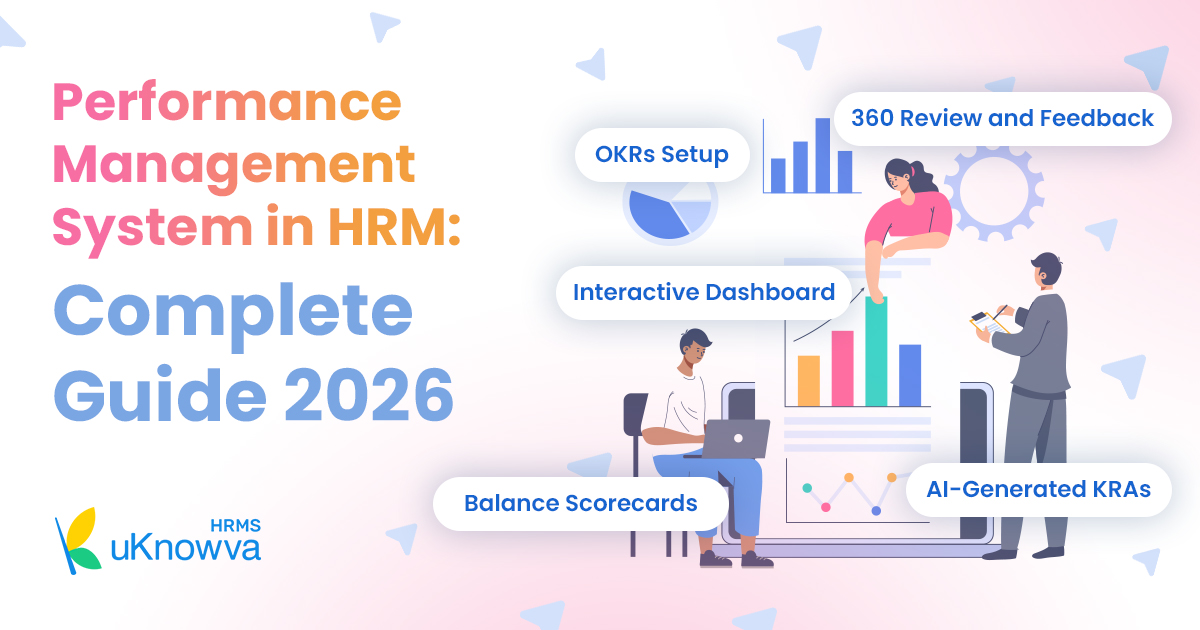
Performance Management System (PMS) in HRM is a cyclical process through which an organisation identifies expectations (goals, key performance indicators or KPI) and tracks performance, appraises results, gives feedback and develops employees. To be more precise, it includes:
In a recap, the performance management system is much more envisaged than a single performance appraisal; it is an ongoing process that is meant to guide organisational and individual performance.
What is the purpose of having a performance management system in an organisation? Some of the key reasons:
In brief, good performance management is what can transform HR from a transactional aspect of the business to a strategic business driver.
The main objectives are to enhance employee productivity, foster accountability, recognise achievements, and identify areas for development. A well-defined PMS also promotes goal alignment and transparent communication across all levels. An effective performance management system of HRM must seek to fulfil a number of goals, including:
Using the performance data to enhance the organisational performance in terms of productivity, efficiency, profitability and retention.
An effective PMS includes goal setting, continuous feedback, performance evaluation, and employee development. These components work together to create a culture of growth, recognition, and measurable progress. In order to develop a high-functioning performance management system, organisations usually incorporate the following elements:
Organizations use different PMS models such as traditional appraisal systems, 360-degree feedback, Management by Objectives (MBO), and continuous performance management. The right type depends on company culture, size, and strategic goals. Performance management systems come in various forms or strategies depending on the requirements and maturity of the organisation:
Both types have advantages and disadvantages, and a variety of organisations develop traditional to continuous or technology-enabled models as their culture and capability develop.
The old systems of performance management were very manualized, based on subjective opinions and fixed goal-setting. As a contrast, high-level AI-based HR tools automate, add objectivity, and personalization to it. Using machine learning, predictive analytics, and LLMs in human resources, organizations can today align the performance evaluation with constant growth, engagement, and data-driven HR decisions - and ultimately, hasten the process of HR digital transformation.
| Criteria | Traditional Performance Management Systems | Advanced (AI & Analytics-Driven) Performance Management Systems |
| Approach | Annual or bi-annual review cycles | Continuous, real-time performance tracking and feedback |
| Feedback Frequency | Infrequent and one-directional (manager to employee) | Regular, two-way feedback with 360° review mechanisms |
| Goal Setting | Static goals set at the start of the year | Dynamic, data-driven OKRs/KPIs updated based on progress and changing priorities |
| Evaluation Criteria | Subjective assessments based on manager perception | Objective evaluation using analytics, behavioral data, and productivity metrics |
| Data Usage | Minimal or manual data collection | Advanced HR analytics tools automate data collection and interpretation |
| Employee Involvement | Limited to review meetings | Employees actively participate in self-assessment and goal tracking |
| Technology Integration | Paper-based or spreadsheet tracking | Integrated HRMS platforms with AI-powered dashboards and reports |
| Decision-Making | Based on human judgment and intuition | Data-driven HR decisions supported by predictive analytics in HR |
| Bias and Accuracy | Higher risk of unconscious bias | Machine learning in HR ensures fair, consistent, and transparent assessments |
| Performance Insights | Retrospective and reactive | Predictive and proactive insights to identify skill gaps and future potential |
| Learning & Development Linkage | Rarely connected to L&D initiatives | AI in HR technology automatically recommends personalized learning paths |
| Employee Experience | Stressful, opaque, and one-size-fits-all | Engaging, transparent, and personalized using AI chatbots and analytics |
| Reporting | Manual and time-consuming | Automated, real-time reports with visual dashboards |
| Outcome | Focus on past performance | Focus on growth, improvement, and future readiness |
| Scalability | Difficult to scale across large teams | Highly scalable with cloud-based HR automation and analytics |
As HBR notes, the shift in performance management is moving from mere accountability to ongoing learning.
The process typically includes planning goals, monitoring progress, reviewing performance, and rewarding achievements. Each stage ensures continuous communication, fairness, and alignment between employees and leadership. A performance management system usually goes through the following steps:
The cycle can be repeated after every quarter, semi-annual, and annual (as far as the model allows). It is becoming more and more continuous as opposed to discrete.
HR plays a pivotal role in designing, implementing, and monitoring the PMS. They ensure fairness, train managers on feedback practices, align PMS with business strategy, and use insights to drive workforce development. HR role is essential to introduce, operate, and improve a performance management system:
System design/ process governance: HR establishes the performance management structure, scoring schemes, and feedback systems and aligns them with business strategy.
Training/ building capacity: It is important to have the managers and employees know how to set goals, provide feedback, use tools and participate in the process.
Facilitating tools & technology: Choose and implement the performance tracking software used by HR, HR software used by employee performance and performance appraisal software.
Data analytics and insights: HR extracts data out of performance dashboards, trends in engagement and retention, and identifies under-performance and high-potential talent clusters.
Change-management culture and coaching culture: Assistance with the culture of continuous feedback instead of a one-time appraisal; assist leaders in changing the mindset.
Connection to other HR activities: Associating performance and talent management strategy, succession planning, learning and development, compensation and benefits.
Essentially, HR takes the role of a driver, facilitator and custodian of a performance management system - making sure that there is value added to the system and it is not a form-filling exercise.
A strong PMS enhances employee engagement, improves productivity, reduces turnover, and supports succession planning. It helps organizations identify top talent and create data-driven strategies for long-term success. The advantages of a proper performance management system are strong in case it is deployed properly:
With such advantages, the cost of mobile performance management tools and software is strategically sound to organisations that are aiming to grow.
Common challenges include resistance to change, inconsistent feedback, unclear goals, and lack of managerial training. Overcoming these barriers requires leadership commitment and transparent communication. Much as it has its advantages, organisations are experiencing a number of challenges in adopting a performance management system, which include:
These issues are best understood in the beginning in order to come up with a more realistic and effective implementation plan.
How to Keep Performance Reviews Fair and Free from Bias
To ensure employee loyalty and the integrity of an organization, it is crucial to come up with performance reviews that are fair and free from any biases. With the identification of typical biases and the utilization of AI and analytics in HR technology, companies will be able to become more objective, transparent, and data-based in evaluation. Technology, along with the spirit of openness and fairness, will make sure that all employees are evaluated using merit and quantifiable results.
Sources of Bias
Unconscious biases, unbiased preferences, or incorrect perceptions may be the cause of the biases in performance reviews. Such biases are judgment-distorting and may demotivate employees when not checked. Common sources include:
The awareness of such biases is the initial move toward establishing a more transparent and fair performance review systems.
Strategies to Promote Fairness
The companies should adopt systematic, evidence-based interventions in order to have every employee reviewed uniformly and without bias.
Once performance management is made organised and transparent, fairness is automatically achieved.
Role of Technology and AI
HR tech, AI and analytics have become the game changers in the removal of bias and the objective-driven decisions.
With the help of AI-based HR solutions, companies will be able to make performance assessments as fair and transparent as possible based on the evidence.
Building a Culture of Trust
Not only technology is needed to eliminate the bias, but also a culture established on the basis of trust, empathy, and fairness.
A high level of trust culture increases the level of engagement among its employees and makes sure that impartiality is not merely a company policy but a reality.
McKinsey found that organisations where employees perceive their PMS as fair are far more likely to have effective systems.
In order to make sure that your performance management system is effective, you can take into account the following best practices:
By following these practices, you will ensure that your organisation is not caught in several pitfalls and derives the best out of its PMS.
The art of performance management is changing at a very fast rate. The existing trends are:
With businesses becoming flexible in terms of remote work, hybrid workgroups and dynamism, performance management systems should be more fluid, proactive and people-oriented.
According to Deloitte’s 2025 Human Capital Trends report, organisations are facing complex tensions between stability and agility in managing workforce performance
The Artificial Intelligence (AI) role in performance management has developed much more than automation. Nowadays, AI and analytics in HR technology are transforming the way companies are appraising, cultivating, and interacting with their staff. Predictive insights to endless feedback loops, AI is changing the direction of performance management to become more data-driven, transparent, and employee-centric.
The annual review of performance is being superseded by real-time feedback systems, which are powered by AI. The AI tools constantly track improvements according to established KPIs, gather the performance data in the form of project results, working platforms, and interactions between employees.
This will enable the managers to give timely feedback, reward the employees immediately, and help them solve the problems in time before they affect the outcomes.
Example: uKnowva HRMS is an example of AI-based PMS systems that track dynamically changing OKRs using performance dashboards and analytics and synchronize them with business objectives.
The analysis of the skills, experience, and job role of every employee simplifies the process of goal alignment using AI. Based on machine learning in HR, AI recommends the appropriate goals and lines of learning based on the individual's needs.
It also has the capability of detecting skill deficiencies and prescribing individual learning and development plans, so that growth can be sustained.
Conclusion: Employees will feel ownership of their growth, and managers will make sure that the goals of each person will help the organization to achieve its goals.
One of the largest challenges of performance management is bias. This is overcome by AI as it works out evaluations based on quantifiable data rather than subjective perceptions.
By performing predictive analytics in HR, AI could detect the history of bias in ratings and indicate departments or reviewers discrepancies.
This will guarantee more data-driven HR decisions and will foster trust among employees in the process of evaluation.
Scenario: Ethical AI in HR may point to inconsistencies in which a group of people constantly scores employees lower, and the HR may start researching the possibility of bias.
AI does not simply analyze previous data, but it forecasts the trends in future performances. Through the assistance of predictive analytics and machine learning, it becomes possible to predict which employee is going to perform well, require more attention, or may be at risk of being disengaged.
Through these insights, organizations are in a position to make proactive talent decisions, plan career progression as well as design more effective retention strategies.
Result: Performance management becomes proactive instead of reactive so that managers can work on long-term success of employees.
Artificial intelligence generates ongoing communication between the employees and the managers.
HR AI chatbots can be used to gather anonymous feedback, give automated performance summaries, and remind managers of outstanding reviews.
This creates a culture of constant feedback and two way communication as opposed to the fear-filled annual review cycle, that is more open and participatory.
As an example, chatbots embedded in HRMS allow employees to monitor their real-time performance or seek feedback.
AI will automatically relate the performance outcomes with compensation, recognition and learning opportunities.
To illustrate, high performers spotted using AI analytics can automatically be proposed to be promoted or put on upskilling, which will guarantee a career promotion based on merit.
This integration facilitates the implementation of HR decisions based on data, which matches the recognition of the employees with quantifiable results, which leads to fairness and motivation.
AI-based dashboards integrate team and time-based performance data, unlike alternative types of performance dashboards that can require a long time to generate results.
Using HR analytics, managers receive insights on the patterns of productivity, engagement, and the effectiveness of training programs.
The result is strategic and evidence-based decision-making which enables HR leaders to concentrate on development instead of administrative tracking.
Though AI has enormous potential, it creates issues in privacy of data and bias of algorithms.
To keep HR ethically oriented with AI organizations need to be transparent in the way performance data is handled, perceived and kept.
The key determinants of trust and fairness include regular auditing of AI systems, human participation in the decision-making process, and open communication with employees.
Best Practice: It is always essential to use AI in conjunction with human judgment to ensure the review remains empathetic and has a contextual understanding.
Several tools and software can be used to facilitate contemporary performance management systems. Key categories include:
In choosing the tools, one should take into consideration such factors: user experience, mobile access, compatibility with the current HR systems, scalability, analytics capability and customisation.
Data Governance, Privacy & Compliance in Performance Management
With AI and analytics in HR technology becoming a more significant issue, the responsible management of employee data has become the top priority. Good data governance will have accurate, transparent, and privacy-conforming performance reviews - establishing trust between the employees and the employers.
Data governance determines the manner in which employee data is gathered, stored and utilized. It ensures:
Accuracy and Fairness: Evaluations are made using reliable and verified data only.
Compliance: Conformity of HR systems to laws, such as GDPR, CCPA, and India DPDP Act.
Transparency: The employees have knowledge of the impact of the data on the performance outcomes.
Even a highly developed AI system without governance can be biased and unlikely to comply.
Current HRs systems should adhere to stringent privacy and data protection regulations:
Best Practices of Secure Data Management
Building Employee Trust Through Data Ethics
What Data Should Not Be Used for Automated Decisions
These are some of the data that should never be used to make an automated performance review:
The evaluation of the performance management process effectiveness assists the HR leaders in knowing whether the system is really enhancing employee development, engagement, and organizational success. Frequent monitoring and fact-based knowledge make the performance strategies relevant and effective.
Why Measuring Matters
In the absence of measurement, performance management will be guesswork. Effectiveness evaluation assists in:
Determine weaknesses and strengths on goal-setting and reviews.
Make sure that there is a match between the personal and organizational goals.
Measure the performance initiative ROI.
Create an ethos of excellence and refinement.
A performance management practice will be a yearly ritual that is effectively measured to an on-going growth driver.
Key Performance Management Metrics & KPIs to Track
A combination of qualitative and quantitative KPIs can be used by HR teams to measure the performance of the systems:
Goal Completion Rate: Percentage of employees who achieved or even higher goals.
Frequency of Check-ins/Feedback: How many 1:1 sessions or feedback loops per quarter.
Engagement/ Retention Rates: Performance-employee satisfaction correlation.
Performance Rating Distribution: Guarantees unbiased ratings amongst teams.
Time to Productivity/Improvement: The time that underperformers spend improving after receiving feedback.
Talent Pipeline health: high-potential employees who have been identified and developed.
System Adoption Rate: Percentage of managers and employees who are actively using the tool.
Calibration & Consistency: Determines the fairness and accuracy of ratings between departments.
Monitoring of such measurements on a regular basis assists the HR in determining areas of improvement and showing quantifiable business results.
Tools and Dashboards for Measurement
The use of modern AI-powered HR solutions and HR analytics tools makes it easier to track performance because it is automated and visualized.
Use HR dashboards which combine data across several modules-performance, learning and engagement.
Use predictive analytics in the HR to forecast performance trends or prospects of attrition.
Automate data gathering using the continuous feedback systems and performance review systems.
Embrace solutions such as uKnowva HRMS, which provides real-time performance analysis and KPI-based dashboards that can be customized to be transparent and agile.
These instruments will enable the HR departments to shift towards performance management, rather than reactionary reviews.
Turning Insights into Action
Information can only be useful when put to strategic use. HR should:
Transform analytics into definite improvement plans.
Disclose information to leaders to lead talent development.
Reward the high performers and deal with low engagement at an early stage.
Keep on improving the goals, competencies, and rating structures according to the outcomes.
This looping of measurement and taking action can help organizations to create a culture of high performance that is backed up by data-driven HR decisions.
Deloitte Insights – Employee Performance Management Optimisation: Building Trust and Effectiveness in 2025
Industry Relevance and Examples
The following are some examples:
Proprietary details may vary, but what unites these examples is how the system has taken performance to the next level of being an annual event into a business-wide strategy of ongoing performance as a driver of business results.
The performance management landscape keeps on changing with organizations responding to the changing workforce expectations, hybrid work models, and business agility needs. In 2026, the HR leaders will be concerned with more human, continuous and strategically aligned systems with the organizational goals.
Annual reviews are being replaced with daily feedback and frequent check-ins. Companies are placing high emphasis on ongoing communication to ensure their employees are engaged, on track and motivated at all times.
The performance management systems will also begin to incorporate individual growth plans that will consider the role, strengths and aspirations of the employee, hence development and retention will be considered together.
The new HRMS systems are aligning the performance with the learning opportunities and career development with the performance to enable the employees to develop skills that are aligned to their personal and organizational development.
Governments are changing the measures of success to encompass well-being, work-life balance, and psychological safety. The experience of employees will be a performance driver, which is monitored and fostered by performance systems.
The systems in the future will facilitate cross-functional visibility and shared goals. This will help in promoting collaboration and accountability because employees will be well aware of the contribution of their objectives to the mission of the organization.
Agile performance models will substitute the fixed KPIs as the business focus varies. These will enable rapid recalibration of goals depending on the dynamic projects and market situations.
Systems, although not based on AI, will grow to be based on structured and evidence-based inputs to create fairness and minimize human bias when conducting performance reviews.
Managers will be provided with more resources, templates, and training in HRMS systems to have effective 1:1s, deliver constructive feedback, and have performance conversations as much as they can be confident.
Mobile-accessible systems will be dominant with a distributed workforce. Both the employees and the managers will demand smooth, on-the-fly access to performance dashboards, as well as feedback choices.
Instead of focusing on the completion of tasks, the focus will be on quantifiable business results, which will promote accountability and goal accomplishment with an impact at all levels.
In 2026, the performance management systems will be more responsive, people-centred and completely embedded in the day-to-day work routine. Companies that embrace such changing HR trends will not only boost productivity, but they will also foster long-term employee involvement and development.
The World Economic Forum’s Future of Jobs Report 2025 indicates that technology and skill-shifts will profoundly shape performance management by 2030.
In summary, a well-designed Performance Management System in HRM is much more than a performance appraisal form — it is a strategic, continuous process that aligns individual efforts with organisational objectives, fosters engagement, supports talent management and uses technology to deliver meaningful insights.
The integration of goal-setting, continuous feedback, improvement planning, analytics and software (Performance Management Tools, Performance Tracking Software for HR) transforms how organisations manage performance. While challenges exist in implementation, adhering to best practices, embracing modern trends and selecting the right tools ensures that the performance management system becomes a core differentiator in your HR strategy.
As business environments evolve, the ability to monitor, develop and leverage human capital through performance systems will be a key enabler of sustained growth and competitive advantage.
What is the PMS system for HR?
A PMS (Performance Management System) for HR is the structured framework that HR uses to manage employee performance — including goal-setting, monitoring, evaluation, feedback, development and integration with talent and business outcomes.
What are the 5 C’s of performance management?
While different models exist, some organisations refer to five key components or “C’s” of performance management, such as Clarity (of goals), Conversation (feedback), Consistency (process), Coaching (development) and Calibration (fairness).
What is a PMS system used for?
It is used for aligning employee performance with organisational strategy, providing feedback, tracking progress, identifying development needs, rewarding high-performers and addressing under-performance through improvement plans.
What are the 4 pillars of PMS?
The four pillars of an effective Performance Management System are:
Together, these pillars create a structured and growth-oriented performance culture.
How can I improve employee performance?
Improving employee performance requires a mix of structure, communication, and motivation. Here’s how HR can help:
Consistent coaching and recognition go a long way in sustaining high performance.
What is the PMS process in HR?
The PMS process in HR typically follows these key steps:
This continuous cycle ensures employees stay engaged, aligned, and motivated to contribute to business success.
What is PMS and its importance?
PMS (Performance Management System) is the systemised approach to managing employee performance over a cycle. Its importance lies in aligning people with strategy, driving accountability, building engagement, improving productivity and enabling HR to make data-driven talent decisions.
What reports can a PMS generate?
Typical reports include goal-completion summaries, performance distribution charts, talent-potential maps (9-box grid), manager/employee feedback trends, departmental performance dashboards, improvement-plan status and retention-correlation analytics.
What types of organisations should implement a performance management system and how will the business benefit?
Virtually all organisations — large, mid-sized, and even SMEs with more than a handful of employees — will benefit. Those with multiple teams, complex roles, distributed operations or high growth will especially gain by improving alignment, engagement and productivity. The business benefits include better performance outcomes, reduced turnover, clearer talent pipelines and improved HR decision-making.
What business problems does performance management software resolve?
Performance management software helps resolve problems such as goal-misalignment, lack of real-time feedback, manual and inconsistent appraisal processes, poor data visibility for HR, difficulty identifying high-potential or under-performers, and lack of integration between performance, learning and compensation.
What are the three stages in a performance management cycle?
A typical three-stage performance management cycle includes: 1) Planning/Goal-setting; 2) Monitoring/Feedback (including mid-cycle check-in); 3) Evaluation/Appraisal & Development planning.
What broader business advantages does performance management provide?
Beyond individual performance improvement, the broader advantages include strategic alignment of workforce, increased organisational agility, stronger talent pipelines, enhanced employee engagement and retention, improved business outcomes and more effective HR operations.
What is an example of performance management?
An example: A software company sets quarterly OKRs (Goals) for each developer (e.g., reduce bug rate by 20 %, implement two new features). Monitoring tools provide real-time updates. Every month, there is a one-on-one check-in. At quarter-end, a 360-degree feedback review is conducted, results are analysed via dashboards, training or PIP is assigned accordingly, and high performers are recognised. This end-to-end cycle constitutes a performance management system.