







 Parth Desai
Table of Content
The HR function is at a crossroads. As businesses evolve, HR teams are expected to do more—faster, smarter, and with greater precision. Yet, drowning in administrative tasks, manual processes, and reactive decision-making, many HR professionals struggle to keep up.
Enter AI-led disruption—a transformative shift that’s redefining HR’s role from paperwork processors to strategic leaders. With intelligent automation, predictive analytics, and seamless workflows, AI isn’t just changing how HR operates; it’s unlocking unprecedented efficiency, accuracy, and employee engagement.
But how can HR teams harness this disruption without losing the human touch?
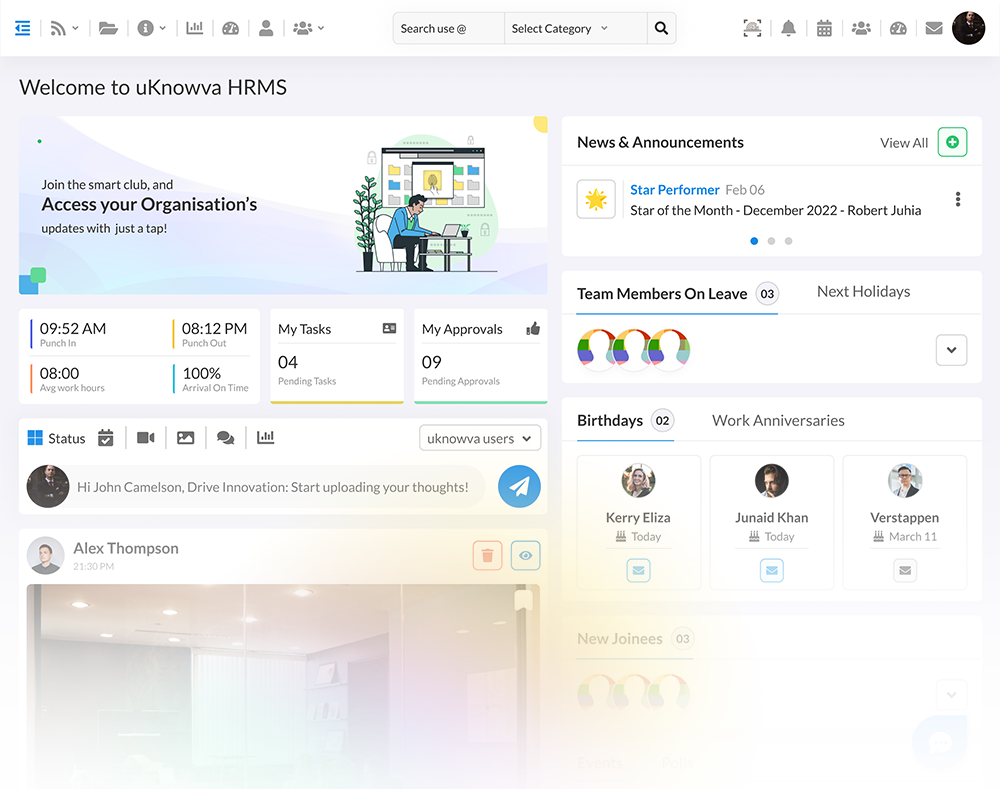
The answer lies in using an efficient AI driven HRMS like uKnowva HRMS that are designed to simplify, accelerate, and elevate every aspect of workforce management.
From AI content creation that drafts policies in seconds to CV parsing that streamlines hiring, and from AI-driven workflows that automate approvals to predictive Genie reports that flag attrition risks before they escalate—uKnowva is reshaping HR’s future.
This isn’t about replacing humans with machines. It’s about empowering HR professionals with AI as their co-pilot—freeing them from repetitive tasks so they can focus on what truly matters: people.
If your HR team is still bogged down by manual processes, it’s time to embrace the AI-led disruption. Because the future of HR isn’t just digital—it’s intelligent.
Let’s explore how!
Here’s a deep dive into how AI-led disruption is reshaping career landscapes, the opportunities it creates, and the skills professionals need to thrive.
The stereotype of HR being buried under piles of paperwork is fast becoming obsolete.
AI-powered HRMS platforms like uKnowva HRMS now automate processes that once took hours or days—attendance tracking, payroll processing, compliance reporting, and more.
But the real shift is happening in decision-making. AI doesn’t just execute tasks; it provides data-backed insights that HR leaders can act upon.
For example:
AI Recruitment Engine: The AI-first ATS screens resumes, ranks candidates, and even predicts cultural fit.
Workforce Planning: Predictive analytics help HR forecast talent needs, skill shortages, and succession planning with unprecedented accuracy.
What this means for HR professionals is clear: the focus is shifting from administrative duties to strategic, human-centered decision-making.
AI is not replacing HR—it’s evolving it. Some entirely new career paths are emerging:
HR Data Analyst: Focused on analyzing workforce trends and using predictive models to guide strategic HR decisions.
AI HR Strategist: Professionals who integrate AI solutions into talent management and organizational culture.
Employee Experience Designer: Using AI insights to craft personalized employee journeys from onboarding to exit.
AI Compliance Specialist: Ensuring AI-powered HR processes remain ethical, fair, and legally compliant.
In the past, HR professionals advanced by deepening expertise in recruitment, L&D, or employee relations. Now, career growth increasingly involves cross-skilling in analytics, AI tools, and digital transformation.
If AI is changing the game, then skills are the new currency. Here’s what will matter most:
1. Data Literacy
Understanding how to read, interpret, and act on AI-driven insights will be essential—not just for analysts, but for every professional. An HRMS tool like uKnowva that summarizes the learnings and suggests actions is the real game changer.
2. AI Tool Proficiency
From HRMS platforms like uKnowva to AI-powered CRM and ERP systems, knowing how to leverage these tools will be non-negotiable.
3. Human-Centered Skills
Ironically, the more AI takes over routine work, the more emotional intelligence, creativity, and ethical judgment will stand out as uniquely human strengths.
4. Continuous Learning Mindset
Careers will be built on adaptability. Professionals must commit to lifelong upskilling to keep pace with evolving technologies.
While some fear AI will replace jobs, in HR it is far more likely to elevate roles than eliminate them.
Here’s why:
AI as a Co-Pilot:
Platforms like uKnowva HRMS can handle repetitive tasks, giving HR more time for strategic initiatives such as leadership development and culture building.
Personalized Employee Development:
AI can track skills gaps and suggest tailored learning programs, allowing HR to create highly targeted L&D strategies.
Enhanced Diversity & Inclusion:
By removing unconscious bias from initial screening stages, AI helps build fairer, more diverse workplaces.
In short, AI is freeing HR to focus on what makes them uniquely valuable—the human touch.
With great power comes great responsibility. As AI becomes a cornerstone of decision-making, the question of ethics becomes critical.
AI systems can only be as unbiased as the data used to train them. HR leaders must ensure AI tools don’t perpetuate discrimination.
Openness is essential—employees deserve to understand how AI makes decisions, particularly in areas like hiring, promotions, and performance evaluations.
With AI handling sensitive employee information, compliance with data protection laws is non-negotiable.
This opens up new career paths in AI governance, ethics consulting, and compliance auditing—fields that blend tech knowledge with policy expertise.
Since AI is becoming a permanent fixture, the wisest approach is to start getting ready today. Here’s how:
Upskill in AI Tools: Take certifications in AI-enabled platforms, analytics, and automation software relevant to your industry.
Develop Soft Skills: Communication, empathy, and adaptability will be the differentiators in an AI-heavy job market.
Stay Industry-Aware: Keep track of AI trends not just in your sector, but in related industries—career pivots will be common.
Build a Digital Portfolio: Showcase how you’ve used AI or data to solve problems, even in small projects.
uKnowva HRMS is a prime example of AI transforming HR into a strategic powerhouse. With features like:
AI Content Assistance: AI support for creating offer letters, job postings, and policy documents in a matter of minutes.
AI-Driven Workflows: Automating approvals, scheduling, and reminders.
AI-Powered Analytics: Providing real-time workforce insights to guide strategic decisions.
OCR-Based Claims Processing: Speeding up reimbursements by extracting data from scanned documents.
AI Chatbots: Handling employee queries instantly, reducing HR workload.
By embracing such tools, HR professionals position themselves at the forefront of digital transformation rather than being sidelined by it.
The future of work in the context of AI-led disruption is not a battle between humans and machines—it’s a partnership. AI excels at speed, precision, and data crunching, while humans bring empathy, vision, and moral judgment.
The most successful careers in the next decade will be those that integrate human creativity with AI efficiency. HR will be less about enforcing policies and more about designing people-first organizations powered by intelligent technology.
Since AI-led disruption is becoming a permanent fixture, the wisest approach is to start getting ready today. For HR and beyond, it’s rewriting job descriptions, creating entirely new career paths, and demanding a fresh skill set.
The professionals who will thrive in this new era are those who:
See AI as an enabler, not a threat.
Continuously invest in learning and adaptability.
Use technology to enhance—not replace—the human element in work.
With the right mindset and tools like uKnowva HRMS, AI’s disruption can be the career accelerator of the century.
AI-led disruption refers to the transformation of industries, jobs, and business models driven by artificial intelligence technologies that automate processes and create new opportunities.
It enables faster decision-making, cost savings, improved efficiency, and innovation, while also forcing companies to rethink traditional strategies and workforce structures.
Sectors like healthcare, finance, HR, manufacturing, retail, and education are experiencing major changes due to automation, predictive analytics, and AI-driven personalization.
Both. While some routine jobs are automated, new roles emerge in AI development, data analysis, cybersecurity, and ethical governance.
By reskilling, upskilling in digital tools, focusing on creativity, critical thinking, emotional intelligence, and learning to work alongside AI systems.
AI reshapes recruitment, performance management, workforce planning, and employee engagement, enabling HR leaders to be more data-driven and people-centric.