








 Aditi Sharma
Table of Content
Managing employee attendance can quickly become complex when spreadsheets go out of sync, leave requests get lost in email threads, and payroll teams spend hours resolving monthly discrepancies.
A modern attendance management system brings attendance, leave, shifts, working hours, and overtime into a single platform. It helps HR teams automate routine processes, improve data accuracy, and ensure attendance information flows seamlessly into payroll.
As organisations grow, managing different locations, shifts, attendance policies, and employee schedules manually becomes even more challenging. The right system should therefore do more than track presence—it should provide automation, visibility, and flexibility.
This guide explores the key features to look for in a modern attendance management system and the factors HR leaders should consider before choosing the right solution for their organisation.
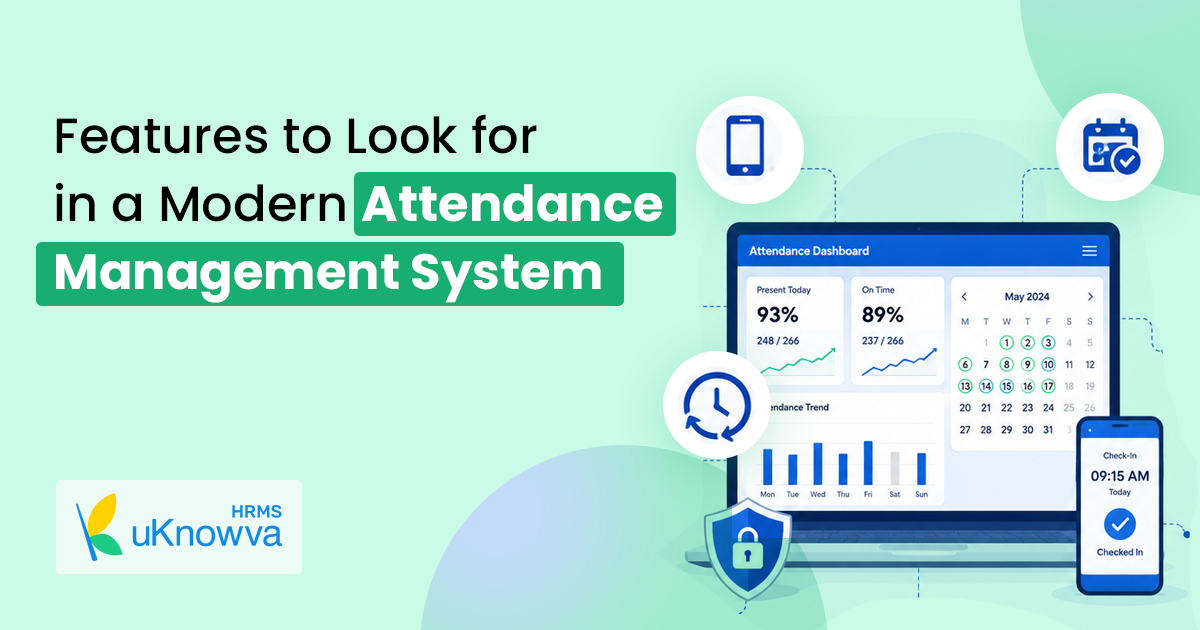
An attendance management system is a software solution for tracking employee arrival and departure times, as well as any leave, break, overtime, or shift change.
It automatically collects this information through biometric devices, mobile apps, GPS, or web check-ins, rather than through manual registers or Excel sheets, and then integrates it into payroll and HR reports.
Imagine it is the only record for "who worked when," and HR is not having to reconcile ten records at month-end.
Attendance information goes beyond simply knowing who attended. It directly impacts payroll accuracy, compliance, productivity planning and how fair the workplace feels for employees.
QuickBooks estimates that buddy punching adds up to more than $373 million for U.S. businesses annually, based on the data from Nucleus Research. Industry estimates, based on lost productivity and compiled by EPAY Systems, estimate total time theft losses in the hundreds of billions of dollars per year. For a CHRO or HR VP, it's not a rounding error; it's a leadership-level reason to get attendance right.
Correct attendance information means salaries are paid, overtime paid, deductions are withheld and working time is recorded accurately. It minimizes attendance irregularities and bad times due to manual attendance and inaccurate time documentation.
Regular attendance tracking enables organizations to detect irregular attendance, unauthorized logging in and buddy punching opportunities and safeguards businesses against unnecessary productivity and payroll problems.
Attendance trends give HR leaders insights into absenteeism, lateness, early departures, and overtime occurrences. This information can help with improved workforce planning and productivity management.
A single attendance record provides a uniformity of truth for workers and managers. This helps to ensure a fair plan to attend across teams and sites.
Good attendance records are essential when maintaining working hour records and in ensuring compliance with relevant working hour laws, policies and audits.
Attendance records assist HR in discovering staffing gaps, frequent attendance patterns, and when the workforce is needed the most to plan shifts and resources accordingly.
Having the data of attendance, overtime, leave and payroll synced together can help organizations reduce overpayment, unauthorized deductions, and other payroll leakage.
Attendance analytics give HR leaders actionable insights into their workforce. Rather than making assumptions and using spreadsheets, CHROs can use real-time attendance trends to make informed workforce decisions.
What you should check before entering into a contract.
Attendance tracking in real time provides current information on who is present, who is late and who is missing, not at the end of the week. This visibility is the key to reacting to issues or preventing them for HR teams who work with distributed teams or hybrid teams.
The ideal leave and attendance system should allow staff to apply for leave, view balances and receive approval without having to send an email or print out a form. If leave and attendance are in the same system, then the numbers will match; there is no need to do manual reconciliation between days present and days off.
A biometric attendance system fingerprint, facial recognition or iris scan ensures that the individual taking attendance is actually the individual working. It matters because a significant portion of employers have been impacted by buddy punching, according to a quote from ShiftFlow that states that over 99% of buddy punching attempts are thwarted by biometric time clocks, as physical presence is a necessity for authentication. A good biometric time clock is also highly durable for high-traffic settings, such as retail, manufacturing, and hospitality.
Reporting tools for attendance should automatically create reports on lateness, absenteeism, overtime and shift adherence, without HR having to pull numbers together. That's where automated attendance management comes in very useful, saving HR from tedious spreadsheets regularly.
An employee attendance app enables anyone to log their hours via a cell phone, particularly helpful for staff members outside of the office, such as sales or field personnel, or those with flexible work schedules. An effective mobile attendance system should also work without an internet connection and sync the data when the internet connection is restored.
Employee self-service attendance allows employees to check their attendance records, download reports or submit corrective requests without having to call HR for minor questions. This alone can reduce a significant portion of the normal HR tickets.
Automatically calculate working hours, overtime, late marks, early departures based on the predefined rules of the organization; thereby eliminating manual working hours calculation and consistent application of rules.
Facilitate staff to make regularization requests for missed punches, incorrect attendance or exceptions, and provide automated workflows for managers and HR to review and approve them quickly and effectively.
HR and department heads require attendance figures broken down by team, rather than overall figures. Department-wise view allows you to easily identify trends, such as a team regularly running late or having more unplanned leave, before they become more serious performance problems.
Attendance information will sync with the company's calendar (holidays, meetings, planned leaves), this eliminates the confusion about who should be in the office on a specific day. It also aids in helping the lead to plan around approved leaves without having to cross-check with multiple tools.
While this may sound basic, the clock-in/clock-out process must be fast and seamless: one tap, one scan, and done. When the process is clunky, the employees find workarounds, and that's where attendance data quality breaks down.
Late clock-in, missed punch or leave request notifications ensure that employees and managers stay updated on attendance matters, removing the need for HR to chase individuals.
Because attendance data contains sensitive personal and biometric information, there's no choice but to use cloud storage that's encrypted and backed up on a regular basis. Seek out vendors that will be clear about where data resides and how it's secured.
Each employer may have a different shift time, grace period and overtime policy. A system that allows HR to define these rules and not have to make policies fit the software will save you from having to constantly go around the system.
Staff should be able to clock in and out from either a biometric terminal, mobile app or a web browser, depending on their location of work. As hybrid working becomes the norm and not the exception, multi-device flexibility is crucial.
For companies with offices, warehouses or stores in multiple cities, they can now benefit from having a single view of attendance rather than city-by-city silos by using GPS-based validation. A GPS attendance system can be especially helpful for field salespeople and deliveries, when employees can be sure they're clocked in from the correct location.
The data from attendance should be automatically uploaded to payroll, and any leave taken or overtime paid should be reflected in your HR attendance software suite. Most payroll mistakes occur when data is manually entered from one system to another.
Beyond the simple reports which alert to the risk of an employee being absent, AI-based attendance insights can forecast staffing gaps, identify unusual patterns of absences or warn of staffing issues before they become significant. This is rapidly becoming a differentiating factor between regular time and attendance software and genuinely strategic AI attendance software.
In this case, there's no universal right or wrong solution. A 50-person startup cannot be as structured as a 5,000-person company with multiple sites. But as HR leaders, the questions to ask are:
The adoption of smarter, cloud-first tools is reflected in the market as well: Biometric attendance has nearly 40% of the market, and the accuracy rate exceeds 98%, according to one industry forecast, while cloud-based systems make up more than 55% of deployments.
uKnowva integrates state-of-the-art attendance management, automation, and workforce management features all into one platform, thus eliminating the need for mish-mashing disconnected HR solutions.
Key Features & Automation:
Multi-Location Attendance Tracking: Track attendance from multiple offices, branches, remote teams and locations from a single source.
Automated Attendance Capture: Streamline attendance workflows by automating punch-in/out and attendance capture.
Biometric & Device Integration: Link attendance devices and biometric systems to automatically record employee attendance.
Flexible Attendance Rules: Set various attendance policies, working hours, shifts, grace periods, late marks and overtime rules for different teams.
Automated Late Mark & Deduction Rules: Automatically detect late arrivals and mark deduction rules as configured without manual effort.
Shift Management: Make and schedule various shifts and automate attendance calculation according to the employee's schedule.
Leave & Attendance Integration: Integrate attendance with leave to get a more accurate picture of employees' presence and absence and leave balances.
Automated Overtime Calculation: Record overtime hours that qualify and automatically calculate overtime hours according to pre-defined organizational policies.
Real-time Attendance Visibility: Provide HR & managers with real-time attendance data to help detect irregularities and workers' patterns quicker.
Employee Self-Service: Enable employees to check their attendance data, check-in/out information, attendance regularization and attendance-related applications.
Payroll Integration: Automatically pass verified attendance, leave, overtime and deduction data to payroll, minimizing repetitive data entry and payroll inaccuracies.
Automated Attendance Workflows: Route attendance regularization, approvals, exceptions and related requests in predefined workflows.
Attendance Analytics & Reports: Create insightful absenteeism, late marks, overtime, working hours & attendance trend reports.
Expandable for Large Teams, Locations, Shifts & Employee Types: Accommodate large teams, multiple locations, shifts and employee types.
This translates into fewer attendance-related headaches for HR teams and CHROs, with fewer mistakes, quicker payrolls and improved oversight of employee attendance all in one HRMS.
Gone are the days of using punch cards and Excel sheets to monitor attendance. The ones that are achieving real value from it are the ones which are using it as a strategic HR tool – one that provides them with clean data for payroll, visibility for managers and a frictionless experience for employees.
If you are comparing a biometric attendance system, a mobile attendance system or a complete HR attendance software package, the features listed above are a good starting point to compare. If you master the basics, then getting to school becomes a painless task instead of a headache and becomes a valuable source of workforce insights.
What should I look for when choosing attendance software?
Look for features such as automated attendance tracking, shift management, leave integration, overtime calculation, attendance regularization, biometric and mobile attendance, payroll integration, real-time reports, and configurable attendance policies. The system should also be scalable enough to support your organisation as it grows.
What is the difference between an attendance management system and a time tracking system?
A time tracking system primarily records the time employees spend working. An attendance management system goes further by managing attendance, shifts, leave, working hours, overtime, late marks, missed punches, regularization, and attendance-related workflows in one platform.
Can attendance software integrate with payroll?
Yes. Modern attendance software can integrate with payroll to automatically transfer working hours, overtime, leave, late marks, and applicable deductions. This reduces manual data entry and helps improve payroll accuracy.
Can employees mark attendance through mobile phones?
Yes, many modern attendance systems support mobile-based attendance. Depending on the system, employees may be able to clock in and out through a mobile app using features such as GPS or location-based verification.
Is biometric attendance secure?
Biometric attendance can provide a secure way to verify employee identity because it uses unique biological characteristics such as fingerprints or facial recognition. Organisations should also ensure that the solution follows appropriate data protection, access control, and security practices.
How does attendance software handle missed punches?
Attendance software typically allows employees to raise a missed-punch or attendance regularization request. The request can then be routed to the relevant manager or HR team for review and approval, with the approved correction reflected in the attendance record.
Does attendance software support biometric devices?
Yes, modern attendance management systems can integrate with compatible biometric devices to automatically capture and sync employee attendance data. This helps eliminate manual attendance entry and provides HR teams with a centralized view of attendance records.