









 Play the audio of the blog
 Pause
Continue
Stop
The Chief Human Resources Officer (CHRO) role is shifting from people management to people, policies, and organizational processes. HR professionals are expected to shape business strategies, boost employee productivity, drive faster AI adoption, and build organizations more resilient to change as they prepare for 2027.
Gartner's October Outlook on CHRO priorities for 2027 highlights the need for HR leaders to balance the demands of the CEO for growth and productivity with the risks and vulnerabilities facing the organization. Gartner also points to the following challenges for HR: accountability with AI, HR skills, and HR's rate of value generation.
Meanwhile, SHRM's 2026 CHRO Priorities and Perspectives explores how economic uncertainty, higher labor costs, shifting employee aspirations, and AI adoption are shaping HR leadership decisions. These developments matter as you shape the HR agenda for 2027.
The next challenge for CHROs is to define a strategy that addresses these new challenges and links people, process, technology, and business performance.
In this guide, we'll delve into the top 10 priorities for CHROs in 2027, the business outcomes they will seek to achieve, and how AI-powered HRMS can help them accomplish those goals.
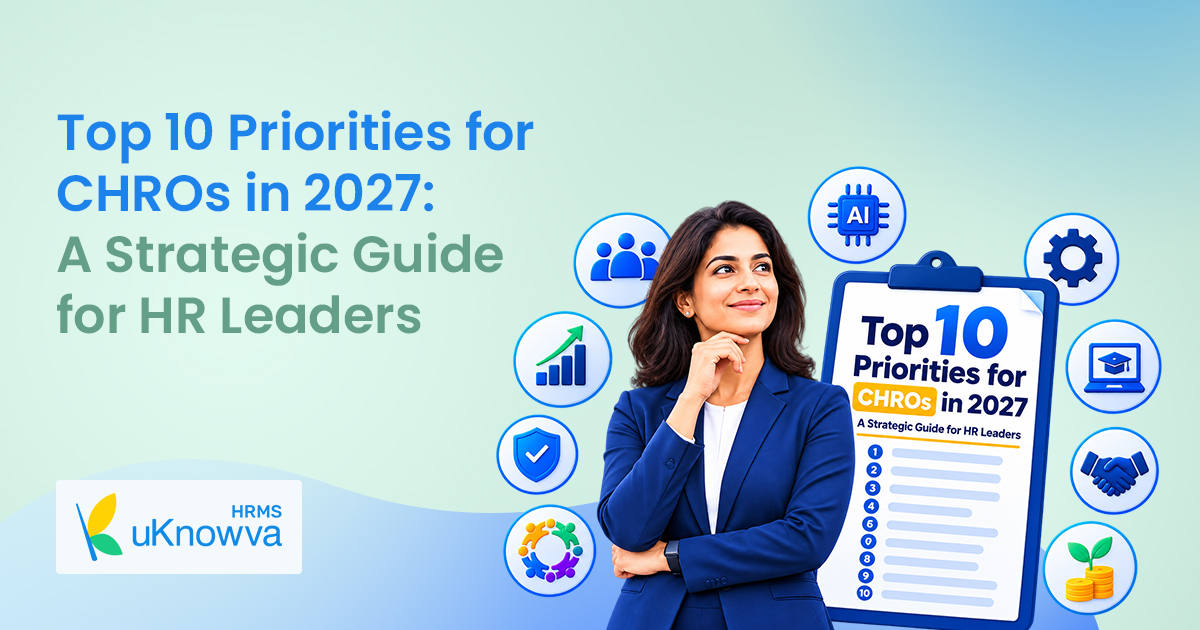
The 10 strategic priorities for CHROs in 2027 are:
These priorities are interdependent. For instance, adopting AI requires reconfiguring employee skills, ensuring data accuracy, holding leadership accountable, and approaching change management with care. By thinking of them as components of an overarching HR strategy, rather than 10 discrete projects, CHROs will have greater success.
As businesses are under great pressure to make their workforce more productive, embrace AI, work with evolving employee expectations and provide ROI for their business, the role of CHROs are changing rapidly. HR leaders are not just about people management anymore but are about transforming organisations, building them for resilience and future value creation.
There are three key developments that are changing the priorities of CHROs in 2027:
Measurable Workforce Outcomes: CHROs will be held responsible to tie HR programs to business performance by monitoring workforce productivity, contribution, efficiency and workforce costs.
A stronger emphasis on HR ROI: Organisations are looking at the value of their HR investments in terms of tangible outcomes such as lower turnover, quicker hiring, better retention, and more efficient workforce usage.
Data-Driven Decision-Making: HR leaders are finding that they can uncover productivity gaps, predict talent needs, and make informed resource allocation decisions with the help of workforce analytics and predictive insights.
HR Automation: AI is streamlining tasks like onboarding, onboarding training, employee queries, payroll, documentation, and workflow management, freeing up time for HR teams to concentrate on strategic tasks.
New Workforces: AI is transforming jobs, skills, and teams, and transitioning to workforce planning, reskilling, upskilling is a top priority for CHROs.
Intelligence of AI Agents: Intelligent AI agents are going beyond simple help to helping HR teams with multi-step workflows, providing insights, recommending actions, and influencing decisions.
Demand for Personalised Employee Experiences: From flexible work schedules to personalized career growth, communication and digital HR tools, employees are expecting a personalised experience.
Leadership and Change Management: CHROs need to get managers ready to lead with diversity, technology and keep their staff accountable, engaged and working together.
Creating an Inclusive Workplace Culture: It continues to be critical to recruit and retain talent in today's evolving workplace by strengthening employee engagement, psychological safety, diversity, and well being.
1. Accelerating AI Adoption and HR Digital Transformation
This will be a key topic in 2027, with AI adoption and HR digital transformation. However, the goal is not to automate every available task. CHROs need to find the right spots to reduce friction, enhance service delivery, improve decision-making, and deliver quantifiable business value through technology.
Manual approvals, spreadsheets, repetitive data entry, and disconnected applications remain the norm in many HR departments. These practices increase administrative workloads, create data silos, and reduce visibility across the employee life cycle.
2. Reimagining Workforce Planning for Human-AI Collaboration
The traditional approach to workforce planning focuses on headcount projections, hiring budgets, and replacement needs. As AI and automation reshape the nature, quantity, and distribution of work, the CHRO must understand these shifts in 2027.
A role-based approach alone may miss opportunities to redesign tasks across teams. Some activities may be automated, others supported by AI, and others kept as human tasks that require judgment, creativity, empathy, or accountability.
As organizations redesign work around AI and automation, workforce planning needs to account for changing skill requirements and the capabilities employees will need in the future, as discussed in the World Economic Forum's Future of Jobs Report 2025
3. Closing Critical Skills Gaps Through Reskilling and Internal Mobility
Organizations' skills requirements are constantly changing. AI literacy, data interpretation, digital collaboration, critical thinking, and change management are increasingly relevant across functions, while specialized technical and industry-specific skills remain required.
Filling these gaps through external recruitment is not always fast or cost-effective. Organizations may lack experienced personnel to fill newly created positions, or the required skills may not be documented in job descriptions or CVs.
4. Demonstrating HR's Business Value and Workforce ROI
As expectations for productivity and financial discipline grow, CHROs need to become adept at articulating how HR investments align with the organization's objectives. This requires a stronger link between employment information and company performance.
Traditional HR indicators like time to hire, absenteeism, turnover, training participation, and cost per employee remain valuable. Their strategic value increases, however, when used alongside other parameters like TTP, sales performance, service quality, labor cost, employee capability, etc.
A decrease in time to hire, for instance, may seem good, but it may not be if new hires leave within a few months or take much longer to become productive. Likewise, cutting training costs can reduce short-term costs but can lead to long-term training deficits.
CIPD's guidance on people analytics explains how workforce data can help organizations evaluate people-related decisions, improve retention, and connect HR initiatives to business outcomes.
5. Strengthening Employee Experience, Engagement and Retention
The employee experience shapes how people experience your organization throughout their employee lifecycle, from recruitment and onboarding to career development, performance management, and separation.
But in 2027, CHROs need to eliminate the mundane distractions in their work environment and foster a culture where employees feel supported, informed, and able to contribute.
While a strong package may appeal to an employee, onboarding, manager communication, and support for growth and development can undermine it.
Gallup's State of the Global Workplace 2026 report found that global employee engagement declined to 20% in 2025, highlighting the importance of understanding employee experience and manager effectiveness.
6. Strengthening HR Data Governance, Privacy and Compliance
As HR systems become more integrated and AI-powered, businesses handle ever-increasing amounts of sensitive employee data. This can include information about compensation, attendance, performance, identity, recruitment, and workforce analysis.
Without effective data governance, it can lead to irregular payrolls, unauthorized access, privacy risks, inappropriate automated decision-making, and more.
The NIST AI Risk Management Framework provides guidance for identifying and managing risks associated with AI systems, making it a useful reference for organizations introducing AI into HR processes.
7. Building Flexible and Resilient Organizational Structures
Organizations must have operating models that can adapt to evolving demand, new technology, economic volatility, and evolving customer expectations.
When priorities shift rapidly, or capabilities are in short supply, structures that worked under stable conditions may not perform well.
By looking at how departments are connected, where decisions are delayed, and what capabilities are critical for business continuity, CHROs can help their organization build resilience.
Deloitte's research on organisational agility and workforce transformation.
8. Improving Workforce Intelligence and Predictive People Analytics
HR teams gather a lot of workforce data, but data alone isn't a strategic asset. The real benefit comes from linking accurate data to the decisions leaders must make.
Workforce intelligence gives CHROs insight into the current situation, trends, and potential future scenarios. For instance, analytics can identify departments with rising employee attrition, long-vacant positions, frequent absenteeism trends, or variations in training effectiveness.
When there's enough relevant data, predictive analytics can take this one step further by forecasting risks like future staffing needs or turnover. The following estimates should be used for investigation and planning, rather than as definite forecasts.
9. Supporting Employee Wellbeing and Sustainable Performance
It's impossible to maintain high productivity when workers are constantly stressed, overworked, or under-rested. With fewer resources to go around, CHROs need to ensure people's expectations aren't unrealistic and that they have the structures in place to support them.
Wellbeing needs and priorities should be part of workforce strategy, not a series of unrelated wellness initiatives. These interventions can include workload reviews, manager training, flexible working arrangements (where possible), accessible support resources, and communication about availability and work boundaries.
10. Developing Change-Ready Leaders and Agile Organizations
Organizational transformation often moves faster than leadership habits and established ways of working. Even well-designed strategies can fail when managers lack the confidence, capability, or support to implement change.
CHROs must therefore treat leadership development as a business capability, not an isolated learning program. Leaders need to communicate strategic direction, manage uncertainty, resolve competing priorities, coach employees, and make decisions with incomplete information.
To turn these priorities into an actionable strategy, CHROs should define how they will measure success. The following table offers suggested KPIs; organizations should establish baselines and set targets based on their industry, size, workforce, and business objectives.
| Priority area | Suggested KPI |
| AI adoption and HR digital transformation | HR process cycle time; automation rate; cost per HR transaction |
| Human-AI workforce planning | Workforce capacity utilization; productivity per FTE; percentage of critical workflows with defined human accountability |
| Skills development and internal mobility | Critical skills gap closure rate; internal fill rate; time to proficiency |
| HR business value and ROI | HR initiative ROI; cost per hire; measurable productivity gains |
| Leadership and organizational agility | Leadership readiness; change adoption rate; time to implement organizational changes |
| Employee experience and retention | Employee engagement score; regrettable attrition rate; employee service satisfaction |
| Data governance, privacy and compliance | Audit findings; data quality score; access-control exceptions; compliance incident rate |
| Organizational flexibility and resilience | Time to redeploy talent; critical-role coverage; workforce plan accuracy |
| Workforce intelligence and analytics | Forecast accuracy; time to generate workforce insights; percentage of strategic decisions supported by validated data |
| Employee wellbeing and sustainable performance | Absenteeism rate; workload indicators; wellbeing survey results; sustained productivity trends |
These KPIs should not be interpreted in isolation. For instance, a lower cost per hire is not necessarily a positive outcome if retention declines. Similarly, a higher automation rate does not demonstrate success unless service quality, accuracy, and employee experience remain acceptable.
Ten priorities are vying for the attention of CHROs – how do they prioritize? Trying to change all HR processes at once may strain budgets, burden employees, and make it hard to track business results.
The first step in an effective strategy is to address the most pressing issues your organization faces today, then move toward long-term change.
To invest in new initiatives, CHROs need to understand the maturity of their current HR processes, systems, HR capabilities, and HR leadership.
This assessment should reveal workarounds, disjointed employee data, critical skill gaps, regular compliance problems, and lack of workforce planning. Talking with employees and business leaders can help differentiate between recurring organizational issues and isolated incidents.
Also for CHROs, there is a need to assess the readiness of the technology, data quality, integration capabilities, and organization's change management capability.
HR strategy should directly support the organization's business direction. Workforce planning and leadership development may become a major concern if the business moves out of its current market segments and into new ones.
Process efficiency, workforce productivity, and skills utilization may be more important if profitability is a concern.
CHROs will need to work closely with the CEO, CFO, CIO and business unit leaders to convert strategies into staffing needs.
HR should clearly link each proposed initiative to the business outcome it is expected to impact. This alignment streamlines executive buy-in, resource allocation, and progress tracking.
Not all HR efforts are created equal. For incoming projects, CHROs should evaluate them by business impact, effort, cost, risk, and time to value.
For instance, an automated employee request process for a large volume of employees can deliver faster results than developing a sophisticated predictive analytics program if employee information is siloed.
Also consider dependencies when prioritizing. For advanced workforce analytics to deliver meaningful results, you may need reliable employee records and effective data governance.
A phased roadmap provides a realistic sequence for implementing the HR strategy.
Organize the sequence, but don't treat it as a fixed timeline. Phases should be owned, have measurable outcomes, and include steps to move to the next phase.
Before starting any major initiative, define success clearly. CHROs need to establish a baseline and set target results, reporting frequency, and who will measure them.
Regular reviews should assess initiative effectiveness and identify any required changes. If the automated project reduces processing time and errors increase, the project may need to be redesigned before it is expanded.
The best HR strategy isn't the one that has the most initiatives. It's the one that always delivers tangible business results from workforce capabilities.
To achieve the 2027 HR agenda, technology must link employee information, automate workflows, support HR workforce decisions, and enhance HR service delivery.
uKnowva HRMS is a tool that can help CHROs to achieve these goals and more.
The top priorities of CHROs in 2027 signal a new paradigm in the interplay between people, technology, and business performance. The responsibilities of adopting AI, planning for the workforce, developing skills, staff experience, governance and organizational agility are becoming more interconnected.
The CHRO who will thrive will link these priorities to a clear business strategy, make deliberate investments and consistently measure the outcomes. They will also understand that technology alone won't build a future-ready workforce. Good leadership, responsible AI use, employee trust, and an emphasis on ongoing learning are still key.
An integrated AI-powered HRMS like uKnowva can help establish this foundation by streamlining HR processes, offering better workforce visibility and making informed choices easier.