








 Aditi Sharma
Table of Content
If you’ve ever sat through a demo of three, four, five different HRMS platforms in a week, you know the pattern. Every vendor shows you the same glossy employee self-service screen: people can see their payslips, update addresses, and request leave. Everyone nods politely. Then you close the laptop and someone at the table says, “Okay, but how safe is this really?”
That’s the moment where MCP employee self-service tends to earn its seat at the table.
Most ESS stories start and end with convenience. MCP comes at it from a different angle: assume your people absolutely deserve consumer-grade simplicity, but never at the expense of control, traceability, and security. Especially when half your workforce has very different data entitlements than the other half.
And that tension, convenience versus control, is exactly where it gets interesting.
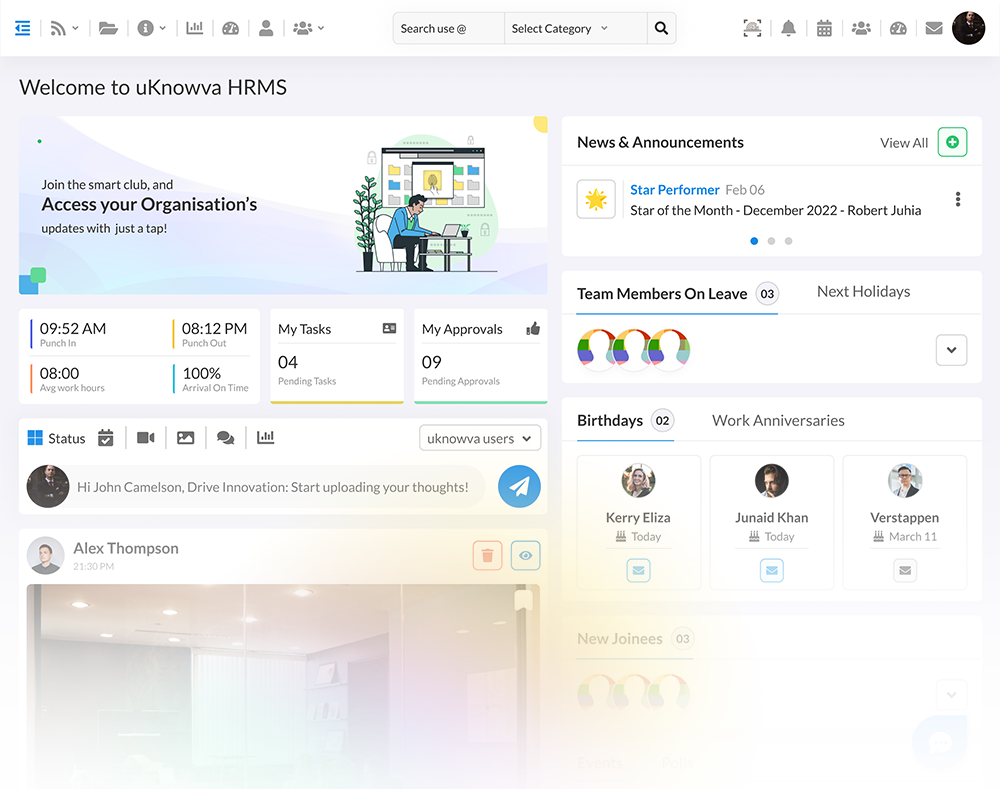
For organizations looking to combine employee self-service with a broader HR technology ecosystem, uKnowva HRMS provides a centralized platform covering core HR, employee management, payroll, attendance, workflows, performance, recruitment, and more.
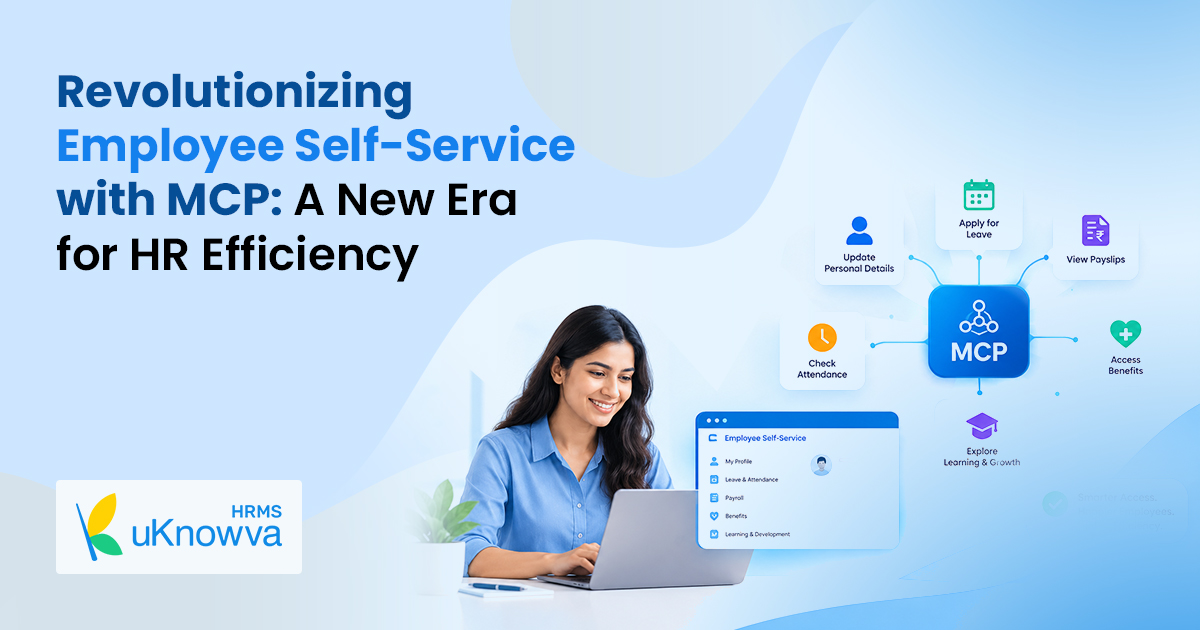
Let’s start with the human side, because this isn’t just an IT architecture decision.
In most organizations, HR is still the bottleneck for things that should feel trivial: proof-of-employment letters, bank detail updates, tax declarations. Employees submit tickets, chase emails, wait three days for something that should take 30 seconds.
With MCP employee self-service, the idea is simple: give employees a clean, role-aware portal where they can handle 80–90% of these tasks themselves. No hunting for forms, no "who do I email for this?" Slack threads. Just log in, see what you’re allowed to see, and act.
The sharp insight here: the real productivity gain doesn’t come from "self-service" in the abstract. It comes from employees never even seeing options they can’t use or data they shouldn’t touch. No cognitive overload. No confusion. Less training. That’s a behavioral design win, not just a tech one.
uKnowva’s HRMS platform supports employee-focused HR processes through features such as employee profiles, leaves and attendance, workflow automation, documents, helpdesk, and other self-service capabilities.
And yes, HR finally gets to stop playing helpdesk for password resets and address changes and can redirect that energy into actual workforce strategy.
Instead of HR functioning as the first point of contact for routine employee requests, self-service shifts those repetitive interactions directly to the employee.
Now, the part your CISO cares about.
Most ESS tools bolt on permissions as an afterthought. You end up with tangled, spreadsheet-driven access matrices that only two admins understand, and both of them are secretly terrified to change anything.
In many traditional ESS environments, access management can become as difficult to maintain as a complex spreadsheet that only a handful of administrators fully understand.
MCP flips that. The architecture starts from per-user permission scoping. Each session is anchored to what that specific employee is allowed to see and do, based on their role, location, seniority, and whatever policy rules you define.
One sharp contrast: traditional ESS often assumes "everyone in this group sees the same thing." MCP assumes "every individual’s view is computed from policy at runtime."
Subtle difference on paper. Massive difference in risk.
Because role-based access is enforced at the session level, three things happen:
For security-conscious buyers, this is the quiet but real MCP advantage: security is a design constraint, not a feature slide.
uKnowva’s security-focused HRMS capabilities are designed to support secure employee engagement, with multiple security levels alongside centralized HR data and processes.
Let’s be honest: every HR tech vendor claims "operational efficiency." Half the time that means "we gave HR a nicer spreadsheet."
In some HR technology environments, operational efficiency can amount to little more than giving HR teams a more polished version of the same manual processes they were already managing.
With MCP employee self-service, the efficiency story is more structural.
Employees can:
But here’s the strategic bit: all of this runs through the same permission-aware engine. Which means HR doesn’t need to manually police who sees what every time you reorganize, add a business unit, or expand into a new country.
You define the roles, map policies to those roles, and the system does the rest session by session.
Why this works: it reduces "policy drift." In most ESS environments, your written HR policy and your system reality diverge over time. People leave, roles change, someone forgets to revoke access, shortcuts get taken.
MCP’s role-based scaffolding pulls those back into alignment; the policy is encoded, not just documented.
The result? HR teams spend less time cleaning up after their own tools and more time modeling scenarios: what happens to access if we create this new role? What if we centralize payroll for these three regions?
The system can answer those questions before you flip the switch.
Instead of treating organizational changes like a risky moment that requires manual access adjustments, the system can apply defined rules when roles, teams, or structures change.
Executives hear "personalized employee experiences" and understandably worry about complexity. It sounds expensive. It sounds like a recipe for a dozen inconsistent portals and support nightmares.
Personalization can easily become an operational burden when every employee group requires a separate experience, workflow, or portal to maintain.
The nuance with MCP employee self-service is that personalization is an outcome of permission logic, not a separate UX project.
A frontline store manager logs in and sees schedules, attendance, and team-level approvals. A regional HRBP sees a broader lens, workforce analytics, escalations, comp cycles, but still through the same underlying framework.
A contractor sees almost nothing beyond what’s legally required and operationally necessary.
Everyone feels like "the system is built for me," but your admin team is still managing one rules engine, not 17 variants.
Here’s the non-obvious insight: personalization isn’t about more features; it’s about fewer irrelevant ones.
By stripping away what a user shouldn’t or doesn’t need to see, you increase adoption. People use systems that respect their time and their boundaries.
And you avoid that scenario we’ve all seen: the ESS portal that’s technically powerful but so cluttered and generic that no one touches it after week two.
The goal is not to create dozens of different employee portals, but to make one system relevant to different users through role-aware experiences.
This approach also aligns with uKnowva’s broader AI-driven HRMS model, where employee self-service, workflow automation, AI assistance, and HR data operate within one connected platform.
When you’re at the mid-funnel stage, the tools all start to blur. Everyone promises integration, analytics, mobile apps. The demos all look fine.
So how do you actually differentiate?
For a leadership team, the strategic appeal of MCP employee self-service usually lands in three places:
Risk posture
You’re not just buying convenience; you’re reducing the probability and blast radius of data exposure incidents inside your own walls.
Per-user permission scoping gives you a defensible position with auditors, regulators, and, frankly, your own board.
Scalability through complexity
MCP tends to shine in organizations where roles, hierarchies, or geographies get messy.
Instead of hardcoding access for every edge case, you codify rules once and let the engine interpret them per session.
Complexity becomes manageable rather than paralyzing. Rather than allowing every new role, hierarchy, or geography to create another layer of administrative complexity, defined access rules can provide a more structured way to manage organizational growth.
Culture and trust
This is the part that rarely makes it onto RFPs but matters in the hallway conversations. The impact often becomes most visible in everyday employee and leadership conversations, where trust in how personal data is handled can influence how people perceive HR technology.
When employees see that the company is careful about who can see their data, and at the same time gives them direct, transparent access to their own information, it sends a signal.
“We trust you, and we’re also protecting you.”
That combination changes how people talk about HR, especially in organizations still shaking off legacy systems and opaque processes.
uKnowva also extends this employee-centric experience through AI Agents, which can support HR operations such as employee queries, data handling, workflows, reporting, recruitment, and performance-related activities.
This is where the concept becomes particularly relevant to uKnowva.
uKnowva’s UVA is an MCP-powered virtual AI assistant that allows employees to interact with HRMS data and complete HR tasks using natural-language prompts.
Instead of navigating multiple menus, employees can ask questions or request actions directly through a conversational interface. UVA reads live HRMS data, responds in context, and can perform tasks based on the user's existing permissions.
The security principle remains central: UVA inherits existing permissions, approval chains, and policies. If an employee cannot access salary information through the HRMS, UVA does not expose it through conversation either.
This makes UVA particularly relevant to the MCP employee self-service discussion because the objective is not simply to add another chatbot. It is to make HR self-service more natural while retaining the access controls and business rules already defined within the HRMS.
uKnowva’s wider AI ecosystem also includes AI Genie, AI Chatbot, CV Parser, CV MatchMaker, and other AI capabilities designed to automate HR tasks and provide faster employee support.
If you’re evaluating HRMS vendors right now, the practical next step is simple: don’t just ask "Do you have employee self-service?"
Ask:
Then watch who can answer those questions without hand-waving.
Because at the end of the day, the employee experience is not just about giving people another portal. It’s about giving them confidence, in the system, in the data, in the company behind it.
And maybe that’s the quiet promise of MCP: a self-service experience that feels simple on the surface because it’s taking the complexity, the risk, and the second-guessing and hiding all of that where it belongs, in the architecture, not on your employees’ plates.
The real value of MCP-powered employee self-service is that employees experience simplicity while the underlying HR architecture handles permissions, policies, workflows, and data access with greater precision.
MCP is changing the conversation around employee self-service from simply asking whether employees can access HR services to asking how securely, intelligently, and contextually they can access them.
For HR leaders and CXOs, that distinction matters.
A modern employee self-service experience should reduce routine HR dependency, provide employees with direct access to relevant information, and adapt to different roles without creating unnecessary administrative complexity. At the same time, sensitive HR data must remain governed by permissions, policies, and clear access controls.
This is where the combination of MCP, AI, employee self-service, and role-aware HR technology becomes significant.
With uKnowva HRMS, these capabilities can come together through a broader HR platform covering employee management, payroll, attendance, workflows, performance, recruitment, AI Agents, and conversational experiences through UVA.