



 Aditi Sharma
Table of Content
Having a cost-effective, interactive, and easy to use employee management system is all an HR can ask for.
The management of employee details for daily tasks and payrolls can be achieved through one system like uKnowva HRMS.
HR systems help organise and track employee performance, and give insights for optimising operations.
Finding a good employee management system for an organisation can be an unsettling task.
While selecting a system one has to ensure that it has all the right features to fulfil the needs. It must be secure, scalable, flexible, and easy to integrate.
Learn more about the essential features of an EMS below and finalise your decision to invest in one later.
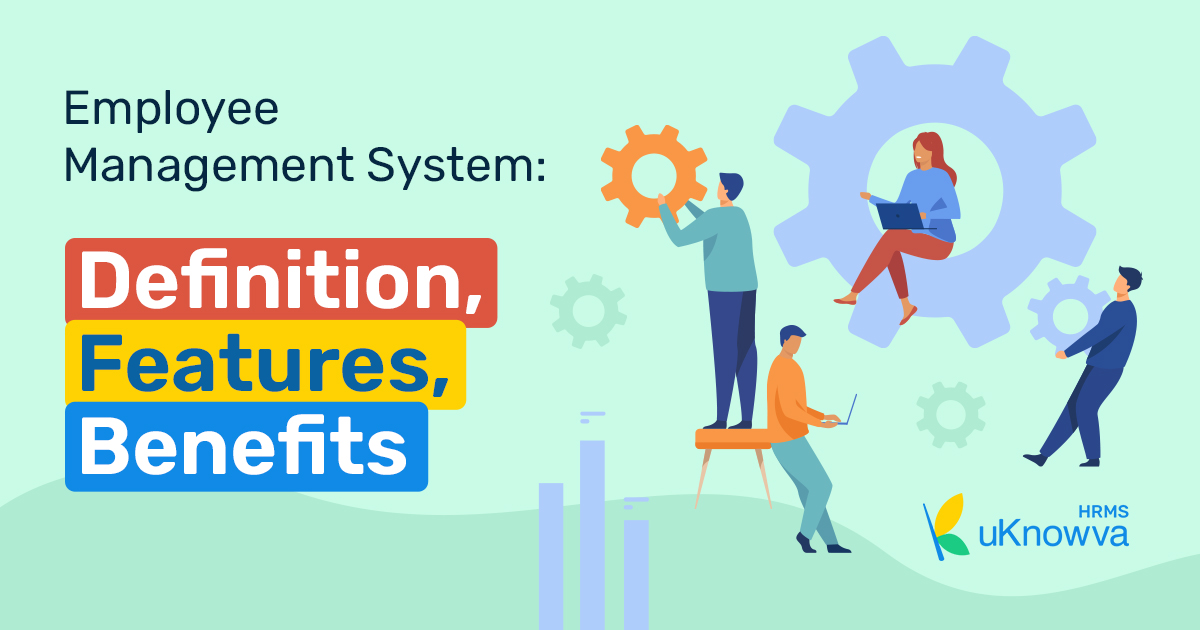
An Employee Management System is a digital software system that helps organizations to manage people data, processes, and daily workforce operations from one platform. Think of it as the backbone that keeps employee information accurate, accessible, and aligned with business needs.
At its core, an EMS stores and organizes employee records such as personal details, job roles, attendance, leave, payroll inputs, and performance history. And also goes beyond storage. The advanced EMS system helps HR teams track employee activity, managers make informed decisions, and employees handle routine tasks more efficiently without constant back-and-forth.
From a business perspective, an Employee Management System enhances consistency, accountability, and transparency throughout the organisation. As teams grow, it becomes nearly impossible to manage employee data manually. An EMS brings structure, speed, and reliability to that complexity.
Employee Management Systems come in different forms depending on the size of the organization, its goals, and the maturity of the system. Here are the main types you will see in practice.
Basic Employee Management System
Core-focused: It is meant for core data of employees. The general modules one can find with this type of HR system include employee profiles, attendance tracking, leave management, and basic reporting. This fits well with a small team needing something simple to manage employee information without advanced automation.
HRMS - Human Resource Management System
An HR focused system expands beyond basic records. It includes recruitment, onboarding, performance management, training, and policy management. This type is common in growing organizations that want better control over the entire employee lifecycle.
Payroll Integrated Employee Management System
This system connects employee data directly with payroll processing. Attendance, leaves, and salary structures flow into payroll automatically, reducing errors and delays. It is especially useful for organizations that want accurate salary processing and statutory compliance.
Enterprise Employee Management System
The enterprise EMS is designed for large organizations, this type supports complex structures, multiple locations, and large workforces. It includes advanced reporting, compliance management, role-based access, and integrations with finance and business tools. It helps enterprises maintain control without increasing manual effort.
Cloud-Based Employee Management System
Cloud-based EMS systems allow access from anywhere and are easier to scale. Updates, data security, and backups are handled centrally. This type is now the preferred choice for most modern organizations due to flexibility, lower maintenance, and faster deployment.
An EMS should have a robust recruitment feature to streamline the process of collecting important information from new joiners to onboarding them easily.
Also, it gathers one’s financial information, including address and tax details, which can be recorded in the employee management system.
With a good onboarding system, a smooth offboarding experience is also a necessary task for the organisations to look up to.
The system should enable the employees to apply for resignations online, receive approval, and conduct exit interviews. It eases the transition for both the employees as well as the organisation.
Managing employees’ details is one of the crucial aspects of any organisation.
A strong database management feature enables one to centralise their HR data seamlessly across departments, regions, and business entities.
This feature enables one to add any employee details or sync data from any third-party applications.
A good EMS smoothly categories all the employees based on department, location, and designation for efficient management.
Moreover, it should give access to the employees to edit their profiles to maintain error-free records.
A performance management system is a must-have module in an employee management system.
Such a module or system has an extensive range of features like goals, KRAs, and skills to conduct fair performance reviews or surveys.
A forward-thinking and 360-degree PMS gives a clear picture of where each team member stands in terms of performance.
It should allow frequent performance reviews. Employees must rate themselves and their peers and receive feedback in return.
It boosts a holistic view of each person’s performance and contribution over a period, limiting or decreasing bias in the evolution process.
Training and career development opportunities lead to improving the employee experience and satisfaction. So it's important to choose an appropriate employee management system that has a comprehensive and continuous e-learning management system.
The software should be flexible enough to support different learning styles and pace learning.
One should be able to curate multiple courses for employees to register according to their interests and needs.
Moreover, employees should have the freedom to start and complete these courses at their own pace, and time, according to their convenience.
An employee management system should help the organisation to streamline and automate time management tasks.
It should provide a robust attendance and leave management system that enables employees to mark their attendance and make leave requests from wherever they work.
Then, employees register their check-in & out time, overtime, leave balances, on-duty information, and user permissions independently.
The synchronised data will further simplify payroll processing and payslip generation to lock the fair pay or disbursements.
The combined payroll feature in an EMS provides both HR and finance departments equal access to all the data, from including confidential pay details to employee records.
This method provides the scope to boost efficiency, reduce costs, and give confidence to the employees to receive proper compensation, reimbursement, and overtime hours they have worked for a smooth payroll integration.
AI and automation are changing how Employee Management Systems actually work on a day-to-day level. Earlier, EMS platforms were mostly digital filing cabinets. The AI-powered EMS actively support decision making, reduces manual effort, and improves accuracy across HR operations.
Smarter data handling and accuracy
AI helps keep data clean and organize employee data automatically. It detects missing information, duplicate records, and unusual patterns before they become problems. This reduces human error and keeps employee records reliable over time.
Intelligent attendance and leave management
Automation tracks attendance in real time and applies leave policies without manual intervention. AI can flag irregular attendance trends, frequent late logins, or leave misuse early, helping managers respond with context instead of assumptions.
Predictive insights for better decisions
AI analyses historical employee data to identify trends related to performance, attrition, or workload imbalance. It means that HR leaders can act before issues grow. For example, spotting burnout risks or high turnover zones early.
Faster and fairer performance management
Automation in EMS simplifies goal tracking, appraisal cycles, and feedback collection. AI-supported systems highlight performance patterns based on data, not bias. This creates a more consistent and transparent review process for employees and managers.
Compliance monitoring without manual tracking
AI-powered EMS platforms monitor policy adherence and statutory requirements continuously. Automated alerts notify HR teams about upcoming deadlines, missing documents, or compliance risks, reducing last minute stress and penalties.
Better employee experience through self-service
Automation enables employees to update details, apply for leave, download documents, and track requests on their own. AI chat support within EMS platforms can answer common queries instantly, improving response time without adding HR workload.
AI and automation do not replace human judgment. They strengthen it. In an Employee Management System, they act as silent enablers that keep processes consistent, data accurate, and decisions informed.
An employee management system that is both convenient and flexible for both HR and employees is what organisations look for.
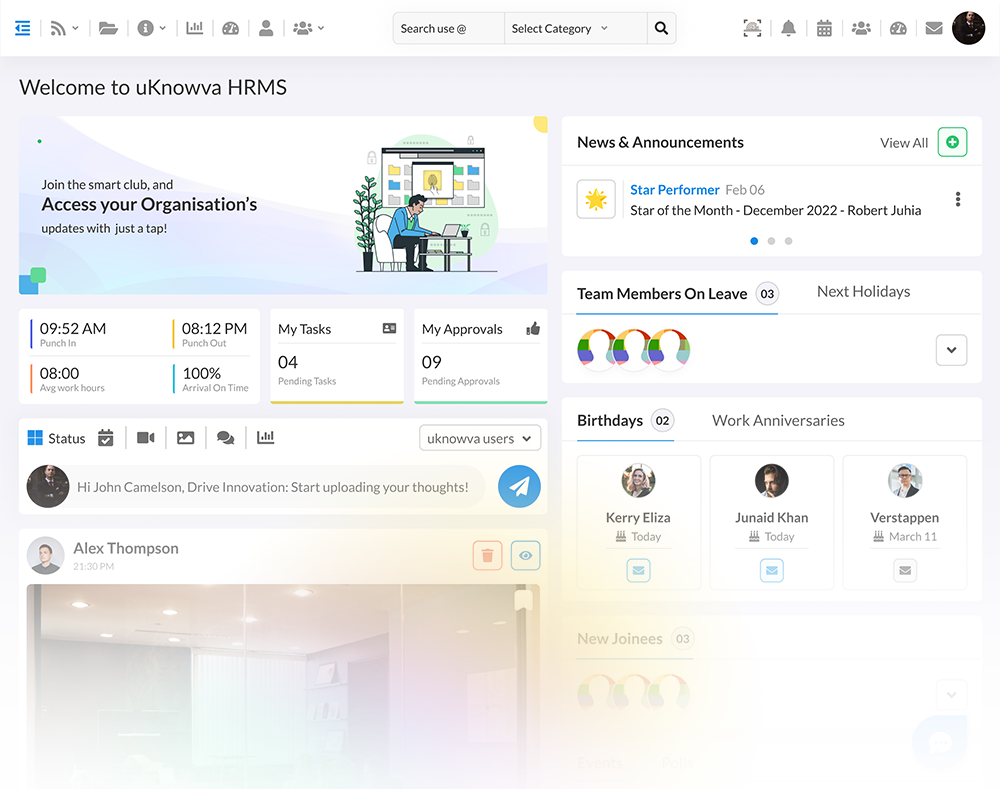
uKnowva HRMS is one such software that has been designed to fulfil these needs of the organisation.
It has features that cover everything for employee management, from a biometric punch-in to payroll or timesheets.
An EMS improves efficiency by automating routine tasks, reduces paperwork, enhances data accuracy, and provides valuable insights through analytics. It also improves employee satisfaction by offering self-service options and transparent communication.
Yes, a well-designed EMS offers high-level security features like data encryption, role-based access controls, and regular backups to protect sensitive employee information
Most modern EMS platforms offer integration capabilities with other software such as payroll systems, accounting software, and third-party applications to create a seamless HR ecosystem.
User-friendly EMS platforms are designed with intuitive interfaces and provide training resources, making it easy for HR teams and employees to adapt quickly.
An EMS can enhance employee engagement by providing features like feedback mechanisms, recognition tools, and communication platforms, allowing employees to feel more connected and valued within the organisation.