Table of Content
HR has long handled recruiting, maintaining employee records, processing payroll, and setting workplace policies. But this definition no longer fits 2026.
HR teams today must manage increasingly complex workforces, diverse employment models, hybrid teams, sensitive employee information, AI-driven processes, and shifting compliance requirements. Organisations also need to prove that their HR systems are effective, transparent, documented, and well-governed.
An HR audit can help.
The HR audit is a comprehensive analysis of your HR policies, processes, employee records, payroll, technology, documentation, and compliance. It can pinpoint gaps, test operational efficiency, and ensure HR practices operate as they should.
The need is especially high for companies in India. Due to the introduction of the four Labor Codes and the changing central and state-level regulations, organisations should revisit their HR compliance audit processes. Rising concerns about employee data privacy, AI governance, and gig workforce management further underscore the need for consistent HR audits.
An HR audit can assist an organization in answering key questions:
Do HR processes, such as hiring, onboarding, and payroll, rely on AI, and are they properly controlled?
This guide covers the HR audit checklist, the full HR audit process, key fields of HR compliance audits in India, and how HR audit software and HRMS technology help maintain consistency, accountability, and ongoing compliance.
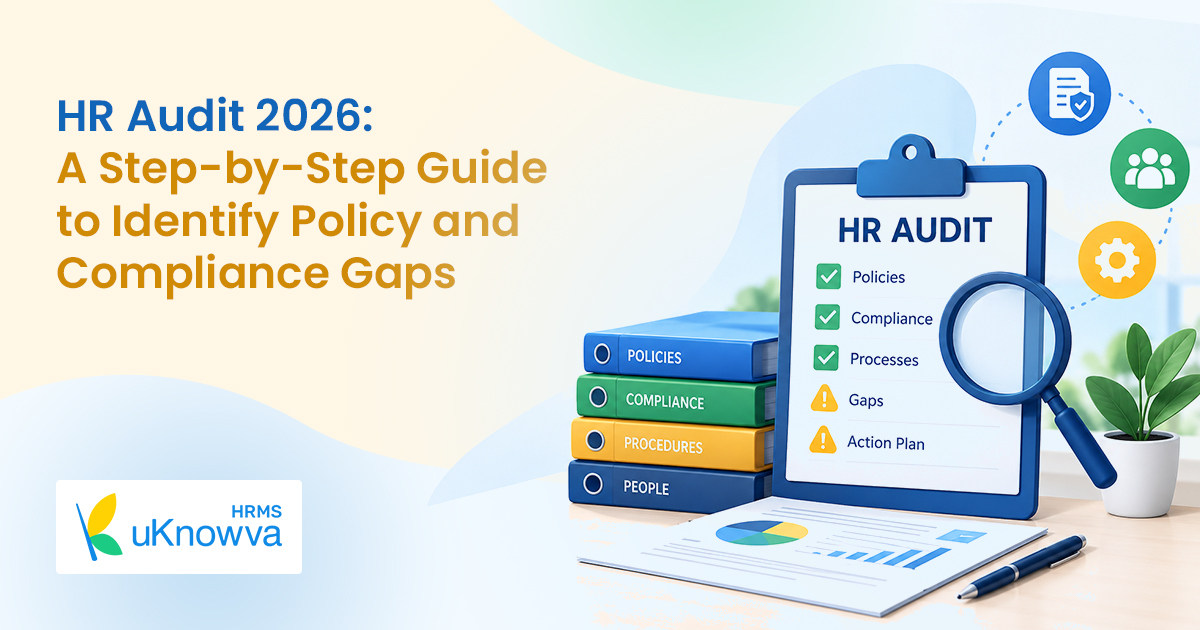
HR audit is a structured review of a company's HR policies, practices, processes, paperwork, systems, and adherence.
The goal is to determine whether HR activities are legally compliant, effective, consistently implemented, and aligned with organizational objectives.
An HR audit is thus much more comprehensive than a review of employee records.
For instance, an organization could have a documented attendance policy. An HR audit, however, would ask whether the policy is up to date, whether employees have read and signed it, whether attendance is recorded properly, whether exceptions are approved properly, whether overtime is calculated properly, and whether attendance information is entered into payroll properly.
The same applies to recruitment, induction, performance management, promotions, remuneration, learning, employee relations, and exit.
An HR audit is a helpful concept to be understood as:
In 2026, HR audits are no longer just a compliance exercise—they are essential for managing workforce risks, protecting employee data, and ensuring business readiness.
With India’s four Labor Codes reshaping the compliance landscape, organizations must regularly review their HR policies, processes, and practices to stay aligned with evolving requirements.
Key areas making HR audits more critical include:
A proactive HR audit helps organizations move beyond compliance to build a secure, fair, transparent, and future-ready workplace.
The Government of India announced the implementation of the four Labor Codes, effective 21 November 2025. HR teams should review the applicable requirements and relevant notifications when assessing labor law compliance. Read the Ministry of Labor and Employment's official announcement on the four Labor Codes.
Identify compliance gaps in payroll, statutory contributions, tax deductions, employee records, POSH, maternity benefits, wages, and data privacy.
Detect outdated, missing, inconsistent, or poorly communicated HR policies and gaps between documented policies and actual practices.
Review approval authorities, segregation of duties, escalation procedures, and audit trails for sensitive HR transactions.
Identify manual tasks, process delays, and opportunities for automation, workflow standardization, and system integration.
Verify salary calculations, attendance inputs, leave deductions, overtime, reimbursements, tax deductions, and statutory contributions.
Identify delays and inconsistencies in onboarding, attendance, performance reviews, and employee exits.
Audit recruitment approvals, candidate assessments, and onboarding, and link turnover and early exits to employee experience.
Use reliable workforce metrics, including hiring efficiency, training completion, internal mobility, absenteeism, payroll accuracy, and attrition, to guide management decisions.
| Type of HR Audit | What It Covers |
| Compliance Audit | Reviews HR practices against employment laws, payroll and tax regulations, statutory requirements, and state-specific compliance obligations. |
| Policy Audit | Evaluates whether HR policies are current, approved, comprehensive, accessible to employees, and properly implemented. |
| Recruitment Audit | Examines the hiring process, including job requisitions, approvals, candidate records, interview notes, background checks, offer letters, and joining reports. |
| Payroll Audit | Verifies payroll calculations, deductions, reimbursements, statutory contributions, tax calculations, and alignment with employee, attendance, and leave records. |
| Employee Records Audit | Checks whether employee documents are complete, accurate, up to date, securely maintained, and accessible only to authorized personnel. |
| Performance Management Audit | Assesses goal setting, KRAs, performance reviews, rating consistency, feedback documentation, calibration, and performance improvement plans. |
| Learning & Development Audit | Reviews training needs, learning plans, compliance training, development programs, training completion rates, and their impact on performance and internal mobility. |
| Compensation Audit | Examines salary structures, increments, bonuses, incentives, allowances, approval procedures, documentation, and compensation-related compliance. |
| Diversity & Inclusion Audit | Evaluates workforce representation, recruitment practices, promotions, pay differences, accessibility, grievance procedures, and employee feedback. |
| Health & Safety Audit | Reviews workplace safety procedures, incident reporting, emergency preparedness, employee training, and occupational health and safety documentation. |
| Employee Engagement Audit | Analyses employee surveys, absenteeism, turnover, grievances, exit interviews, and participation data to identify workforce concerns and engagement trends. |
| HR Technology Audit | Assesses HR systems, user access, role permissions, integrations, workflows, data quality, system configurations, audit logs, security controls, and AI-enabled HR processes. |
| Data Privacy Audit | Examines how employee data is collected, processed, stored, accessed, and shared, including retention periods, third-party processors, legal bases, and breach-response procedures. |
| Exit Process Audit | Reviews resignations, approvals, notice periods, full and final settlements, asset recovery, exit documentation, termination consistency, and exit interviews. |
Organizations can conduct a comprehensive HR audit or focus on specific audit types based on business priorities, regulatory requirements, workforce risks, and operational needs.
A structured HR audit process makes the audit more repeatable.
The first step is to determine what the audit should establish. For instance, the purpose could be to assess compliance with the law, the performance of payroll controls, employee documentation, or the effectiveness of HR technology. Clearly define the audit objectives so the report is easier to interpret and gives the audience clear direction.
Then determine who, where, what, and when to assess. A large organization may audit one location or process first, then another. By applying risk-based scoping, HR can focus on areas with greater legal, financial, operational, or employee impact.
Prepare documents and records needed for the audit. This can involve policies, employee files, payroll records, attendance records, leave records, contracts, training records, performance records, and statutory records. Avoid manual collections wherever possible by using a central HRMS.
The review should consider central requirements in addition to state-level requirements for organizations that have multiple offices in India. The labour code transition needs to be addressed in conjunction with other requirements like professional tax and tax compliance.
Policies show what should happen; interviews reveal what actually happens.
Engage HR, payroll, and managers to uncover workarounds, recurring issues, and gaps between documented processes and actual practices.
Another source of audit evidence is through employees. Surveys can measure awareness of policies, experience with leave, absence, management, safety, grievances, training, etc. An anonymous survey can be particularly valuable for uncovering what employees are not saying out loud.
The risks associated with audit findings vary. Sort/rank findings based on legal, financial, and employee exposure, likelihood and frequency. This allows management to prioritise their resources toward the most critical issues.
A gap analysis compares existing HR practices with legal requirements and organizational standards to identify areas for improvement.
Use a structured approach: Current Practice → Required Practice → Gap Identified → Risk → Corrective Action.
There should be clear ownership and date for each of the key findings.
The corrective action plan should include what the change will be, who is responsible, what resources will be needed to implement the change, and how it will be demonstrated.
The HR audit report should convert the findings into management-level knowledge and understanding.
It should highlight significant risks, trends, non-compliance issues, inefficient operations, and suggested solutions. A good report differentiates between important findings and routine process improvements.
The audit shouldn't stop after the report is finished. HR should review corrective actions and set up regular reviews for high-risk processes. Transform a periodic audit into continuous HR governance with HR dashboards, automated reminders, and workflow alerts.
Effective audit planning starts with defining the scope, identifying the relevant records and stakeholders, and deciding how findings will be documented and addressed. SHRM's guidance on planning an internal wage and hour audit discusses these steps, including the need to establish clear follow-up actions.
The HR audit checklist should not just ensure compliance with statutory requirements; it should cover the entire employee lifecycle.
Check to see that job requisitions, hiring approvals, candidate information, interview records, and selection decisions are recorded. Recruitment teams should also check that candidate information is processed in accordance with relevant privacy and retention policies.
Ensure offer letters, appointment letters, employment contracts, and required joining documents are issued consistently. Salary components and terms of employment should be consistent with approved records and payroll configuration.
Ensure new staff sign mandatory paperwork, policy acceptances, bank details, statutory details, and mandatory training. The audit should also determine whether the onboarding steps are monitored until completion or treated as a one-time administrative process.
Discuss payroll, attendance, deductions, reimbursements, statutory obligations, and tax. Compare payroll information to employee master records and ensure the proper approval process is kept.
Ensure employees are paid their benefits according to their eligibility and policy. The audit should also review documentation and communication for benefit enrollments, changes, and exits.
Review attendance capture, shift rules, overtime, missed punches, regularisation, and approval processes. Where the team is hybrid and/or distributed, ensure the attendance model aligns with the organization's working practices.
Review leave eligibility, accumulations, leave balances, leave approvals and leave carry-forward and payroll integration. The audit should also identify that statutory leave requirements (if applicable) are properly documented in the system/policy.
Discuss goal setting, KRAs, review cycles, ratings, manager involvement in review and documentation of manager performance. If the organization has performance improvement plans, ensure they are a consistent, documented process.
Review required training, learning and role-specific training requirements. For compliance-based programs, make sure HR can provide proof of attendance and completion.
Discuss work site security policies, incident reporting, training and emergency protocols. Also, consider the type of organization and employees to ensure their safety arrangements are appropriate for the nature of their work.
Resignation of Auditor, Notice periods, Approvals, Asset recovery, full and final settlement, Documentation of employees. Processes of termination should be standardized, traceable and suitably documented.
Check any relevant labor, payroll, tax, workplace and privacy issues. Keep the checklist up to date in response to changes in regulatory requirements, and do not treat it as an annual report.
Re-evaluate the HRMS access, role permissions, integrations, workflows, audit logs and data accuracy. It's also a good idea to evaluate if employee information is consistent across multiple HR systems for organisations with more than one.
Ensure that key HR information is complete, searchable, secure and held for the required length of time. Even if the HR process was followed correctly, lack of documentation can be a big problem.
Conduct an employee feedback review, grievance trends and workplace behaviour indicators. HR should assess whether staff have clear avenues to raise concerns without fear of reprisal.
Ensure the grievance system, investigations, discipline procedures and warnings are documented. Control sensitive employee-relations issues and maintain evidence trails.
Check salary changes, increments, incentives and allowances to approved records. Document any changes to compensation with authorized requests and approvals.
Check out eligibility for remote work, attendance, hours, equipment, expenses, information security and employee conduct. Policies should be based on the organisation's real hybrid working model and not just on working from the office.
Review the access granted to employees and whether it is appropriate for their role. It is important that employee information is protected at the collection, processing, storage, sharing and deletion stages.
Locate the use of AI in recruitment, employee services, performance, learning/workforce analytics. Analyze vendor controls, data usage, human oversight and documentation of AI-influenced decisions.
Download the Complete HR audit guide: An HR audit checklist and audit template make performing a practical HR audit simpler.
Verify that HR policies are up to date, approved, communicated, acknowledged, accessible, and consistently implemented.
Review working hours, shifts, overtime, late marks, missed punches, regularisation, and HRMS attendance settings for remote employees.
Check remote-work eligibility, availability, attendance, expenses, equipment, and data security, ensuring consistent application across teams.
Verify requisition approvals, candidate assessments, background checks, offer approvals, onboarding, and candidate data management.
Review promotion eligibility, performance criteria, approval requirements, and consistency in promotion decisions.
Check probation periods, extensions, timely performance reviews, confirmation decisions, and supporting documentation.
Verify goal setting, review cycles, ratings, feedback, performance improvement processes, and record maintenance.
Review eligible expenses, supporting documents, approval limits, authorisation workflows, and reimbursement timelines.
Ensure behavioural expectations are documented and accessible, with clear procedures for reporting and addressing concerns.
Verify Internal Committee composition, required representation, policy communication, complaint procedures, and periodic committee reviews.
Audit employee data collection, access, storage, sharing, retention, HRMS configurations, and third-party vendor controls.
Review notice periods, exit approvals, documentation, final settlements, asset recovery, and consistent handling of employee exits.
A whistleblowing policy is a formal procedure to report significant concerns that include fraud, misconduct or conflicts of interest,
In 2026, HR audits in India must account for evolving labor laws, statutory obligations, and state-specific tax requirements. A practical review can be divided into three tracks:
One of the most critical areas to look at in payroll is the 50% wage rule.
The research material highlights that basic pay plus DA should be at least 50% of the applicable wage and can play a role in the calculation base for PF, gratuity, bonus and leave-related components.
When conducting an HR compliance audit, check:
The Code on Wages, 2019 defines wages and specifies how different remuneration components are treated under the law. During an HR audit, organizations should review salary structures and payroll configurations against the statutory definition of wages and the applicable rules. Refer to the official Code on Wages, 2019 when reviewing wage-related compliance.
An EPF audit should ensure that employees are eligible, that their contributions are timely, and that supporting documents.
It should also align payroll deductions with statutory payments. Interest and damages may be charged for late payments or withheld PF contributions; thus, timely compliance processing is important, the research material notes.
For employer-facing EPF services, contribution-related processes and official compliance updates, HR and payroll teams can refer to the EPFO employer portal.
Review employees' records, contribution amounts and contribution timelines, and discuss ESI eligibility.
The audit should compare payroll records with statutory records to promptly detect discrepancies.
Check that wages are being paid properly and on time.
The audit should also check deductions for proper documentation and processing.
Check employee categories and locations to ensure pay levels comply with applicable minimum wage laws.
Organisations that have multiple locations should be wary of this, as there may be different rates applicable based on jurisdiction and worker type.
Discuss bonus eligibility, how to calculate a bonus, when a bonus can be paid, and what can be used as supporting evidence?
The research material reveals that the statutory bonus framework is now part of the Code on Wages, and the minimum and maximum bonus provisions should be closely examined.
The simple formula for gratuity is:
Gratuity is calculated as (Last Drawn Wages x 15 x years of service) / 26
The 50% wage rule may, however, impact the wage base. Employment classification is also a key audit consideration, with the research highlighting what to watch for regarding fixed-term workers.
Conduct an audit on maternity leave eligibility, records, payments, adoption-related provisions and relevant crèche requirements.
According to the research material, the basic maternity entitlements include 26 weeks for the first two children, plus additional ones for more children and others.
Maternity benefit audits should be based on the applicable legal provisions, employee eligibility and required records. The Ministry of Labor and Employment provides an official overview of maternity benefits under Indian labor legislation.
Please note that the four Labour Codes are not a replacement for all the older labour laws.
The study specifically recognises the Contract Labour (Regulation & Abolition) Act as an important consideration by itself. Employers who employ contractors should check registration and licensing of contractors, payment of wages and obligations for principal employers.
Review grievance and disciplinary procedures, standing order requirements (if applicable) and other industrial-relations controls.
An audit should also determine whether employees and managers understand escalation processes.
A POSH audit should address the following:
The research material also indicates that POSH duties apply to remote and hybrid working.
Review engagement, registration, contracts, and applicable workforce requirements for apprentices.
The research material also signals significant numbers of apprentices taking part in NAPS, further underlining the importance of reliable apprenticeship documentation.
Professional Tax is a state-level requirement and should be audited separately from the Labour Codes.
This is especially relevant for multi-state employers, as some states tax employees' professional activities while others do not. The research singles out this difference as a typical audit trap.
Payroll teams should check TDS configuration, employee tax declaration, deductions, filing and supporting documents.
One of the research documents outlines the Income Tax Act 2025 from 1 April 2026 as a significant documentation/ payroll system transition which organisations must consider.
Payroll audits should account for the applicable tax provisions, TDS requirements, and transitional rules when reviewing salary deductions and filings. Refer to the Department's official FAQs on the Income-tax Act, 2025 for further details.
Documentation is one of the most critical areas of an HR audit as it allows the auditor to see that processes have been done correctly.
Employee acknowledgments indicate that important policies or communications have been shared with employees.
It is very useful when being audited for policies and compliance, showing how much more than just a policy the organisation did.
There may be some evidence of a process but not enough.
This is challenging for HR to prove during an audit and can lead to a reliance on the memory of specific employees and/or emails.
A new member can enrol without filling out any necessary paperwork, policy confirmation, statutory information etc.
This can be minimized with a structured onboarding workflow that alerts you to outstanding tasks before you finish the onboarding process.
HR information can be in a multitude of email inboxes, spreadsheets and individual folders.
This can make retrieval difficult and may lead to inaccuracies or delays.
Payroll problems can arise if salary information, attendance data, leave deductions, or statutory calculations are entered or applied incorrectly.
Errors should be looked for based on 'recurring error patterns' and not treated as an individual error.
Fixed-term employees, contractors, apprentices, and gig workers all have different legal and operational requirements than permanent employees.
That can lead to misclassification problems throughout payroll, benefits and documentation downstream.
Changing regulations, structures or working practices in an organization can make an employee handbook quickly out-of-date.
Audits to confirm effective dates, approvals, references and employee acknowledgement.
Publishing a policy isn't enough for employees to receive and understand it.
Digital acknowledgement records can lead to more robust evidence of policy communication.
Managers may have informal performance discussions without keeping appropriate records.
It can cause issues if HR should need to show the history of giving feedback or a process of improvement.
If employee terminations are not well documented and consistently approved, they can lead to employee-relations and legal issues.
Processes should be examined to determine if they are standardised and controlled appropriately for an audit.
Employee grievances must be handled in a controlled manner when they are sensitive. Confidentiality, access control, evidence retention and escalation process should be reviewed in the audit.
Training (where it is required) may not be completed and documented regularly. An HRMS can help HR identify overdue training and track evidence of completion.
Policy failures can occur when managers avoid processes.
Audits should, therefore, uncover where managers have approved, exceptions or delays are causing HR process gaps.
AI can be implemented without clear documentation on the data used, review mechanisms for outputs, and who is responsible for decisions.
This is a growing element of the contemporary HR technology audit.
HR staff and senior management should clearly understand the findings of an HR audit.
The executive summary should include the explanation of scope of the audit, the major findings, significant risk and the priority actions.
Senior leaders need to see the big picture of the most important issues without reading each detailed observation from the audit.
The observations and the evidence for each finding should be clearly stated.
For instance, if there are gaps in policy acknowledgement records, the report should estimate the number of employees affected, if possible, and specify the gap.
The findings can be rated and assigned a severity level, e.g. critical, high, medium or low.
The rating should be based on objective factors like, potential of legal exposure, financial impact, employee impact, frequency and likelihood.
Practical recommendations should be made for every significant finding.
Recommendations should not just say that there is a need to improve a process, it should tell what it needs to change.
The suggested timeframes for corrective actions should be realistic.
High-risk findings relating to statutory or data aspects can be addressed immediately, while administrative improvements can be implemented in longer-term process plans.
Each action should have an accountable owner. Audit findings can never be closed without ownership.
The compliance score gives management a general overview of progress.
The score should not be used as a substitute for the findings as a single serious violation may be offset by good performance in less risky areas.
Management Comments enable leaders to document their response to their findings.
These can contain agreed activities, business context, resources needed and timelines expected.
HR audits become more valuable when they connect compliance observations with workforce metrics.
| HR Audit KPI | What It Helps Measure |
| Time-to-hire | Recruitment efficiency and process delays |
| Turnover | Workforce stability |
| Retention | Employee experience and organisational health |
| Training completion | Learning and compliance readiness |
| Payroll accuracy | Payroll process quality |
| Compliance score | Overall control maturity |
| Employee satisfaction | Employee experience |
| Offer acceptance | Recruitment effectiveness |
| Internal promotion | Career development and mobility |
| Absenteeism | Attendance patterns and workforce wellbeing |
The research material includes 2026 benchmarks for India for some of these metrics, like attrition, time-to-hire, employee replacement cost and early-stage employee exits.
View these as reference points, not targets, as workforce size, sector, location, and employee mix can affect results.
But, what is the role of HRMS in HR audits?
An HRMS links employee information to audit goals to make sure records are accurate, assists in finding gaps, and enhances compliance, without having to sift via a variety of files and emails.
It assists auditors to audit:
Managing employees' records: missing documents, incomplete records
The salary changes, payroll inputs, and approval trails are included in the Payroll module.
Attendance: Exceptions and leave acknowledge and track policy compliance, including pending workflows.Track pending workflows and acknowledge policy compliance.
Performance Appraisal and training completion: an auditor can follow the approval process for a salary revision, rather than having to go looking for it in emails.
An HRMS can speed up audits and make them easier to monitor, but the auditor still needs to verify the information independently.
AI is transforming HR audits by helping teams analyze workforce data, identify anomalies, and reduce manual effort.
AI Governance: AI-driven audits should include privacy assessments, data protection measures, vendor audits, and human oversight to ensure responsible decision-making.
| Manual HR Audit | HRMS-Based Audit |
| Spreadsheet-driven | Centralized employee data |
| Manual document collection | Digital documentation |
| Email-based approvals | Workflow-based approvals |
| Periodic checks | Continuous monitoring |
| Difficult to trace changes | Structured audit trails |
| Manual reporting | Automated dashboards |
| High dependency on individuals | Standardised workflows |
| Difficult cross-location comparison | Centralised reporting |
| Reactive issue identification | Exception-based monitoring |
| Time-consuming reconciliation | Integrated HR data |
The goal of HRMS-based auditing isn't to remove people.
Instead, it makes human audits more efficient by providing better data, better documentation, and better process visibility.
An HR audit is only effective when it identifies real risks and drives meaningful action. Avoid these common mistakes:
Choosing the right HR Audit Software is essential.
The right HR audit software makes audits easier, reduces manual tasks, and improves compliance without adding complexity to HR operations.
The process of conducting an HR audit is easy when all employee data, HR processes, approvals, documentation and reporting are unified in a single HRMS.
By integrating multiple HR processes into a single platform, uKnowva HRMS can enable an audit-ready HR environment.
Organizations can build processes around digital workflows and established approval chains, rather than using individual spreadsheets for each process.
For example:
Adding an employee to Attendance, capturing documents, acknowledging policies, and setting attendance and payroll happen in quick succession.Adding an employee to Attendance, capturing documents, acknowledging policies, and setting up attendance and payroll occur in quick succession.
The integrated approach helps to build a more transparent employee lifecycle.
uKnowva HRMS can be of great assistance to HR teams in managing employee information in a centralised way.
This can help to streamline the process of auditing and make it more convenient to find pertinent employee information, decreasing reliance on disjoined records.
Organisations can use structured workflows to standardise HR processes' approvals. This gives more visibility of who started, approved or finished an activity.
Digital HR records can help streamline access to records for internal and external audits.
It can also help prevent the loss of valuable employee records when they are stored in multiple folders or in an individual's email.
Automation reduces repetitive HR administration and delivers more consistent process execution.
For instance, HR teams can rely on automation for reminders, approvals, and HR lifecycle tasks instead of manual follow-up.
HR leaders gain visibility into workforce and process data through dashboards.
This can help uncover exceptions like under-documented items, items awaiting approval, attendance issues, or late processes before they become audit findings.
With uKnowva's AI capabilities, HR teams can engage with workforce information in more human, conversational ways.
Rather than providing a static report, HR leaders can now use AI-powered interactions to summarize or explore workforce data faster.
Linking employee data, workflows, and documents means HR teams have a stronger evidence trail.
The goal isn't just to get ready for the audit.
It is to set up an HR operating model where compliance, governance and visibility are part and parcel of everyday HR processes.
An HR audit in 2026 is more than an annual review of employee records. It evaluates whether an organisation’s HR operating model is structured, documented, controlled, measurable, and adaptable.
Changing labor regulations, employee data privacy, AI adoption, hybrid work, and diverse employment models make regular HR audits essential. An effective HR audit checklist must assess policies, processes, technology, and people together.
The HR audit process involves defining the scope, reviewing documentation, assessing compliance, identifying risks, analysing gaps, and implementing corrective actions. For Indian organisations, particular attention to applicable Labour Codes, state-level requirements, and statutory obligations helps strengthen compliance, governance, and operational efficiency.