









 Play the audio of the blog
 Pause
Continue
Stop
AI is not a fledgling tool on the fringes of the HR function anymore. AI is being used in a variety of ways in 2026, such as aiding in the recruitment process, employee performance management, workforce analytics, and customising employee experiences, to name a few.
For Chief Human Resources Officers (CHROs), it is a larger question than “Where can we use AI in HR?”
The real question is: How can AI optimise HR while maintaining a human touch?
The modern-day CHRO AI strategy must be more than just automation. It should define:
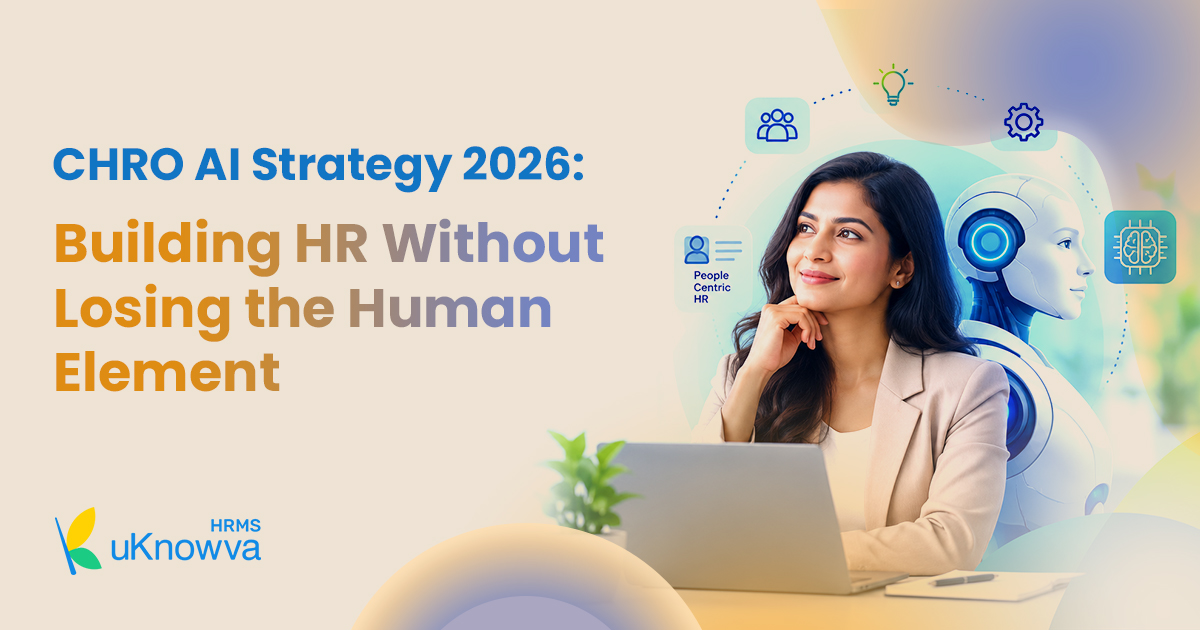
The goal isn't to create an HR machine function. It's about creating an HR role that is more technologically driven to reduce administrative burden, freeing up time for HR professionals to spend on people, strategy, leadership and organisational growth.
A lack of a clear strategy for adopting AI can lead to a fragmented implementation. But various HR teams might use different tools, employees might use tools that are not approved by HR, and sensitive information about employees can be stored in systems out of HR's control.
The structured AI strategy provides a pathway for CHROs to relate the use of AI to workforce and business needs.
AI is doing more than just automating repetitive activities in human resources. It's also reshaping jobs, processes, and techniques, team arrangements, and decision-making.
As more and more CIOs shift to a state of perpetual change, CHROs must learn the following:
The ILO’s research found that one in four workers globally is in an occupation with some GenAI exposure, but that continued need for human input means job transformation is generally more likely than full replacement.
The workforce has become more familiar with the immediate influx of digital experiences in their day-to-day lives and is now looking to have the same ease in the workplace.
They have a right to expect HR to:
HR teams can then dedicate more time and resources to tackling more complex, sensitive issues, as AI manages routine tasks. This means HR can meet the expectations of employees and concentrate on more complex and sensitive issues.
Today's HR systems have vast amounts of information about employees, including:
The problem is that having better analytics doesn't necessarily mean having more dashboards; it means having better decisions.
With HR handling sensitive data and critical decisions affecting individuals' careers and livelihoods, AI governance becomes a cross-functional affair.
This involves:
There is no inherent value in purchasing an AI-powered HR platform.
CHROs should link the use of AI to results such as:
Better quality and timely decision-making in HR: AI can offer relevant information and analysis, while the decision-making remains in the hands of the leader(s).
The job of the CHRO is shifting from HR process management to creating the human component of an AI-driven business.
The CHRO needs to be aware of the evolution of AI:
AI will change the skills leaders need to recruit, lead, and manage a team alongside AI.
Instead of asking the simple question of “How many staff does it take?” HR should ask the question of “What combination of people, technology, skills, and AI capabilities will it take?”
It's not a case of just plugging AI into current workflows.
CHROs should identify:
Gartner argues that AI will change HR work, workflows and operating models, not merely automate individual processes.
The CHRO should be part of the equation when determining the impact of AI on employees.
This includes:
The use of AI is a transformation programme for the workforce.
Staff can be concerned about:
CHROs must tackle these challenges by communicating, training, reskilling, and involving employees.
To make the most of AI for HR, the CHRO needs to align it with company goals and make it an integral part of the HR strategy, not a standalone project.
A useful model is:
HR human-centric AI should encompass:
SHRM's research explicitly emphasises combining AI with human experience, judgment and empathy.
The main concept is:
Automate the process - not the responsibility
All AI projects need to be linked to a business or workforce goal. CHROs should define:
Identify key stakeholders who will be responsible for ownership, management and monitoring of the initiative.
Success metrics: Identify key metrics that will determine the value of the initiative.
The goal of AI is to make employees' and HR's work easier, not harder.
Identify use cases that:
AI is only as reliable as the data it is based on.
CHROs should establish:
There are clear rules with HR relating to, Have a list of AI tools that employees can use:
HR and employees require the ability to utilize AI effectively.
This includes:
HR processes should be embedded with AI instead of it being a bunch of unrelated tools.
For example:
The training and development process is also called succession planning.The training and development process is also referred to as succession planning.
Linking these steps can enable HR to establish better and more streamlined employee workflows.
The AI strategy should be adaptive. CHROs should regularly review:
AI can help employees in their initial interaction with the organisation right through to their last contact with it.
AI can support:
The role of the human recruiter remains unchanged, and so do the contextual judgment, candidate experience and decision-making for the final selection.
AI can:
AI assistants can assist employees in locating:
This reduces repetitive HR queries and lets HR focus on complex employee needs.
AI can assist with:
While AI can provide performance evaluations, it is important to note that these evaluations should be reviewed with careful consideration as there are other aspects of performance that may not be evident in HR data.
AI can personalize:
AI can analyze:
It can identify potential talent pools, but succession planning should remain with human leadership.
AI can support:
AI doesn't need to be applied to all HR functions.
Recruit and acquire talent
AI can benefit high-volume and repetitive tasks like:
Employee Service Delivery
AI-powered HR assistants can provide 24×7 access to routine HR data.
This can reduce:
AI can help HR shift from generic training catalogs to more personalized training recommendations.
Workforce Analytics
AI can discover trends and patterns across:
Performance Management
AI can help minimize administrative tasks associated with goal setting, review, feedback and documentation of performance.
Payroll and HRM Operations
AI can assist with:
Even with automated payroll systems, controls and human review should remain for sensitive payroll decisions.
A CHRO should not rush to automate all HR processes at once.
Focus on the business value, feasibility, risk, and employee impact of each use case.
Priority 1: Employee AI Assistant is a priority
Use AI to answer routine employee questions around:
This is a story of HR workflow automation, specifically
Priority 2: HR Workflow Automation
Automate repetitive tasks, including:
Priority 3: Recruitment Intelligence
Leverage AI to automate/streamline efforts on:
Priority 4: Workforce Analytics
Create AI-powered dashboards to gain insights into:
Priority 5: Personalized Learning
Use workforce data to recommend appropriate learning and development opportunities.
Priority 6: Manager Copilots
AI can assist managers by providing:
Priority 7: HR Content with AI
AI can assist HR teams in creating:
For sensitive or high-impact content, include human review in the process.
Build AI governance in advance of large-scale deployment—not after problems appear.
NIST's AI RMF offers a helpful framework with four functions: Govern, Map, Measure, and Manage, with governance being performed throughout the AI lifecycle.
Have a single database of the AI tools used throughout the HR function.
Record:
The type of HR data AI can use. Data that is not allowed to be added to public AI tools. Access to sensitive information is limited to. How data is stored. The duration that information is stored.
Determine decisions that must be taken by humans.
These may include:
When evaluating AI systems, assess the potential for adverse impact on relevant groups of employees or candidates.
Testing should happen:
Provide appropriate information about the use of AI in HR processes to employees and candidates.
The amount of disclosure should be proportional to the degree of sensitivity and impact of the use case.
CHROs need to collaborate with procurement, legal, IT, security and other teams to analyze the following:
Create a process for reporting and investigating:
NIST’s AI Risk Management Framework says organizations should identify, assess, monitor, and manage AI risks throughout the AI lifecycle.
The roadmap can be broken down into five stages:
Stage 1: Assess
First, understand the current situation. Reevaluate current AI tools for audit. Map HR processes, identify manual work, assess data quality, surface workforce issues, and review existing governance.
Stage 2: Prioritize
Develop an AI use-case portfolio.
For each use case, consider:
Stage 3: Pilot
Begin with limited cases of use.
For example:
Establish measures of success prior to the start of the pilot.
Stage 4: Scale
After a pilot has emerged as a measurable value:
Stage 5: Continuously Optimize
Implementing AI is just the beginning.
Review:
Gartner's 2026 advice also focuses on the importance of CHROs setting up an AI-enabled HR operating model and to regularly reviewing the strategy as technology evolves.
AI Implementation is a people transformation program, as well as a technology program.
Communicate the "Why"
Staff should be aware of the rationale for the use of AI
Explain:
What issue does it address?
What will it be changed to?
What will NOT change?
How do employees benefit?
Where is people's judgment still required?
Train Managers First
Managers are more influential in adoption than technology announcements.
Train managers on:
AI capabilities.
AI limitations.
Responsible usage.
Employee communication.
Human oversight.
Escalation procedures.
Build AI Literacy
Incorporate AI literacy into workforce development.
Training can cover:
AI basics.
Prompting.
Data privacy.
Fact-checking.
AI bias.
Responsible usage.
Create Feedback Loops
Reporting should be facilitated for employees to do so by providing access to reporting channels such as:
Incorrect AI responses.
Poor experiences.
Bias concerns.
Missing information.
Privacy concerns.
Don't just deploy, adopt!
Adding an AI feature doesn't mean employees are using it effectively.
Track:
Active users.
Repeat usage.
Task completion.
User satisfaction.
Escalation rates.
Time saved.
While AI presents opportunities, HR leaders should consider key ethical challenges as AI becomes part of the workplace. As AI becomes an integral part of the HR landscape, it raises important ethical considerations that must be addressed.
Bias
Patterns of inequality can exist long before the start of the historical period. AI can learn from bad data and replicate or compound such patterns.
Privacy
HR information is very sensitive.
CHROs should make sure that AI is used with integrity by ensuring that it adheres to:
Data minimization.
Access controls.
Privacy requirements.
Appropriate retention.
Employee confidentiality.
Explainability
Employees have a right to ask:
Why was this suggested by the system?
HR should have enough transparency into AI decisions to explain them if necessary.
Human Accountability
The AI system will never be a way to avoid accountability.
There has to be somebody accountable for:
Decisions.
Exceptions.
Errors.
Employee impact.
Employee Surveillance
AI can provide more powerful workforce monitoring.
CHROs have to differentiate between:
Supporting productivity and intrusive employee surveillance.
Having data doesn't necessarily mean HR should use it for monitoring.
Digital Inequality
Employees can be digitally and AI literate to varying extents.
Accessibility and training, therefore, need to be part of the AI transformation, not something automatically assumed to be done equally quickly.
OECD research specifically looks at software and AI being used to instruct, monitor, and evaluate workers and documents concerns around accountability and explainability.
Balanced operational, financial, employee, and risk metrics are the right measures for CHROs to take when assessing AI.
Productivity KPIs
HR hours saved.
Tasks automated.
The mean number of days to resolve HR service requests.
Number of HR transactions completed per employee.
Manager time saved.
Recruitment KPIs
Time to hire.
Time to shortlist.
Candidate response time.
Recruiter productivity.
Candidate experience scores.
Employee Experience KPIs
AI assistant adoption.
Employee satisfaction.
The percentage of successful responses to HR queries.
Self-service completion rate.
Escalation rate.
Learning KPIs
Learning completion.
Skill development.
Learning engagement.
Internal mobility.
Development-plan completion.
Financial KPIs
The per HR transaction price.
Cost per hire.
HR operating cost.
The cost of AI to the employee.
Estimated productivity value.
Governance KPIs
AI incidents.
Bias review completion.
Privacy incidents.
Human-review compliance.
Approved AI tools vs. unapproved AI Tools.
Saying “how much AI are we using?” is not the most helpful KPI.
It is:
What measurable improvements has AI brought without sacrificing the trust, fairness, privacy, or employee experience?
CHROs need to assess the AI risks throughout the lifecycle.
Strategic Risks
There may be no alignment between business goals and AI programs. There might be differences between business goals and AI programs.
HR can use the technology without redesigning processes.
Technology fragmentation could result from multiple, unrelated AI tools.
Operational Risks
Incorrect AI outputs.
Poor data quality.
Integration failures.
Excessive automation.
Relying on AI by employees.
People Risks
Employee resistance.
Concern over loss of employment.
Lack of interpersonal relationships.
Reduced trust.
Poor adoption.
Business compliance and legal risks
Unauthorized data processing.
Discriminatory outcomes.
Inadequate transparency.
Inconsistent documentation.
Failure to comply with the relevant regulations.
Security Risks
Employee data entered into insecure systems.
Unauthorised access.
Third-party vendor exposure.
AI Phishing and/or Social Engineering threats.
NIST's AI RMF is designed to address risks while also fostering desirable attributes of AI, including reliability, safety, security, accountability, transparency, explainability, privacy and fairness.
1. Automating Before Redesigning
Does not ensure that the process improves when it is broken and put into an AI.
Simplify the flow, first. Next, identify the role AI can play in driving value.
2. Considering AI a project in the realm of information technology (IT)
AI impacts HR in human resources and management workflows, soft skills, policies, and culture.
HR needs to become a technology consumer, though, is a thing of the past.
3. Purchasing too many tools
A wide range of AI tools can be used to generate:
Data silos.
Duplicate functionality.
Security risks.
Higher costs.
Poor user experience.
4. Ignoring Employee Concerns
AI implementation can go wrong if leaders only consider productivity and not employee sentiment.
5. Measurement of Activity rather than Outcomes
It isn't business value if it's just a number of prompts, AI users or automated workflows.
6. Removing Human Oversight
While AI can aid decision-making, humans should remain accountable for high-impact HR decisions.
7. Forgetting Data Quality
AI is not a magic wand that can solve the problem of inaccurate employee records, disjointed systems and HR data that's constantly inconsistent.
8. Seeking to govern AI as an exercise once and for all
The use cases for organizations, data, regulations, AI models, and vendors change.
Governance must be looked at on an ongoing basis.
To scale AI throughout HR, CHROs need to be able to answer the following questions:
Strategy
Does the organization have an AI strategy that it is pursuing?
Are the highest-value HR use cases identified?
Will AI investments have tangible results?
Does there exist some AI roadmap?
People
Have there been any announcements about employees using AI?
Are managers trained?
Is AI literacy included in workforce development?
Are new skills and changes in skills identified?
Technology
Are HR data accurate and up to date?
Are there any ways to make AI tools work with the core HR system?
Does access to the area have controls?
Can the AI capabilities be expanded?
Governance
Do you have an HR AI policy?
Are all AI use cases documented?
Do high-impact decisions require human review?
Are there regular risk assessments of AI risks?
Do vendors receive proper evaluation?
Employee Experience
Does AI make employees' work lives smoother?
Can you get help from humans when you need it?
Will employees be able to voice concerns about AI-supported processes?
Is experience accessible and understandable?
Measurement
Are the gains in productivity measured?
Do employees use it? Is it monitored for usage?
Is financial outcome measured?
Is there a system of monitoring of risks and incidents?
Do workers' trust or lack of trust get measured?
The journey of AI in HR is from individual generative AI tools to more comprehensive, workflow-centric solutions.
AI agents are increasingly able to do more than just churn out text, they can find out what to do next in the process.
In HR, this can involve AI being used to automate processes like:
Employee request: retrieve data; validate it; route it to the employee for approval; update the HR system; notify the employee.
If the process needs it, "Human Approval" may be left in.
Microsoft's 2026 research focuses directly on agents taking on execution while people retain direction, decisions and ownership
AI co-pilots are poised to become a more common tool for managers and HR professionals to use more frequently in the near future, and in the following categories:
People will increasingly talk rather than click through a series of menus to access HR systems.
For example:
This not only improves the ease of using HR technology, but also minimizes repetitive administrative tasks.
AI can help organizations shift from job-based workforce planning models to skills-based ones.
CHROs can analyze:
HR experiences can be more personalized in the following ways:
Governance will replace the occasional “compliance” exercise and become a permanent part of HR operating models as AI becomes more embedded in HR.
Perhaps the biggest change isn't AI taking over HR jobs. It may be the HR jobs changing in response to human-AI collaboration. It could also be the HR jobs being redesigned because of this human-AI collaboration.
A similar theme is highlighted in SHRM's 2026 research, which underscores the need for human expertise and judgment alongside AI to ensure the technology's effectiveness within HR operations.
The question facing CHROs in 2026 is not if, but how, HR will use AI. The strategic issue is: what is responsible HR use?
A good CHRO AI plan must result in HR becoming more:
However, it shouldn't make HR:
The best HR operating model will be a mix of the best attributes of both:
AI delivers fast, scalable pattern recognition, automation, and round-the-clock assistance.
Context, empathy, judgment, accountability, creativity, and trust are all areas where people bring value.
For CHROs, it's not about choosing between AI and human intelligence; it's about identifying which is more robust for critical decisions. The question for CHROs is: Which is more effective at making critical decisions? The task is to create an HR model where each complements the other.
This is what we should expect from AI in HR when it's fully grown in 2026: technology that makes HR more human, not less.