








 Aditi Sharma
Table of Content
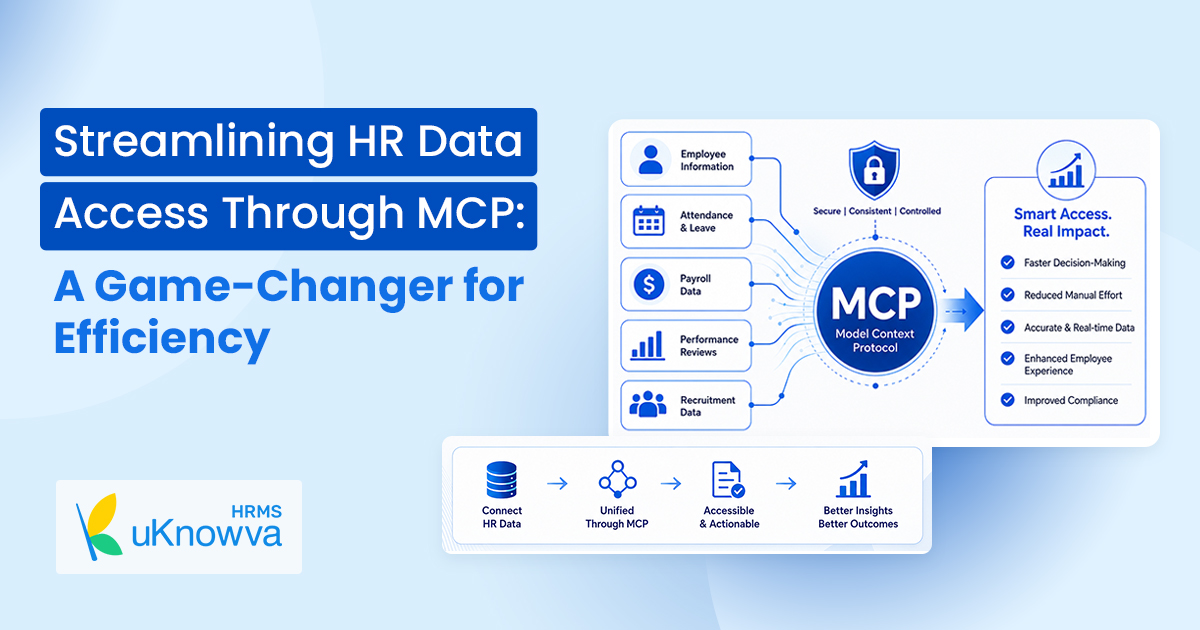
MCP stands out as a transformative solution in an AI-native HCM ecosystem, offering unparalleled efficiency in accessing HR data. MCP has the potential to significantly simplify how HR teams access and work with data, making information available more efficiently.
For HR professionals who are in charge of HR analytics or operations, this day is quite familiar.
It’s 4:30 p.m. The CHRO asks:
“What is the quick view of the CS regrets vs sales top performers for the last 3 Quarters by manager?”
Recognizing “quick” is a misnomer, someone exports from the HRMS, then someone else pulls compensation information from another system. You both put it into Excel and mess around with VLOOKUPs and hope the employee IDs match and you don't double-count transfers, after an hour of stress. When the slide is sent the question has already evolved.
Weird, right? Despite an era of “data-driven HR,” the engine of decision making is still the same: export, clean, cross reference, hope.
That's the space that MCP HR data access is attempting to fill.
In all honesty, it isn't your employees who can't make reports. They do. The problem is in the execution of manual processes and tasks.
Every time you:
Your senior HR spends their time on repetitive, mundane, and manual tasks, instead of deploying their intellect to strategic thinking for multiplying business outcomes.
This is another cutting-edge lesson most leaders don’t get: the slow return of information not only delays answers, but subtly redefines questions that are asked.
So the organization continues to make guesses on headcount, internal mobility, or manager effectiveness, not out of a lack of information but because it hurts to get the information.
A well-designed MCP HR data access layer reverses this dynamic by making relevant HR information easier to access and query when decisions need to be made.
In the case of a “hard” question taking 30 seconds instead of three days, the quality of questions from leadership changes. That's the true ROI!
MCP HR data access isn't about another tool, it's about a mindset shift with HR data.
Instead of:
“What system is the true one for tenure? Who has access? Is it possible to extract an extract?”
…you move to:
Ask, get the answer, from live unified data, right away with natural language.
When you type in “Show attrition of high performers in sales and CS over the past 3 quarters by manager”, the system interprets your query and runs it as a query through your HRMS, performance and payroll databases. There is no exporting, no stitching and no “version_final_FINAL2.xlsx”.
The strategic maneuvering here is small but big:
That's why it is effective. You’re compressing two workflows - data wrangling and analysis - into a single human interaction: asking.
Since MCP HR data access operates across systems, you are not jumping around between systems to re-create the same filters. Instead of HR teams repeatedly preparing reports across disconnected systems, MCP can help make HR data accessible through a more unified interaction layer.
HR is no longer a “report factory” and becomes an internal decision intelligence team.
All the vendor presentations promise time-saving and efficiency. Don't get me wrong, those words don't really resonate with a CFO these days.
Well, let's set the groundwork then.
With MCP HR data access, three real things happen when you remove the “export to Excel and cross-reference five sheets” process:
1. Collapsing Cycle Time
Cycle time for recurring reports, compliance, headcount, DEI, variable pay eligibility, etc. that used to take days, now take minutes. That isn't a margin of improvement, it's a structural improvement.
2. Leaders Make Decisions Earlier, With More Confidence
Instead of waiting till QBRs, your leaders can ask the awkward questions mid-quarter:
“Are we over-hiring in one BU?”
or
“Which managers have consistently low engagement and high attrition?”
If answers are readily available, they are used!
3. Free Up Senior HR Talent for Real Strategy
Most orgs underestimate this. No matter how much time you save your analytics team by clawing back that time from manual data prep, that time isn't lost. It moves from the design of policies, experiments, and interventions, to the design of better ones.
The real value is shifting HR analysts from spending most of their time preparing information to spending more time interpreting it and helping leaders act on it.
The comparison here should be: do you want your best HR analysts to be the ones who say “the people who get me my report fast,” or “the people who help me avoid a 12-month attrition disaster before it even begins”?
The shift is from measuring how quickly reports are produced to measuring how effectively HR teams use data to prevent problems and improve decisions.
When the data is moved from the first bucket to the second bucket, this data is the MCP HR data access.
Without any other data source, MCP HR data access is primarily concerned with access and speed. Ask a question, get data clean, fast, live.
With the addition of an analytics and reporting solution, such as uKnowva HRMS, you have something more strategic on your hands: pattern recognition at scale.
Think of MCP as the layer that helps answer “What’s happening?” while uKnowva’s analytics capabilities can help HR teams understand patterns, trends, and potential actions within that information.
For instance, you can retrieve “employees at risk” data in real time because of tenure, performance decline, and engagement scores using MCP. Next, perform further cohort analysis within uKnowva to find out which interventions (manager 1:1s, internal mobility, compensation changes) actually affect the trajectory.
The real genius of this approach: If you get on the field, you're not guaranteed to win the game. The real value emerges when an “ask anything” data-access layer is connected with an analytics layer that helps HR teams examine patterns, trends, dashboards, and outcomes.
This is where HR takes on more of a revenue ops role, test, iterate, and demonstrate "hard numbers".
uKnowva already brings together HR data and processes across areas such as Core HR, attendance, leave, payroll, recruitment, performance management, employee engagement, and analytics.
Its AI capabilities also extend into AI Agents, enabling organisations to explore more intelligent and automated ways of interacting with HR processes and data.
This is where it gets interesting for CHROs and CFOs: Most talent decisions are labeled as "strategic," but are based on remarkably shallow data.
A critical bet can be anything, such as:
…based on one or two lagging measures and a lot of gut feel.
MCP HR data access is integrated into your stack, so you can ask really nuanced questions on the fly:
No more having to use one consolidated annual ‘talent review deck'. Instead, HR leaders can work with more frequent, focused queries that surface emerging patterns earlier and provide opportunities to act before those issues become larger workforce problems.
Which is the actual contrast: traditional HR is stuck with the story of what happened. With MCP HR data access, modern HR can move from reviewing historical outcomes toward asking questions that help determine what should happen next.
But if there is a way here, it's this: Don't view your HR data stack as a plumbing system, view it as a product design.
Instead of treating the HR data stack as infrastructure that simply moves information between systems, HR leaders should design it around how employees, managers, HR teams, and executives actually need to use that information.
Ask:
How hard is it when the HRBP is a smart guy who doesn't bother with begging analytics for a non-trivial answer?
How many times do leaders ask questions to which they already know the answer?
If you get any wince from the truth, then it's a Caution! signal.
Maybe what you really need isn't 'better reports,' it's a new relationship with your data. Combined with something like uKnowva's analytics, that transformation is one very real, not theoretical, way to make that shift.
uKnowva's AI ecosystem also includes UVA, its AI-powered conversational assistant, designed to help users interact more naturally with HR information and processes.
Next time someone Slacks for “a quick view” on the crufty cross-system question, imagine being able to enter that question into a single HR interface and receive the relevant information without repeatedly exporting, combining, and validating multiple spreadsheets.
Will that alter the role of HR in the upcoming board meeting?
It might.
MCP HR data access has the potential to change the way HR teams interact with workforce data. Instead of spending hours exporting files, cleaning spreadsheets, reconciling employee records, and rebuilding recurring reports, HR leaders could move toward asking questions directly and receiving relevant information through a more connected data environment.
The bigger opportunity, however, is not simply faster reporting. It is giving HR professionals more time to interpret data, identify workforce patterns, challenge assumptions, and support better business decisions. When combined with analytics capabilities, AI Agents, and conversational tools such as UVA, platforms like uKnowva HRMS can help move HR from reactive reporting toward more continuous, data-informed decision-making.
For CHROs and CFOs, the question is therefore not just whether HR can produce reports faster. The more important question is whether HR technology can make meaningful workforce insights accessible when decisions actually need to be made.