







 Aditi Sharma
Table of Content
HR software is a technology solution that automates and manages core human resource functions such as payroll, attendance tracking, recruitment, employee records, leave management, performance reviews, and statutory compliance. It helps businesses cut down administrative workload, reduce manual errors, and make faster, data-backed workforce decisions.
For Indian businesses, 2026 is a turning point. The country's four new Labour Codes are being rolled out state by state, employee expectations around mobile-first, self-service HR have gone mainstream, and AI has moved from a buzzword to a working part of everyday HR operations.
Whether you run a 20-person startup or a 5,000-employee enterprise, the HR software you choose this year will shape how efficiently, compliantly, and competitively you manage your people. This guide walks through what HR software is, how it works, why it matters right now, and how to pick and implement the right one for your organisation.
Here is what this guide covers: what HR software is and how it works, its core components and features, why it matters for Indian businesses in 2026, a side-by-side comparison of HR software, HRIS and HRMS, the industries that benefit most, the role of AI, compliance and payroll management in India, the risks of going without HR software, how to choose and implement the right system, an ROI framework, real-world use cases, and the trends shaping the future of HR technology.
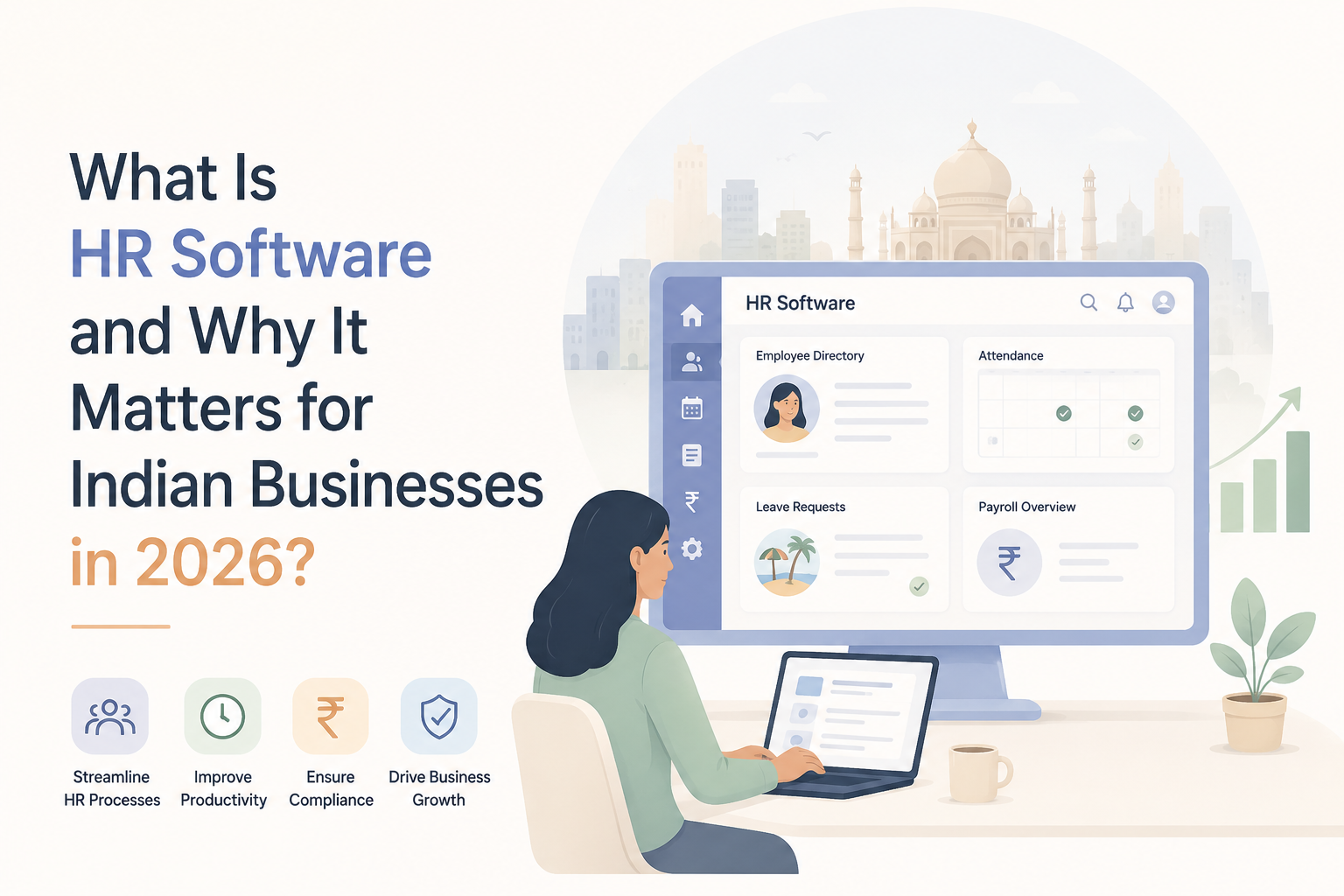
At its core, HR software is any digital platform that centralises the tasks a human resources team would otherwise handle through spreadsheets, paper files, and email threads. It typically covers the full employee lifecycle, from the day someone applies for a job to the day they exit the organisation.
HR software (also called HRMS or HRIS depending on scope) is a system that stores employee data, automates repetitive HR processes, and gives managers and employees a single point of access for HR-related tasks.
Its purpose is simple: replace manual, error-prone HR work with automated, auditable, and scalable workflows, so HR teams can spend less time on paperwork and more time on people strategy, culture, and retention.
HR software has evolved from basic payroll calculators and personnel databases in the 1990s, to cloud-based HRMS platforms in the 2010s, to today's AI-enabled systems that can predict attrition, screen resumes, and answer employee queries through chatbots. India's HR technology market reflects this shift clearly: the sector was valued at roughly USD 1.2 billion in 2025 and is projected to keep growing through the rest of the decade as more businesses move off spreadsheets and legacy tools (Source: IMARC Group, https://www.imarcgroup.com/india-human-resource-technology-market).
Modern HR software works by connecting several modules into one system, so data entered once (like an employee's joining date or salary structure) flows automatically into payroll, attendance, leave, and reporting, without needing to be re-entered.
Employee Database
Centralised employee records: All personal, employment, and compensation details live in one searchable system instead of scattered files.
Digital documentation: Offer letters, ID proofs, contracts, and policy acknowledgements are stored and retrieved digitally, which also helps during audits.
Attendance Tracking
Biometric integrations: Fingerprint or facial recognition devices sync attendance directly into the system.
Mobile attendance: Employees can check in and out from a mobile app, useful for hybrid and field teams.
GPS attendance: Location-tagged check-ins help verify attendance for remote, sales, or on-site staff.
Payroll Processing
Salary calculation: Automatically computes gross pay, deductions, and net pay based on attendance and leave data.
Tax deductions: Applies TDS and other statutory deductions without manual calculation.
Statutory compliance: Keeps payroll aligned with EPF, ESIC, and Professional Tax rules as they change.
Leave Management
Automated approvals: Leave requests route to the right manager and get approved or rejected digitally.
Leave balance tracking: Employees and HR always see real-time, accurate leave balances.
Employee Self-Service
While features vary by vendor, most HR platforms are built around five core components that together cover the full employee journey.
HRIS (Human Resource Information System)
Purpose: Acts as the central repository of employee data.
Functions: Stores personal details, job history, documents, and organisational structure.
Benefits: Eliminates duplicate data entry and gives every other module a single source of truth.
Payroll Management
Salary processing: Automates monthly pay runs, bonuses, and reimbursements.
Tax compliance: Keeps TDS, PF, and ESIC calculations current with the latest rules.
Recruitment Management
ATS (Applicant Tracking System): Manages job postings and incoming applications in one pipeline.
Candidate tracking: Shows where each candidate stands in the hiring funnel.
Interview workflows: Schedules interviews and collects structured feedback from panels.
Performance Management
Goal setting: Lets managers and employees define and track measurable objectives.
Appraisals: Structures periodic review cycles with consistent rating criteria.
Feedback: Supports continuous, 360-degree feedback rather than a once-a-year review.
Workforce Analytics
Beyond the core components, most modern platforms in 2026 also offer the following features, which are increasingly considered standard rather than optional:
India's workforce, regulatory environment, and employee expectations have all shifted enough in the last two years that HR software has moved from a nice-to-have to an operational necessity.
Increasing Workforce Complexity
Remote teams, hybrid work schedules, and multi-location operations mean HR can no longer rely on manual coordination. A single dashboard that shows attendance, leave, and payroll across every location has become essential for consistent people management.
Labour Law Compliance
India's four Labour Codes — the Code on Wages, the Industrial Relations Code, the Code on Social Security, and the Occupational Safety, Health and Working Conditions Code — became effective on 21 November 2025, and the Central Government notified the final central rules on 8 May 2026
(Source: DLA Piper, https://knowledge.dlapiper.com/dlapiperknowledge/globalemploymentlatestdevelopments/2026/Key-considerations-of-the-notified-Central-Rules-under-Indias-Labour-Codes).
Because states must also notify their own rules, compliance requirements now vary by state and continue to change throughout the year. On top of this, businesses must still track EPF, ESIC, Professional Tax, and TDS on an ongoing basis. HR software with built-in statutory modules helps businesses stay current without relying on manual tracking of every notification.
Rising Employee Expectations
Employees increasingly expect the same convenience from HR that they get from consumer apps: mobile access to payslips and leave balances, self-service for routine requests, and fast responses instead of email back-and-forth.
Talent Competition
With competition for skilled talent remaining high across IT, manufacturing, and services, retention now depends heavily on employee experience, transparent career development paths, and how efficiently HR resolves day-to-day requests.
Data-Driven Decisions
Workforce analytics and predictive insights let CHROs and CXOs move from reactive HR to proactive workforce planning, spotting attrition risk or skill gaps before they become a problem.
The table below summarises the most commonly cited benefits of adopting HR software and the business impact each one drives.
|
Benefit |
Business Impact |
|
Automation |
Saves time by removing repetitive manual tasks |
|
Compliance |
Reduces the risk of statutory penalties and fines |
|
Accuracy |
Fewer payroll and data-entry errors |
|
Analytics |
Enables better, faster workforce decisions |
|
Employee Experience |
Higher satisfaction through self-service and transparency |
|
Scalability |
Supports business growth without proportional HR headcount increase |
These three terms are often used interchangeably, but they differ in scope. HR software is the broadest category, HRIS focuses primarily on data and records, and HRMS extends into full workforce management, including payroll and performance.
|
Feature |
HR Software |
HRIS |
HRMS |
|
Employee Records |
✓ |
✓ |
✓ |
|
Payroll |
✓ |
Limited |
✓ |
|
Recruitment |
✓ |
Limited |
✓ |
|
Performance |
✓ |
Limited |
✓ |
|
Analytics |
✓ |
Basic |
Advanced |
While every business benefits from HR automation, the specific pain points and the software modules that solve them vary significantly by industry.
IT & Software
Common challenges: high attrition, distributed teams, project-based staffing. Relevant modules: performance management, timesheets, workforce analytics.
Manufacturing
Common challenges: shift-based attendance, blue-collar compliance, contractor management. Relevant modules: biometric attendance, statutory compliance, payroll.
Healthcare
Common challenges: round-the-clock shift scheduling, credential tracking, high staff turnover. Relevant modules: shift management, leave management, employee database.
Retail
Common challenges: seasonal hiring, multi-location staff, high-volume onboarding. Relevant modules: recruitment tracking, onboarding, mobile attendance.
BFSI
Common challenges: strict regulatory compliance, background verification, audit trails—relevant modules: compliance documentation, audit-ready reporting, HRIS.
Logistics
Common challenges: field staff spread across locations, GPS-based attendance needs. Relevant modules: GPS attendance, mobile self-service, payroll automation.
Education
Common challenges: academic-year staffing cycles, faculty appraisal, leave tracking. Relevant modules: performance reviews, leave management, employee database.
Hospitality
Common challenges: high seasonal turnover, shift-based payroll, multi-property operations. Relevant modules: attendance management, payroll automation, recruitment tracking.
AI is no longer an experimental add-on in HR software; it is being used for everyday tasks across recruitment, employee support, and workforce planning.
AI Recruitment
AI now handles resume screening and candidate matching at scale. Research from Talent Board and Phenom found that AI-powered screening tools can cut the time spent reviewing resumes by up to 75% (Source: MSH, https://www.talentmsh.com/insights/ai-in-recruitment). Separately, SHRM data shows close to 9 in 10 HR professionals say AI saves time or increases overall efficiency in their day-to-day work (Source: SQ Magazine, https://sqmagazine.co.uk/ai-recruitment-statistics/).
AI Chatbots
Chatbots now handle a large share of routine employee queries, such as leave balances, payslip requests, or policy questions, freeing up HR teams for higher-value work like employee support and helpdesk escalations.
Predictive Analytics
Predictive models flag employees at higher risk of leaving and help HR and business leaders plan workforce needs months in advance rather than reacting after resignations come in.
Performance Insights
AI-assisted goal tracking and productivity analysis give managers real-time visibility into how teams are performing against targets, instead of relying solely on an annual review.
Personalised Employee Experience
Learning recommendations and career pathway suggestions are increasingly personalised to each employee's role, skills, and performance history, making career growth feel more individualised.
Compliance is one of the biggest reasons Indian businesses adopt HR software, given how many statutory obligations run in parallel every payroll cycle.
EPF Management
HR software automates Employees' Provident Fund contributions, deductions, and filings, reducing the manual effort of tracking employee and employer contributions.
ESIC Compliance
Employee State Insurance contributions are calculated and tracked automatically for eligible employees, based on current wage thresholds.
Professional Tax
Since Professional Tax slabs vary by state, HR software applies the correct deduction automatically based on the employee's work location.
TDS Calculations
Tax Deducted at Source is computed on salary components each cycle, reducing the risk of under- or over-deduction.
Labour Law Documentation
With India's four Labour Codes now in force and central rules notified on 8 May 2026, appointment letters, wage structures, and grievance redressal records need to be properly documented and readily accessible
Audit Readiness
Because state-level rules under the Labour Codes are still rolling out through 2026, businesses that keep digitised, timestamped compliance records are far better positioned during inspections than those relying on physical files.
Businesses that continue to run HR manually or on spreadsheets tend to run into the same set of recurring problems.
Manual Payroll Errors
Traditional, non-automated payroll processes can carry error rates approaching 20%, according to research from EY
Compliance Risks
Manually tracking EPF, ESIC, Professional Tax, TDS, and now the Labour Codes across multiple states significantly raises the chance of missed deadlines or incorrect filings.
Data Silos
When attendance, payroll, and employee records live in separate spreadsheets or tools, HR ends up reconciling data manually every cycle, which is slow and error-prone.
Employee Dissatisfaction
Delayed payslips, slow leave approvals, and repeated manual follow-ups directly hurt the employee experience and, over time, retention.
Administrative Overload
Without automation, HR teams spend a disproportionate share of their time on repetitive administrative tasks instead of strategic work like culture building or workforce planning.
Poor Reporting
Manual systems make it difficult to generate accurate, real-time reports for leadership, which slows down decisions that depend on workforce data.
With dozens of HR platforms available in India, the right choice depends on a structured evaluation across the following factors.
Business Size
Required Features
List out must-have modules (payroll, attendance, recruitment, performance) versus nice-to-have ones, so you don't overpay for capabilities you won't use.
Compliance Capabilities
Confirm the platform is updated for India's four Labour Codes, EPF, ESIC, Professional Tax, and TDS, and that it pushes regulatory updates automatically.
Integration Options
Check whether the software integrates with your existing accounting, biometric, or collaboration tools to avoid duplicate data entry.
Security Standards
Since HR platforms store sensitive personal and financial data, verify data encryption, access controls, and hosting standards before committing.
Scalability
Choose a platform that can comfortably support your headcount two to three years from now, not just your current team size.
Customer Support
Responsive implementation and support teams matter especially during payroll cycles or compliance deadlines, when delays are costly.
A typical HR software rollout follows seven broad steps, regardless of company size.
Measuring the return on an HR software investment comes down to comparing cost savings against the total cost of the platform.
Cost Savings
HR hours saved from automating repetitive administrative tasks.
Payroll automation reducing correction and reprocessing costs.
Compliance automation reducing the risk of statutory penalties.
ROI Formula
ROI = (Net Benefit ÷ Total Cost) × 100
Example Scenario
If a business saves roughly ₹6,00,000 a year in HR hours, payroll corrections, and compliance risk after spending ₹1,50,000 annually on HR software, the net benefit is ₹4,50,000. Applying the formula: (₹4,50,000 ÷ ₹1,50,000) × 100 = 300% ROI. Actual figures will vary by company size, current manual overhead, and how many modules are adopted, but this framework gives HR and finance leaders a simple way to build a business case.
HR software delivers different values depending on company stage. Here is how the impact typically plays out.
Startup
Before: HR runs entirely on spreadsheets and WhatsApp groups, with founders personally approving leave. After: a lightweight HRMS automates onboarding, attendance, and payroll, freeing founders to focus on the business instead of HR admin.
Mid-Sized Company
Before: fragmented tools for payroll, attendance, and recruitment that don't talk to each other, causing duplicate data entry. After: one integrated platform gives HR a single source of truth and cuts manual reconciliation significantly.
Enterprise
Before: multiple regional offices each following slightly different compliance and payroll processes, making audits slow and inconsistent. After: a centralised HRMS standardises compliance and reporting across every location, while still allowing state-specific configurations.
MAC Group Ltd, a diversified holding company with interests spanning manufacturing, banking, agriculture, and real estate, moved its HR operations onto uKnowva HRMS to replace manual, disconnected processes.
After implementation, MAC Group reported up to 8x faster leave and attendance management, deeper visibility into employee sentiment, and a notably more engaged workforce through uKnowva's collaborative social intranet features (Source:https://uknowva.com/casestudies/digital-hr-real-results-the-mac-group-s-uknowva-story)
This mirrors the broader pattern seen across mid-sized and enterprise businesses: consolidating HR functions into one platform doesn't just save time; it materially improves the speed and quality of people's decisions.
Looking beyond 2026, a few trends are likely to shape how Indian businesses use HR technology over the next few years.
HR software has moved from a back-office convenience to a strategic necessity for Indian businesses in 2026, driven by the rollout of the new Labour Codes, rising employee expectations, and the growing role of AI in everyday HR work.
Whether you're a startup automating your first payroll cycle or an enterprise standardising compliance across states, choosing the right HR software and implementing it well is one of the highest-leverage decisions an HR or business leader can make this year.
1. What is HR software?
HR software is a digital platform that helps organizations manage employee-related processes such as payroll, attendance, recruitment, performance, and compliance.
2. What is the difference between HR software and HRMS?
HRMS is a comprehensive type of HR software that integrates multiple HR functions into one platform.
3. Is HR software suitable for small businesses?
Yes. Small businesses can use HR software to automate administrative tasks and improve operational efficiency.
4. How does HR software improve productivity?
It reduces manual work by automating routine tasks such as attendance tracking, payroll processing, and leave management.
5. Can HR software help with compliance?
Yes. HR software helps maintain accurate records and supports compliance with labor and payroll regulations.
6. What are the main modules of HR software?
Common modules include payroll, attendance, recruitment, onboarding, performance management, employee engagement, and analytics.
7. Is cloud-based HR software secure?
Most modern HR platforms use advanced security measures, encryption, and access controls to protect employee data.
8. Why is employee self-service important?
It empowers employees to manage routine HR tasks independently, improving efficiency and employee satisfaction.
9. How does HR software support hybrid work?
It enables remote access to HR services, attendance tracking, communication, and performance management from any location.
10. Why choose uKnowva HRMS?
uKnowva HRMS combines HR automation, payroll, recruitment, engagement, analytics, and compliance management into a unified platform designed for modern Indian businesses.