








 Aditi Sharma
Table of Content
You're not the only one who's been dealing with HR tech overload over the past five years. Most executive teams have been adding the parts of an ATS, payroll, engagement, LMS and “that one legacy system nobody wants to work with but finance does.”
We have tried to work within the tools. We don't really understand how these tools communicate with each other and it's not crazy. That's where HR technology starts to get interesting with the help of MCP. No, not as another pretty acronym. As infrastructure.
Imagine a Multimodal Communication Protocol (MCP) that is an open standard for systems to share capabilities and data with AI agents and other systems. It's not only a spec on GitHub anymore as it was born at Anthropic and then picked up by OpenAI, Google, Microsoft and more.
In 2026, there will be authentic vendors delivering authentic products on top of it. Which changes the strategic discussion for HR and EX leaders.
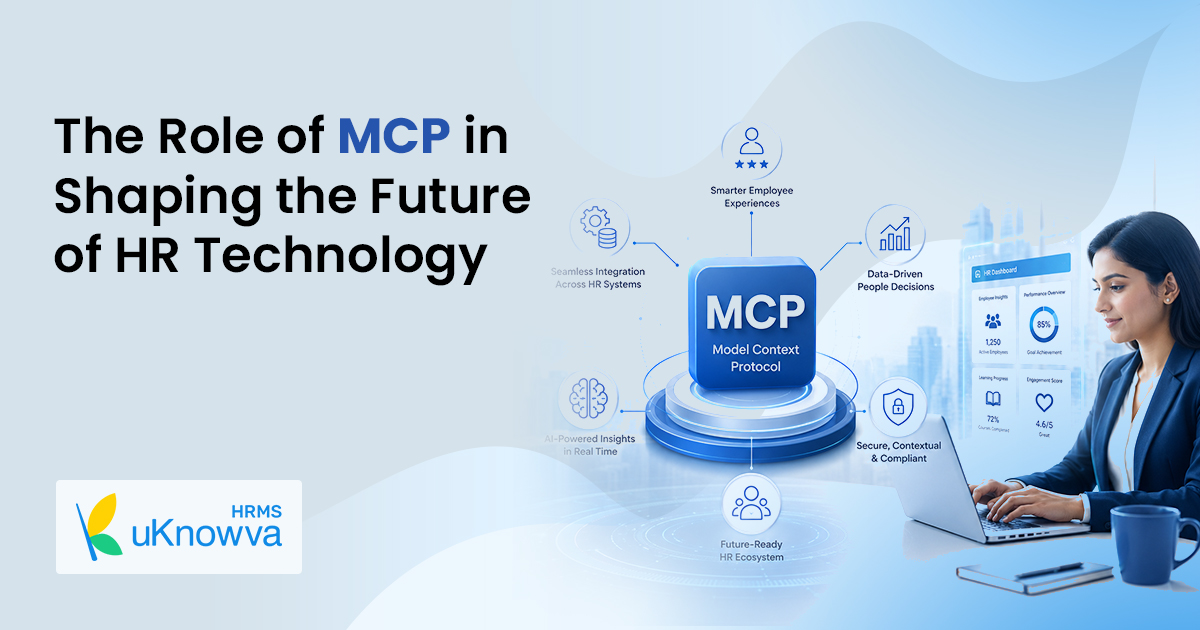
Think of MCP as the common connection layer for HR technology: instead of managing a different integration approach for every system, HR teams can work toward one shared model for connecting AI agents, workflows, and applications.
Taking an analogy from hardware. Familiar with the old times that each device had to have its own cable? All sorts of printers, phones, cameras, and more, with slightly different connectors. The IT closets were filled with all kinds of black snakes.
Then USB-C introduced a more consistent connection model, allowing one port to support multiple devices and use cases. MCP aims to bring a similar simplicity to how HR systems, AI agents, workflows, and applications interact.
With MCP, the shared language is the AI agents, workflows, and other apps will “talk” to each other through it. Instead of each HR system having its own language for AI agents, workflows, or other apps to “talk”, MCP provides a shared language.
Multiple vendors with the same interface style. So there's no need for 20 custom integrations in your workspace; an HR copilot inside your workspace can orchestrate through the MCP endpoints.
The acuteness of this statement: standards do not only cut down the integration prices, however they alter that who can be involved. If the “port” is universal, then lesser tools with focused capabilities can integrate into enterprise processes without a six month effort. This is a totally different business model than today's “buy the suite or suffer the swivel chair.”
This can be seen in the market now and will continue to align by 2026. Workable has started a native MCP server. Simple business impact: any MCP aware agent (Anthropic, OpenAI or your own stack) can find and utilize Workable's without plumbing. Looking for a background check automation tool that filters applicants in Workable, compares comp bands and initiates background checks? That's not three times you can wire that together.
On the enterprise side, Workday launched its Agent Gateway. Inside, it's based on the MCP concepts, which enable agents outside of Workday to interact with data and workflows in a safe way. That could translate to your AI “HR assistant” being able to:
This will retrieve an organization structure from Workday.
It's all through a controlled and rationalized interface, rather than fragile APIs that fail on the flapping of every sneezing data model.
The difference though was the focus of legacy HR integrations: Data sync (“copy records from System A to System B overnight”). MCP-style integrations are all about capability orchestration – “ask System A to do X now, then provide the output to System B”. This is what sets MCP apart from all other HR technology integration buzzwords—that it's about orchestrating actions rather than syncing data. It's a change in operating model.
If the architecture diagrams don't matter, why should it matter to a CHRO or COO? If it is successful in taking hold, then if MCP is successful, it solves three chronic problems:
At this time, workers and managers work with 8–12 tools. Each with unique UX, logins and notification style.
MCP can act as a common connectivity layer that brings capabilities from different HR systems into a more unified conversational or workflow experience.
Teams, Slack, your HR portal, without having to rewrite them all.
Trying a new HR solution is painful these days. Integration cost is not only financial, it's in political terms as well.
A common protocol can make HR technology more composable, allowing organisations to evaluate specialist solutions without rebuilding their entire integration architecture each time.
You can test a point solution, plug it into your agent system and see if it has an impact, quickly keep or kill it.
Confusingly, open standards can be more secure. In HR technology, the scope of what an agent can do is clear, it's limited, tools, these fields, these actions. Much easier to audit than a myriad of custom integrations and shadow scripts.
The strategic explanation: MCP doesn't work because it is “better tech,” it works because of incentives. The vendors want to be easily adopted. Businesses desire composability, but not chaos.
The agents require well defined and well defined interfaces. MCP provides a sufficient amount to both parties to win the game without losing control.
So, let's discuss uKnowva HRMS. The truthful answer is that they aren't going to say “full MCP support” until they've verified that all of the boxes have been ticked and that they've knocked the thing over twice in staging. Over-claiming is in bad taste to executives a mile away.
However, this is the type of change that uKnowva was designed to capitalize on. uKnowva is a platform that already covers the core HR, workflows, and engagement and is located in the middle of the employee experience.
Think of uKnowva as a potential central layer where core HR data, workflows, employee experiences, and AI capabilities can come together as MCP-driven ecosystems evolve.
This is a lever, or a leverage point. With caution added to the word if, if uKnowva gets into the HR technology game early, three things become possible:
uKnowva could position itself as a connected participant in MCP ecosystems, opening itself to outside agents while also consuming MCP endpoints from partners.
Can open itself up to outside agents and ingest MCP endpoints from partners. Don't think about syncing data with Workable or Workday Agent Gateway, think about orchestrating actions in them.
For organisations exploring AI-led HR workflows, uKnowva AI Agents already provides capabilities across areas such as recruitment, AI-powered imports, employee assistance, insights, reimbursements, and performance-related workflows.
uKnowva could serve as an environment where HR teams experiment with specialised AI-powered tools and HR capabilities without treating every new capability as a completely separate technology project.
HR teams might experiment with a new type of microtool: a specialist learning coach or a niche well-being app, for instance, and show it as part of uKnowva without having to integrate it over many months.
Rather than simply adding MCP compatibility, uKnowva could help demonstrate what an MCP-aware HR platform can look like in practice.
Not only is it's “we integrate with MCP”, but “here's what a truly MCP-aware HR platform should look like.”
uKnowva's broader HR platform already brings together Core HR, payroll, recruitment and onboarding, performance management, employee collaboration, projects and timesheets, and e-learning capabilities.
Its AI layer also includes conversational and workflow-oriented capabilities such as AI Genie, AI Chatbot, CV Parser, CV Matchmaker and other AI agents.
If you're on the hook for HR technology change over the next 24-36 months, think of it more as a design constraint than as a purchase.
Instead of viewing MCP only as another technology purchase, treat it as an architectural principle that can influence how your HR technology ecosystem is designed over the next 24–36 months.
Concretely:
For example, uKnowva already supports automated recruitment and onboarding workflows, including AI-based job requisitions, candidate sourcing, interview scheduling, applicant tracking, offer management, and preboarding-to-onboarding.
Similarly, its performance management capabilities include 360-degree reviews, AI-generated KRAs, OKRs, self and manager evaluations, scorecards, succession planning, and interactive dashboards. Explore uKnowva Performance Management
After that keep being curious.
So, perhaps, just perhaps, this is one of those subtle moments when the whole thing is "this is" or "that is" noticed only with the benefit of hindsight, when HR technology went from a collection of tools to a truly integrated system.
MCP could represent a shift from individually connected HR applications toward a more consistent technology ecosystem where systems, agents, workflows, and people can interact through shared standards.
Truthfully, I doubt anyone has the entire playbook at this point. However, it is those who begin at this time with eyes open and expectations grounded who will get to write it.
MCP has the potential to change how HR leaders think about technology not simply as a collection of applications that need to be integrated, but as an ecosystem where capabilities can be orchestrated more intelligently.
For CHROs, COOs, and HR technology leaders, the opportunity is bigger than reducing integration complexity. It is about creating smoother employee experiences, reducing innovation bottlenecks, improving governance, and giving AI agents a more structured way to interact with HR systems and workflows.
uKnowva is well positioned within this conversation because its platform already brings together core HR, workflows, employee experience, AI capabilities, and automation. Its evolving AI ecosystem, including AI Agents and the MCP-powered UVA conversational AI assistant, reflects the broader direction toward more natural, action-oriented HR technology. Read about UVA and uKnowva's MCP-powered AI direction
The future of HR technology may not be about having fewer tools. It may be about making the tools work together more intelligently. And MCP could be one of the standards that helps make that shift possible.