









 Play the audio of the blog
 Pause
Continue
Stop
Every organisation has employees who consistently deliver. But not every strong performer is a future leader. That distinction is one of the most difficult decisions a CHRO has to make.
A high performer may be excellent at their current role. A future leader needs something more: the ability to learn, adapt, influence others, make decisions with incomplete information and take responsibility beyond their job description.
Traditionally, organisations have identified such employees through manager nominations, annual performance reviews, assessment centres and informal leadership discussions.
These methods still have value. But they also have limitations. Managers can have blind spots. Highly visible employees may receive more attention. Quiet contributors can be overlooked. And a once-a-year review may not capture how someone actually behaves over time. This is where AI can change the process.
Not by deciding who should become a leader, but by helping CHROs see patterns that are difficult to identify manually. Start by defining what "high potential" actually means: The first mistake organisations make is treating high performance and high potential as the same thing.
They are not.
AI can only be useful if the organisation first defines what it is looking for.
For example, a company may define leadership potential through five practical signals:
The exact criteria will differ by organisation.
The important point is that AI should analyse clearly defined leadership expectations, not a vague idea of what a "future leader" looks like.
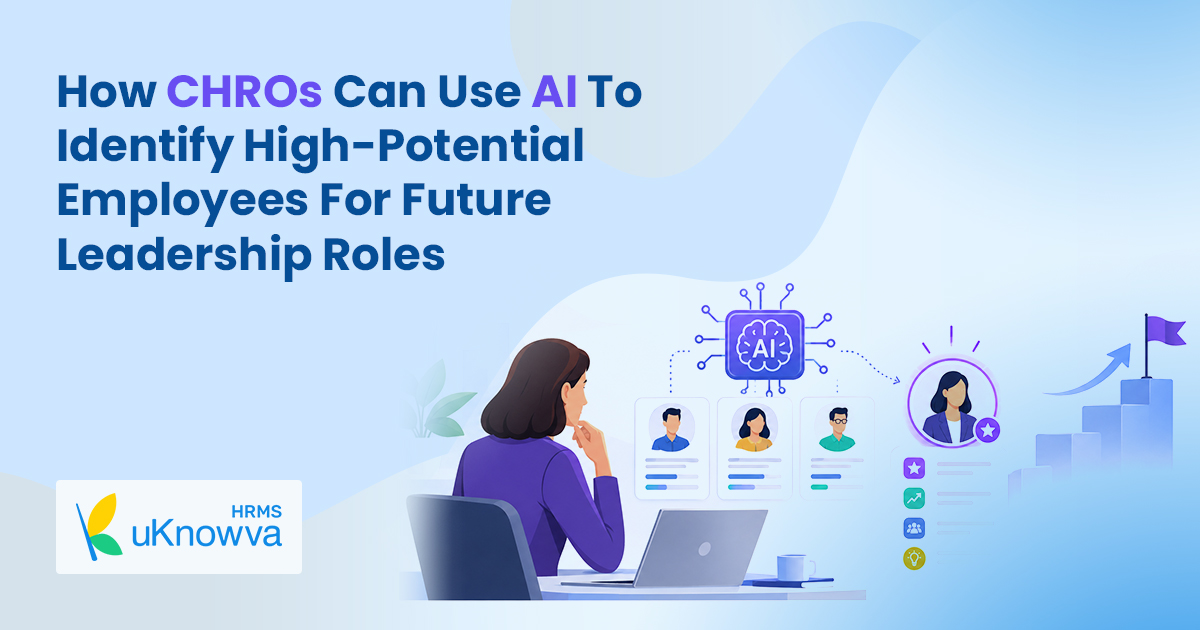
Imagine an employee who receives a good performance rating every year.
That tells us something, but not everything.
What if the same employee has also volunteered for difficult projects, learned new skills without being asked, helped colleagues solve problems and successfully handled responsibilities outside their formal role?
Those signals may be scattered across different systems.
AI can bring them together.
Performance history, learning activity, project participation, internal mobility, skills acquired, recognition, feedback and career progression can provide a richer picture of an employee's development.
The goal is not to create a complicated score. It is to identify patterns. For example: "This employee has consistently taken on broader responsibilities over the last three years and has demonstrated strong learning agility."
That is a much more useful leadership conversation than simply saying: "Their performance rating is 4.5."
Leadership pipelines often suffer from a visibility problem.
Employees who speak most in meetings, work closely with senior leaders, or have strong internal networks may naturally become more visible.
But leadership potential does not always announce itself.
There is an important difference between saying: "AI has identified you as a future leader."
and saying:
"Here are the capabilities you have demonstrated, and here are the areas that could prepare you for a larger role."
The result is a development plan based on observed evidence rather than generic training calendars.
Most organisations discuss succession when a senior position becomes vacant.
That is already late.
AI can help make succession planning an ongoing process.
For critical roles, HR teams can continuously examine the internal talent pool and ask:
This allows CHROs to think about leadership pipelines before vacancies become emergencies.
It also gives employees more opportunities to prepare for future roles.
There is a serious risk if organisations treat an AI-generated recommendation as a verdict.
Leadership potential is difficult to measure completely through historical data.
Someone may have limited opportunities because of their role. Another employee may have changed significantly in the last six months. A manager's feedback may contain bias. Some leadership qualities only become visible when someone faces a genuinely difficult situation.
Therefore, AI should support the decision, not make it.
The final assessment should involve managers, HR and, where appropriate, structured leadership assessments and conversations with the employee.
AI provides the evidence.
People provide the judgment.
The biggest opportunity is not building another talent dashboard. It is changing how organisations think about leadership development.
Instead of asking once a year, "Who are our high-potential employees?",
CHROs can continuously ask: "Who is demonstrating the behaviours and capabilities that our future leaders will need and what experience can we give them next?"
That turns succession planning from a periodic HR exercise into an ongoing organisational capability.
The future leader may not always be the person with the highest current rating.
They may be the person who learns fastest, takes ownership when things become difficult, helps others succeed and keeps expanding the scope of what they can handle.
AI can help organisations notice those signals earlier. But the real advantage will come from what happens next: giving those people the opportunity, experience and responsibility to prove what they can become.
AI can help identify potential. Organisations still have to create the opportunity for that potential to become leadership.