









 Play the audio of the blog
 Pause
Continue
Stop
I was talking to an experienced CHRO from one of the world's largest investment banks, and she stopped and looked me right in the eye, and said, “Our people are fascinated with AI, but they're also concerned that it's a countdown timer on them being relevant.”
That's a paradox all CHROs face today. The task is straightforward: create an AI‑ready workforce. The other side of the coin, however, is also of great concern: don't build an AI‑anxious culture.
I was at a forum a few weeks later, surrounded by top industry leaders and entrepreneurs, discussing the implications of AI. The dialogue started as expected; questions about the loss of jobs, ethics, and the possibility of jobs being replaced by machines.
However, the tone changed when we began talking about the facts, real-life examples, and moving beyond the story. All of a sudden, that culture is possible—if we're not seduced into its use everywhere for no reason._BADBREAKS is a balance of humans and artificial intelligence that embraces it, adapts to it and isn't seduced into it.
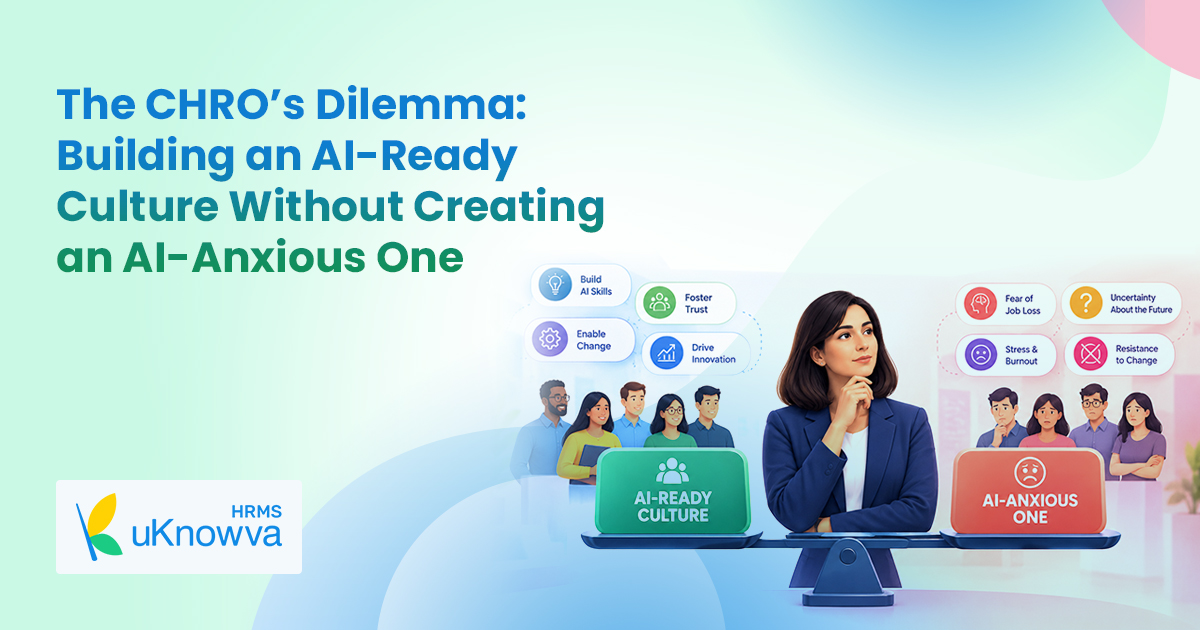
The fear of AI is not just about technology, it's about uncertainty.
Financial teams hear about AI joining in on the reconciliations and ask themselves, "Will my job be reduced?Finance teams hear about AI joining in on the reconciliations and ask themselves, "Will my job be reduced?
Customer service managers see the use of Chatbots and dread being pushed aside.
Gen Z analysts are eager to try out new things, but are hindered when leaders see AI as a compliance risk and not an innovation tool.
AI anxiety is not the concern with machines, it's the fear of uncertainty.
These are not fears of AI itself, but fears of communication not being clear, role clarity, and a lack of reassurance.
The CHRO’s toolkit is not just about technology adoption; it’s about cultural stewardship. Four levers matter most:
| Lever | Build Readiness | Reduce Anxiety |
| Capability Building | Upskill employees in AI literacy, data fluency | Reinforce irreplaceable human judgment |
| Communication | Share AI vision and roadmap | Address fears openly, emphasize augmentation |
| Culture | Encourage experimentation | Create psychological safety and inclusion |
| Leadership Modeling | Leaders use AI visibly | Leaders share learning journeys, normalize mistakes |
One bank's finance analysts were concerned that AI forecasting would take over their jobs. The workshops helped people understand how their expertise was enhanced by AI, which reduced anxiety.
In the case of Customer Service, a CHRO used the chatbots as “first-line triage” to shift the focus onto more complex cases. Human empathy was the difference in recognition programs.
Gen Z Example: A company set up “AI Labs” for developing younger staff to test tools and share their results with management. This connected generations and took the place of anxiety with excitement.
These narratives tell us that there's no need to feel anxious, it can be recorded as empowerment. “Our people didn't ask ‘Will AI take my job away from me?’, but they now asked, ‘How can AI help me do my job better??””
The question isn't so much about the "how" of embedding AI, but the "why. It is important for leaders to first be asking themselves the question: why do I need to integrate this into my practice? This way of thinking will prevent blind adoption and ensure that AI is being used for something and not the hype.
As I said in the forum of leaders and entrepreneurs, “We need to have a mindset of asking 'why' before using AI, it should be used when it serves a purpose rather than being trendy.”
Whether you're a business owner, individual, or parent, these five strategies can help minimize anxiety and use AI to your advantage.
Decode AI: Conduct brief, targeted literacy sessions with hands-on examples of how AI can be applied.
Establish Safe Spaces: Conduct “Ask Me Anything” sessions where staff can talk about concerns without judgment.
Design roles together: Don't impose changes from the top, engage employees in a design process that involves them in the discovery of new roles for AI.
Human Value: It is a celebration of contributions where empathy, creativity, and judgment have triumphed alongside AI.
Model Curiosity: Ask leaders to discuss their own experiences with learning AI, so that people understand that they don't need to be perfect, they just need to explore.
Adopting a mindset shift a leader's key challenge is to "be purpose before adoption.
Below is a list of questions a leader can use to help them build an AI‑Ready, Anxiety Avoiding Culture.
Introduce AI literacy initiatives specifically designed for different roles. Start role-specific AI literacy initiatives.
By carefully balancing readiness with reassurance, staff members will see AI as a tool for growth and not a threat to being relevant. The CHRO's job is to make sure that the implementation of AI enhances the capability of the organization and the confidence of the humans.
That is how productive your team believes AI will be: a partner, not a competitor, the investment bank CHRO I spoke to later with me said.
That's the challenge for the CHRO, not only to create an AI ready culture, but to have a confident, resilient, human-centric culture.
Gaining an AI ready culture is not an issue of technology but about preparing folks to work with confidence when using the technology. Balancing innovation with empathy is a key challenge for CHROs, as they need to ensure that their employees understand the potential benefits of AI while also ensuring that they remain valuable.
By communicating clearly, learning continually, rethinking jobs collaboratively, and adopting responsibly, organisations can seize the opportunity of uncertainty.
By leveraging uKnowva HRMS, companies can enhance their HR processes and foster a more cohesive and future-proof workforce. But it will take more than the intelligent use of technology for organisations to succeed in the AI transformation, it will also require the confidence of their people to engage with technology.