Table of Content
The emergence of Fractional CHROs is an indication of a paradigm change in the manner in which an organization gains access to senior HR leadership. Firms in the present day desire strategy with no overheads, governance with no bureaucracy and deliverables with no delays. It will not be possible to meet these expectations in 2026 without a planned HR technology stack.
To Fractional CHROs, technology is not a support plane, it is the operating system that allows scale, speed, and strategic influence of a multiple organization.
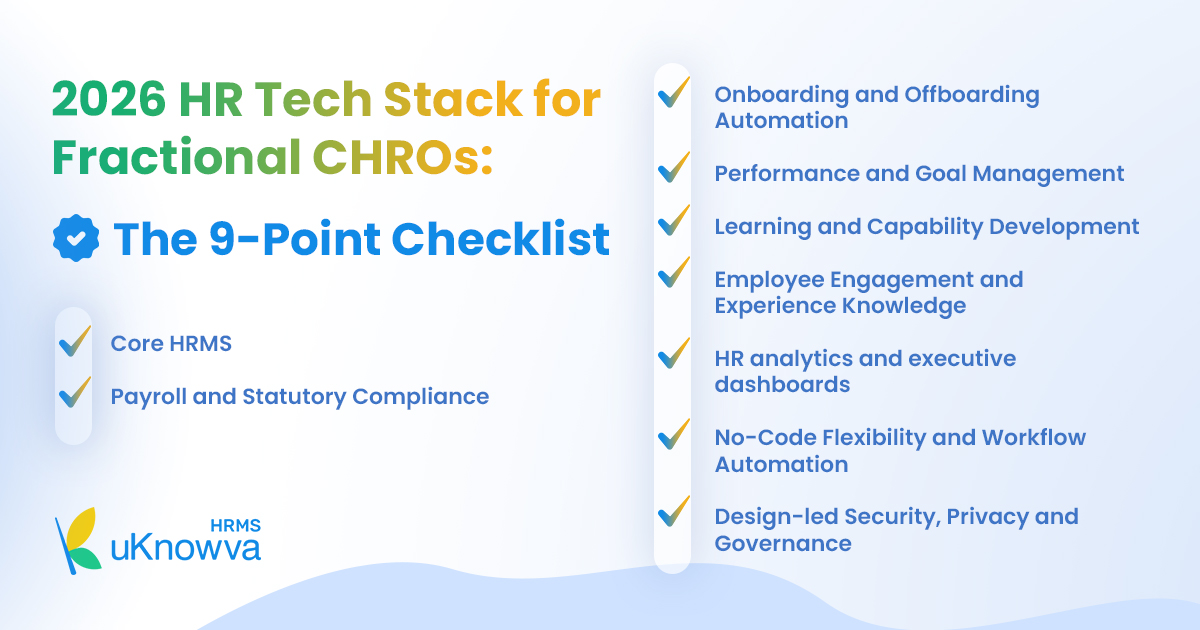
In this blog, the 9 point HR tech stack checklist aimed specifically at Fractional CHROs working in complex and high-paced business settings is disaggregated.
Fractional CHROs work within limits that full-time leaders hardly experience:
The HR leadership will be:
A contemporary HR technology ecosystem enables Fractional CHROs to normalize the governance but personalize performance to make sure that credibility and consistency is upheld even in different engagements.
The fractional HR model relies on a powerful HRMS. It should have the ability to centralize the data of employees and at the same time be dynamic to fit and form to the structure, policies and workflow of each client.
An HRMS which is future ready should support:
HRMS systems such as uKnowva HRMS in 2026 will be more than record-keeping systems: they are decision enablers and one system provides visibility, automation, and governance services.
Directly affecting the trust is payroll and compliance errors. Here, ambiguity and manual control are not allowed in fractional CHROs.
A successful payroll and compliance layer should:
In the year 2026, as the regulatory oversight becomes more intense, compliance automation is not about efficiency anymore, it is about risk prevention.
Fractional CHROs have to deal with high growth, restructuring, and attrition. The onboarding and offboarding processes should be uniform, safe, and expeditious.
The contemporary systems ought to coordinate:
No step will be overlooked because of automation- data, continuity, and employer brand are all taken care of.
In 2026, performance management will be regarding continuous alignment, rather than annual appraisals.
Systems required by fractional CHROs include:
This is making performance management a business accelerator, and not an administrative ritual.
Organizations are putting an increasing pressure on CHROs to facilitate the workforce in being ready to AI, automation, and new business models.
A contemporary learning ecology must:
Scalable learning platforms allow them to create value in the long term with short-term engagements, in the case of Fractional CHROs.
The data on engagement is now considered a strategic resource. The employee sentiment can be a better predictor of attrition than compensation in 2026.
The tools to be used should be able to facilitate:
In case with Fractional CHROs, engagement analytics provides early warning signals, which are not based on intuition.
The HR leaders must be able to report to the boards and the CEOs on insights, rather than anecdotes.
Advanced HR analytics must offer:
Dashboards also enable Fractional CHROs to make evidence-based decisions, which enhances their strategic credibility.
There are workflows peculiar to each organization. Rigid systems make the work slower in terms of fractional leadership and develop workarounds.
Flexibility will not be an option in 2026. Systems must offer:
Easy-to-configure workflows enable Fractional CHROs to change fast--not to wait on the IT or vendors.
Fractional CHROs deal with sensitive employee and organizational information among clients. Reputational risks are security failures.
The stack of the future should be able to guarantee:
By 2026, security will not be an IT-based problem--HR leadership will take care of it.
By using the appropriate HR technology, Fractional CHROs can:
The uKnowva HRMS is ideally fit to use with fractional models, as it is configurable, can be automated to a high degree, and has 4 levels of data security that an enterprise requires.
The future of HR leadership is agile, fractional and outcome-oriented. A Fractional CHRO will be successful in 2026 not only based on experience, but on how to maximize the experience with technology.
An effective HR tech stack will allow Fractional CHROs to:
After all, HR technology is not an auxiliary device anymore- it is the operational backbone of contemporary HR leadership. Those fractional CHROs who invest in the right stack will not simply follow change; they will be the leader.
Fractional CHROs require scalable, configurable systems that work across multiple organizations and maturity levels.
Yes. Modern HRMS platforms support multi-entity configurations with strong access controls.
Because business models, regulations, and work structures change rapidly, requiring adaptable systems.
It enables data-driven decisions, early risk detection, and board-level reporting.
AI enhances automation, insights, and decision support—making it increasingly essential.
Fragmented tools that lack integration, visibility, and compliance controls.
Through automation, self-service, and centralized workflows.
They combine flexibility, intelligence, compliance, and ease of use—ideal for fractional leadership models.