








 Aditi Sharma
Table of Content
When Anthropic released the Multi-Collaboration Protocol (MCP) in late 2024, most executives didn't notice. Another acronym, another framework. Then something unusual happened: within a few months, OpenAI, Google DeepMind, and Microsoft all adopted it.
In infrastructure terms, that kind of convergence almost never happens that fast unless something is quietly becoming "the thing everyone will build on," and in HR, that matters more than most leaders realize. Because if you're serious about AI in talent, workforce planning, or engagement, you're not just choosing tools anymore. You're choosing a backbone.
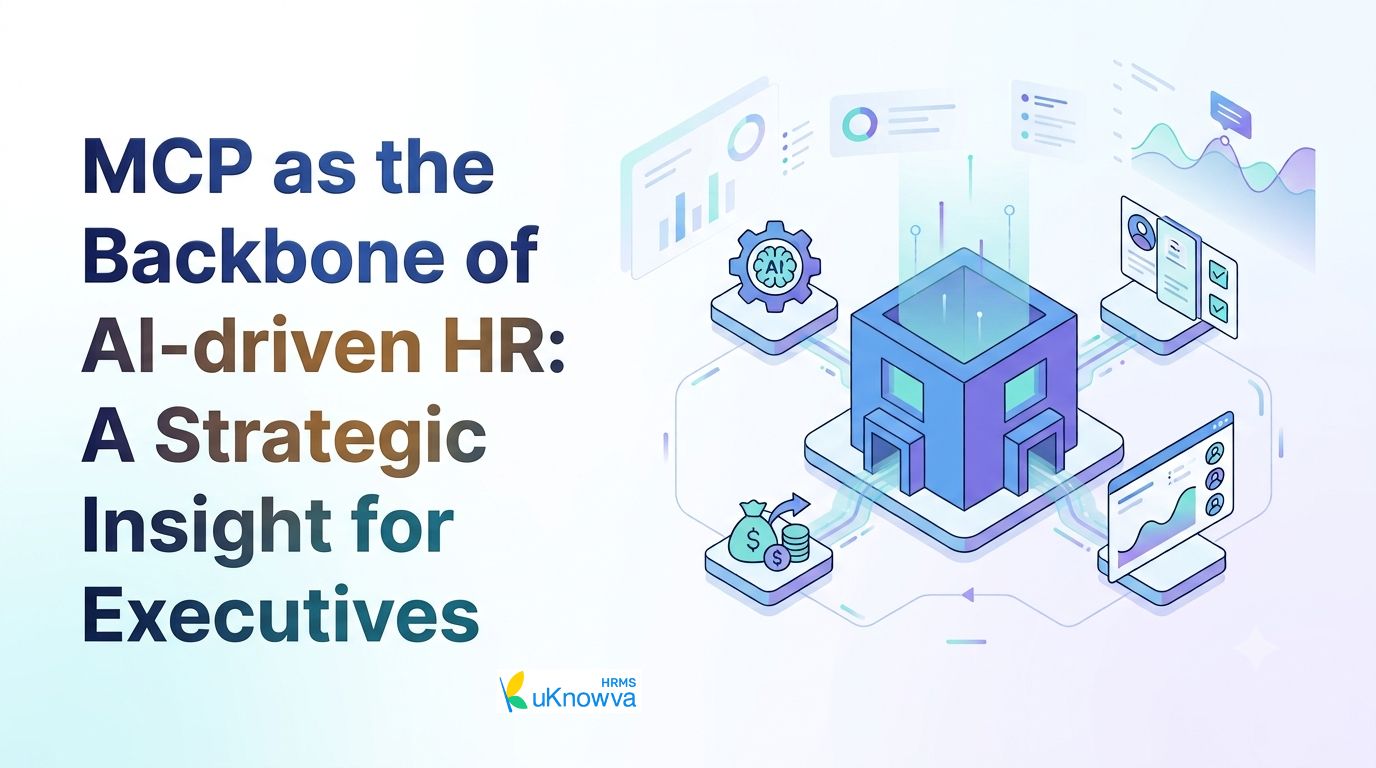
Let me skip the vendor slides and say it plainly: MCP is basically a shared protocol that lets different AI systems talk to each other cleanly, consistently, and securely. Instead of recruiting AI, learning AI, internal mobility AI, and employee listening AI each living on their own island, MCP gives them a common language. It’s not another monolithic platform. More like the TCP/IP of your AI stack, boring, invisible, and utterly decisive.
What made it take off so fast is not the theory, but the timing. HR has been drowning in "AI-lite" features that don’t talk to each other: a chatbot here, a recommendation engine there, an opaque "skills cloud" you can’t quite validate. The pressure from boards to "do something with AI" hasn’t helped. You get pilots, not progress.
MCP showed up as a way to stitch those islands together, and the major AI labs all backing the same protocol sent a very blunt signal: this isn’t just another integration layer. This is the default wiring.
Here's the sharp insight most people miss: the real advantage is not smarter models; it’s shared context. When your AI systems see the same version of reality, HR stops being a series of point fixes and starts behaving like one continuous system.
Let’s make this concrete. Today, most HR stacks look like a museum of good intentions. Best-of-breed tools bolted onto a 12-year-old core system. Some of them were brilliant, none of them coordinated. Watching TA leaders sit on three different "AI-powered" products that all claim to know who the best candidate is, and each one gives a different answer.
With MCP, those systems don’t just exchange files; they can share live signals and reasoning. That opens up a few non-obvious shifts:
Your sourcing engine, assessment platform, internal talent marketplace, and performance data can all plug into the same backbone. So instead of "this candidate looks good for this job," you get "this candidate is a 2-year succession risk mitigator for that critical role, here's why, here's the internal benchmark, and here's the ramp-time delta."
That changes the conversation with your CHRO and CFO from "we need to fill reqs" to "we’re hedging specific capability and continuity risks."
Most workforce plans are still PowerPoint-heavy bets wrapped in confidence. With MCP, your demand forecasts, learning data, external labor market feeds, and internal mobility models can all draw from the same protocol.
The result? You can ask questions like:
That means:
Let me draw a contrast because this is where some strategies quietly go off the rails.
Traditional HR tech thinking:
The assumption is: the system of record is the center of gravity.
The MCP mindset flips that:
Why this works better:
It respects reality. Your data is already scattered: ATS, LMS, VMS, engagement, payroll, collaboration tools. Forcing everything into one monolith has failed for 20 years. MCP doesn’t fight the fragmentation; it routes through it.
It preserves optionality. Because Anthropic, OpenAI, Google DeepMind, and Microsoft all lined up behind the same protocol, you get an unusual form of strategic freedom: you can switch models, add vendors, or test new AI capabilities without re-architecting the whole stack each time.
It aligns with how AI is actually evolving. Models are becoming more specialized and more contextual. The value isn’t "one giant brain"; it’s a mesh of brains that cooperate. A protocol-first architecture matches that reality. A suite-first mindset doesn’t.
Before this sounds too clean, the minute you let multiple AI systems coordinate over a backbone, you’ve just raised the stakes on governance, compliance, and trust.
On the upside, MCP makes it possible to centralize:
But that only happens if you design for it. If you don’t, you’ve essentially created an extremely efficient way for errors, biases, or policy breaches to propagate across your whole HR ecosystem.
I’ve seen this pattern in other domains: once the plumbing gets smarter, the blast radius of bad decisions grows. HR is not immune.
If you’re sitting in the C-suite wondering what to actually do with all this, here’s a simple, grown-up path that doesn’t require buying into hype:
Ask one pointed question: “Where in HR would a shared AI protocol create the most business leverage in the next 12-18 months?” Nine times out of ten, the answer lives in one of three places: critical talent pipelines, workforce planning, or frontline retention.
Run a backbone-first pilot, not a feature-first one. Instead of buying “an AI recruiting tool,” design a small use case that forces at least two or three systems to cooperate over MCP, for example, linking external candidate data, internal mobility options, and future skill needs for one strategic function.
Build governance into the architecture. Don’t bolt it on. Treat explainability, access control, and data minimization as core design constraints of your MCP backbone AI HR strategy. Your CHRO, CIO, and Chief Risk Officer should all be in that room early.
Decide what you’ll decommission. The hardest discipline for most organizations isn’t adopting something new; it’s letting go of the half-broken tools that made sense five years ago. A backbone forces clarity: if it doesn’t plug into the protocol or benefit from it, why are you keeping it?
In the end, this isn’t really a story about MCP as a piece of technology. It’s about whether HR remains a loose collection of digital workflows or becomes an intelligent system that can see, interpret, and respond to the human side of your business in real time. Maybe that’s the quiet shift we’re all circling around: HR moving from systems of record to systems of insight, and now, with the right backbone, systems of coordinated action.
Whether we’re ready for that is a different question. But the infrastructure is here.
Artificial intelligence is rapidly reshaping how organizations manage their workforce, but its true potential depends on access to accurate, secure, and contextual enterprise data. This is where the Model Context Protocol (MCP) becomes a strategic advantage.
Rather than acting as another AI tool, MCP serves as the backbone that enables AI to communicate with HR systems, business applications, and enterprise workflows in a standardized and secure manner.
Solutions like uKnowva HRMS are well-equipped to capitalize on this shift by combining comprehensive HR capabilities with AI-ready architecture. By embracing MCP, organizations can transform their HR function from an administrative support system into an intelligent business partner that delivers measurable value across the employee lifecycle.
The future of HR belongs to organizations that connect data, AI, and people seamlessly—and MCP is the foundation making that future possible.
1. What is the Model Context Protocol (MCP)?
The Model Context Protocol (MCP) is an open standard that enables AI models to securely connect with enterprise applications, retrieve contextual information, and perform actions across multiple business systems using a unified interface.
2. Why is MCP considered the backbone of AI-driven HR?
MCP provides the connectivity layer that allows AI assistants to understand organizational context, access HR data securely, automate workflows, and deliver intelligent, action-oriented responses across enterprise systems.
3. How does MCP benefit HR executives?
HR executives gain faster access to workforce insights, improved operational efficiency, automated administrative processes, enhanced employee experiences, and more informed strategic decision-making.
4. Can MCP work with existing HR software?
Yes. MCP is designed to integrate with existing HRMS platforms, payroll systems, collaboration tools, ERP software, and other enterprise applications without requiring a complete system replacement.
5. Is MCP secure enough for sensitive HR data?
Yes. MCP supports secure authentication, role-based permissions, encrypted communication, and governed data access, helping organizations maintain compliance with data privacy and security standards.
6. Which HR functions can be enhanced using MCP?
Recruitment, onboarding, employee self-service, leave management, payroll support, performance management, learning and development, compliance monitoring, workforce planning, and HR analytics can all benefit from MCP-enabled AI.
7. How is MCP different from APIs?
While APIs enable direct communication between applications, MCP standardizes how AI models discover, access, and interact with enterprise systems, making integrations more scalable, contextual, and AI-friendly.
8. Does implementing MCP require replacing current HR infrastructure?
No. MCP is built to work with existing enterprise technology, allowing organizations to enhance their current HR ecosystem with AI capabilities rather than replacing their core systems.
9. How can uKnowva HRMS leverage MCP?
uKnowva HRMS can integrate MCP to enable conversational HR, intelligent workflow automation, contextual employee support, AI-assisted reporting, predictive workforce insights, and seamless integration with enterprise applications, creating a more connected and efficient HR ecosystem.
10. What should executives consider before adopting MCP?
Executives should evaluate their organization's AI readiness, integration capabilities, data governance practices, cybersecurity framework, scalability requirements, and long-term digital transformation strategy to maximize the value of MCP-enabled HR solutions.