







 Aditi Sharma
Table of Content
Somewhere around 2020, many companies decided that "going digital" in HR meant buying several new tools and hoping they would magically talk to each other.
By 2026, those same organizations are sitting on an expensive pile of disconnected systems: an HRMS that doesn’t sync with payroll, a fancy analytics tool with incomplete data, collaboration platforms full of noise but no signal, and a talent stack that feels duct-taped together.
You might recognize this. CFOs often stare at three different headcount numbers for the same quarter and ask, “So, which one is real?” That’s what happens when tools are treated as a shopping list instead of the design of a connected ecosystem.
The difference now is that you are under pressure to build a unified HR technology stack where HR integrations are a strategic capability, not a technical afterthought. That’s a very different game.
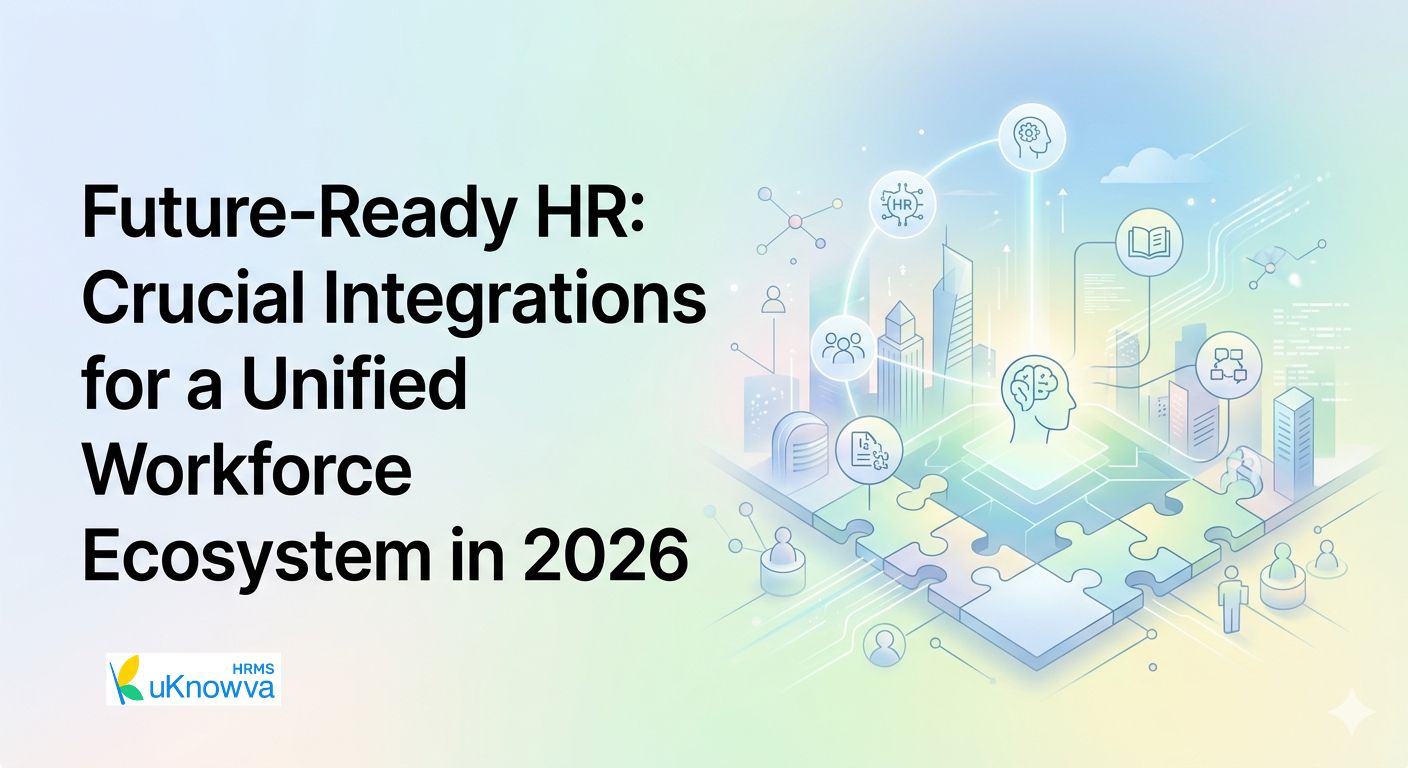
Modern HR operations, at their best, look like a connected network: HRMS, payroll, recruiting, learning, performance, collaboration tools, analytics, maybe an employee listening platform, all passing data across a shared spine.
On paper, every vendor promises this. In reality, here’s what typically happens:
The tech itself isn’t usually the blocker. The missing piece is coherent, intentional HR integrations that match the way your business actually runs, not the way your org chart looked three restructures ago.
Get the integrations right, and HR stops being a cost-center process engine and starts becoming an intelligence layer for the business.
Let’s start with the least glamorous part: tying your HRMS to payroll. Everyone says this is "basic." Yet, global organizations often re-key data from HR into payroll every cycle, then wonder why employees keep raising salary disputes.
When HRMS and payroll are properly integrated:
It’s not just about efficiency. People will tolerate clunky systems for a while, but they will not tolerate getting paid wrong. You lose trust quickly, and it’s hard to win back.
In a mid-size SaaS company, unifying HRMS and payroll cut payroll errors by over 70% in one quarter. The less obvious impact?
Their HRBP conversations with business leaders finally shifted from “Why was my new rep paid late?” to “What’s our ramp productivity by cohort?”
Most executives think of Slack or Microsoft Teams as communication tools. They are that. But when connected to HR data, they become something more interesting: a behavioral signal layer sitting on top of your org chart.
When collaboration platforms are integrated into your HR stack:
Are these signals perfect? Of course not. But they’re a lot better than relying solely on annual surveys and "manager gut feel."
Connected collaboration data often highlights that some “high performers” are over-functioning because they’ve become the unofficial help desk for several teams. Without that visibility, burnout looks like a character flaw instead of a system design problem.
Every board wants "people analytics." Every HR leader has at least one slide in their deck about becoming data-driven.
But analytics tools are only as good as the data plumbing feeding them. If your analytics platform isn’t fully integrated with HRMS, payroll, recruiting, learning, and even collaboration metadata, you get:
In other words: nice charts, weak decisions. With tightly designed HR integrations, your analytics stack can answer questions executives care about:
Notice: none of those questions can be answered by a single system. They’re all integration questions. The best people analytics programs were driven by leaders who treated data integration as basic infrastructure, not by genius data scientists.
Here’s the thing about any HR tech stack: it will be wrong in 12–18 months. You’ll enter a new market, spin up a new business unit, shift to more contingent talent, or acquire a company in a new jurisdiction.
Suddenly, all the neat architectural diagrams from that original RFP process look aspirational. This is why true interoperability matters:
If you’re a CXO, you don’t need to specify the API calls. But you do need to ask, “If we double headcount in a new region or acquire a company with its own stack, how painful will this be to integrate?”
When HR integrations are designed with the future in mind, you’re not rebuilding every time the strategy shifts. You’re extending an existing nervous system.
AI and machine learning can absolutely improve sourcing, selecting, onboarding, and retaining people. Used poorly, they become a way to automate existing biases faster. The difference usually comes down to integration:
When AI tools sit on top of a well-connected stack, HR integrations let them learn from the entire employee lifecycle: who you hired, how they performed, where they moved, when they left, and why.
AI becomes genuinely useful, highlighting patterns a human wouldn’t see scanning spreadsheets.
There’s one more piece executives cannot afford to treat as “IT’s problem”: data protection. As HR data flows through more systems HRMS, payroll, ATS, benefits, engagement, collaboration every integration becomes a potential attack surface and a compliance headache.
A few blunt truths:
Robust HR integrations should embed encryption, role-based access, auditability, and compliance controls as part of the design, not as an afterthought. That might slow down some quick wins, but it’s cheaper than a breach or a regulatory investigation.
Leaders who get this right treat employee data with the same care they give to customer or financial data because trust is a part of their employment value proposition.
If you’re thinking, “Our HR stack is nowhere near this,” you’re not alone. Most organizations are mid-journey, with a mix of modern tools, legacy systems, and heroic spreadsheets.
Resist the temptation to declare a massive transformation program and start from scratch. Those rarely land as glossy consulting decks promise.
Instead, for the next 12–24 months, treat HR integrations as a focused strategic program with three clear moves:
If you do that, something interesting happens. HR stops bringing you point problems (“We need a new engagement tool”) and starts bringing you system-level insights (“Here’s where we’re structurally constrained in how we grow”).
If there’s one thing 2026 is making clear, it’s this: HR transformation isn’t about adding more tools—it’s about connecting the ones you already have.
A fragmented HR stack creates noise, confusion, and mistrust. A connected ecosystem, on the other hand, creates clarity. It allows leadership teams to move from debating data accuracy to making confident, forward-looking decisions.
The organizations that will win in this next phase aren’t the ones with the most sophisticated tools. They’re the ones with the most coherent systems—where HRMS, payroll, analytics, collaboration, and AI all work as a single, intelligent network.
Because when integrations are done right:
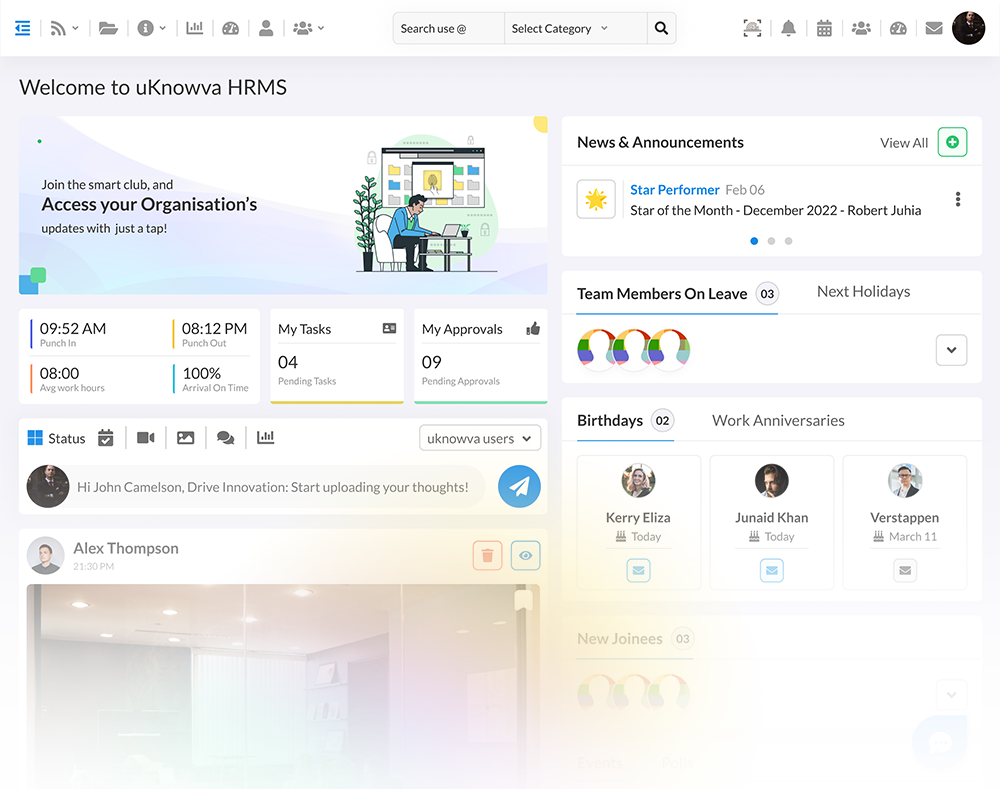
Platforms like uKnowva HRMS play a critical role here by acting as the central backbone, ensuring seamless integrations, real-time insights, and a unified workforce experience.
In the end, the goal isn’t just digital HR.
It’s connected HR—the kind you can actually steer with confidence.