Introduction
In the world where data breaches are in the news, and online privacy has never been under more regulation, HR departments find themselves in a precarious position.
They analyze and process delicate identity information. But have to comply with the regulations of the UIDAI as well to maintain the loyalty of employees.
Meanwhile, the introduction to the Aadhaar Vault extension of uKnowva: an HR convenience/ air tight Aadhaar security bridge. In this post we will unpack the reason why this extension is not just a feature, it is a strategic change in the manner in which organisations manage Aadhaar in HR systems.
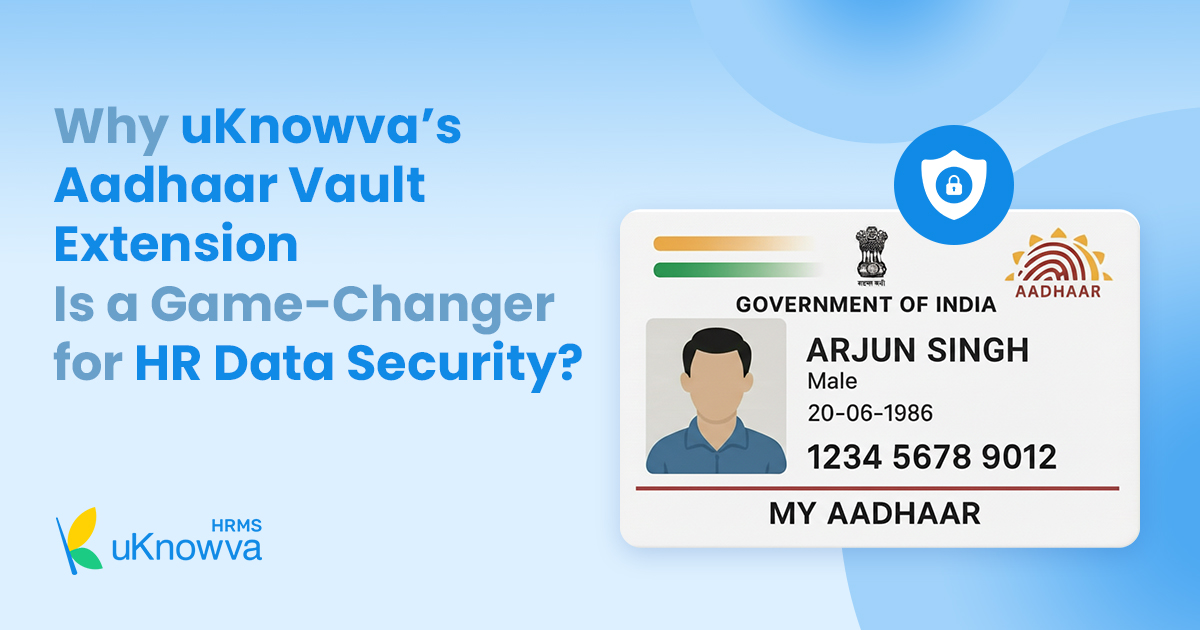
Aadhaar Is Mandatory—Why Secure Handling Matters More Than Ever
For Indian employers, Aadhaar-based workflows have become inevitable. They enable automated KYC, support Aadhaar-based attendance systems, and simplify statutory compliance checks. However, raw Aadhaar numbers and eKYC XML files are high-value targets for misuse if not handled correctly.
When stored without adequate safeguards, Aadhaar data exposes organizations to significant regulatory and reputational risks. The Aadhaar Data Vault principles, along with the latest UIDAI circulars and official advisories, consistently emphasise reducing the Aadhaar footprint across IT ecosystems and enforcing stricter controls on how Aadhaar data is stored, accessed, and used.
In essence, Aadhaar cannot be treated like any other employee data field. It demands a vault-first approach, encryption with hard keys, and protection through Hardware Security Modules (HSMs) to ensure compliance and resilience against breaches.
This is the core challenge HR teams must navigate—keeping employee and HR admin processes seamless, while ensuring Aadhaar data is stored and managed in strict alignment with UIDAI requirements, with minimal exposure and zero tolerance for non-compliance.
What does the uKnowva Aadhaar Vault extension do?
The Aadhaar Vault Extension by uKnowva securely stores both Aadhaar numbers and eKYC information within a fully encrypted, UIDAI-compliant vault. Instead of retaining raw Aadhaar numbers within standard HR modules, the system replaces them with secure, unique reference tokens.
Whenever an HR process requires identity verification or Aadhaar-based operations, uKnowva HRMS uses these tokens to securely access the Aadhaar Vault. This approach ensures that Aadhaar numbers are never exposed across the broader HRMS environment. In effect, Aadhaar data remains confined to a controlled, auditable vault, while the HRMS operates only on safe references—significantly reducing risk and strengthening compliance.
Key technical points:
- Stored encrypted Aadhaar in a vault architecture (not in plain DB fields).
- Reference token abstraction - less footprint on modules of HR.
- Developed based on the requirements of Aadhaar Data Vault and HSM of UIDAI.
Why is this important to the HR staff ?
- Huge assault surface diminishing- With the Aadhaar numbers not being sent out in the HRMS, there is considerably less to steal on the part of attackers and considerably less to audit on the part of the auditors. It is a reasonable measure to replace PII with reference tokens in case anything can go wrong to restrict the blast radius.
- Streamlined compliance attitude- The Aadhaar vault rules and other guidelines by UIDAI incline organisations to segregate Aadhaar data to regulated vaults. By adopting a purpose-specific extension (that adheres to such principles), an organisation will find it simpler to demonstrate compliance when under audit as well as to adopt the technical controls anticipated by UIDAI.
- Business continuity without loss of privacy- HR can still run processes that rely on Aadhaar onboarding, verification, attendance and more. The variation is that the operations are currently performed by means of safe tokens and vault entry, as opposed to actual Aadhaar exposures. That makes workflows seamless and encrypted to both employees and admins.
- Accountability and auditing done centrally- Vault applications are generally able to provide access logs, role-based access controls, and audit trails. The features assist the HR and security teams to identify the time, date, and reason of their access to Aadhaar data. It’s one of the main demands of any developed data governance programme. The necessity can be noted through recent implementations of Aadhaar vault plans in both governmental and non-governmental institutions.
Benefits decomposed: technical and business effects
Technical benefits
- Encryption at rest and in transit- Encrypted Vaulted Aadhaar data is encrypted with strong cryptography and in combination with an HSM, even the keys are isolated. This complicates exfiltration significantly and guards against typical cases of database theft.
- Reference keys/ tokenisation- Rather than storing Aadhar in modules, uKnowva stores tokens which correspond with vault records. A best practice towards minimising exposure to sensitive data is tokenisation.
- Least-privilege access- The request of a vault lookup can only be done by systems and users with explicit and auditable permissions, which satisfies the regulatory expectations of limited access and accountability.
Business benefits
- Lower compliance overhead- Once the Aadhaar footprint is reduced, fewer systems have to be vetted by auditors and legal teams and even a lesser number of incidents have to be dealt with. That accelerates the speed of audit and mitigates the exposure to legal liability.
- Faster, safer onboarding- KYC and Aadhaar-based onboarding can be privacy-first, fast and automated.
- Stronger employee trust- Employees have a growing concern of the perils of uploading their personal data on online platforms without the right reason, consent, and seriously encrypted methods incorporated. The fact that their Aadhaar is vaulted and guarded with stringent measures, enhances trust, which is an elusive perk with concrete HR effects (retention, morale).
The alignment of how uKnowva works with the UIDAI expectations
The Aadhaar Data Vault framework of UIDAI promotes entities that receive Aadhaar data to have separate secure vaults, operate on HSMs, and have the reference keys serving as the operational interface to mitigate the proliferation of Aadhaar numbers.
uKnowva extension has the same architecture, whereby it separates storage of Aadhaar data and general HR records, as well as it uses reference tokens as the interface of operation.
This match is essential as it implies that organisations that implement the uKnowva extension are heading in the right direction towards the very directives highlighted by UIDAI: vaulting, cryptographic measures, restrained footprint and auditable access.
Normal HR processes to which the extension was beneficial
- Onboarding & eKYC: New employee Aadhaar information is directly written to the vault. uKnowva eKYC check-in is done automatically with the token, so that means the HR gets no visibility to see the Aadhaar number of the candidate or newly hired person.
- Aadhaar-based attendance: The vault tokens can be connected to an attendance system which is biometric or Aadhaar-enabled allowing the attendance to be recorded correctly without revealing Aadhaar in an attendance record.
- Background verification / statutory checks: External verifiers, which require Aadhaar references, can be incorporated to operate with tokens or controlled vault retrievals - with third party exposure reduced.
Risk scenarios that it deals with in the real world
- Database leak of HR records- When a database dump is stolen, which is tokenised (i.e. contains no Aadhaar numbers), an attacker will not be able to use it to obtain much useful identity information. The actual Aadhaar exists in the vault where there are more stringent safeguards.
- Insider misuse- Role-based controls and audible access logs imply that an HR administrator cannot just export a bulk of Aadhaar numbers without being detected. That contains internal threat vectors.
- Regulatory enforcement- A well-designed vault architecture also makes the collection of evidence easier in case of audits or compliance checks. Additionally, it proves that the architecture complies with the UIDAI recommendations.
Implementation implications
- Know points of integration- Figure out all HR workflows that currently read or write Aadhaar fields attendance, onboarding, payroll verifications etc., and the intent to replace those read/writes with token calls. uKnowva extension is designed to hook into typical uKnowva modules, but requires mapping.
- Define access policies- Work together with the legal team to specify whom to request vault lookups, under which circumstances, and how to log the lookups. Enforce technical (RBAC) and operational (approval workflows) policies proactively.
- Key management and HSMs- Wherever mandated by the UIDAI requirements, make sure hardware security modules or accepted key management practices are present. This is where the IT/security leadership is usually called in.
- Audit and monitoring- Ensure to incorporate the audit logs of the vault in your SOC/monitoring tooling to enable faster issuance of alerts upon detection of suspicious access patterns.
- Employee communication- Educate employees on the protection of their Aadhaar. Such a show of transparency fosters trust and reduces queries in the onboarding process. A brief FAQ or push notifications on the social intranet will also raise curiosity amongst employees to research and read more about this to leverage this functionality.
Limitations & honest truth
There is no technical control which removes risk. Vaults are to be correctly configured, patched and monitored; tokens are to be cryptographically robust and non-reversible; integrations are to be verified to make sure no accidental logs contain Aadhaar.
Selecting a vaulting strategy will eliminate a huge percentage of the risk. However, it does not replace a mature security program that has patching, network controls, least-privilege practices, and regular audits. The changing direction of UIDAI also implies that organisations have to keep their policies and architecture reviewed.
Rapid checklist of HR leaders at the Aadhaar Vault extension
- Are there Aadhaar-based processes which can be tokenised?
- Is the UIDAI Aadhaar vault and HSM guidelines checked by our security team?
- Is it possible to have role-based access and logging of vault requests?
- Are we content with evidence models of vaults with our auditors?
- Have we ready front office communication on Aadhaar protection?
When you can say yes to these, then the extension can be implemented in a low-friction high-impact manner.
Conclusion
The extension of uKnowva to an Aadhaar Vault is more than a compliance patch; it is a change in the circumstances of how the most sensitive ID asset in India is managed by HR systems.
It provides the HR teams with the capability to execute Aadhaar-powered processes safely and in a transparent way by integrating tokenisation, vault-based storage, and alignment with UIDAI guidance.
That is reduced legal risk, a reduced number of internal headaches, more trust between employees, and a current security stance that is evolutionary with your organisation. Vaulting Aadhaar is no longer a choice, but a necessity that HR executives need to consider in regard to efficiency and privacy.
FAQs on uKnowva's Aadhaar vault extension
- What is uKnowva’s Aadhaar Vault Extension?
It is a secure feature that stores Aadhaar data in an encrypted vault instead of the regular HR database, reducing data exposure risks.
- How does the Aadhaar Vault improve data security?
It uses strong encryption, tokenisation, and restricted access controls to prevent unauthorized access to sensitive Aadhaar information.
- Is the Aadhaar Vault compliant with UIDAI guidelines?
Yes, the extension is designed to align with UIDAI’s Aadhaar Data Vault framework and security best practices.
- Does the vault affect HR processes like onboarding or attendance?
No, it works in the background. HR teams and employees can continue using Aadhaar-based workflows without disruption.
- What is tokenisation in the Aadhaar Vault?
Tokenization replaces real Aadhaar numbers with secure reference tokens, so the actual number is never exposed during routine HR operations.
- Who can access Aadhaar data stored in the vault?
Only authorised users and systems with role-based permissions can access the vault, and all access is logged for auditing.
- How does this help during audits and compliance checks?
The vault maintains clear audit trails and controlled access logs, making it easier to demonstrate compliance to auditors.
- Can the Aadhaar Vault be integrated with existing uKnowva HRMS modules?
Yes, it integrates seamlessly with uKnowva’s onboarding, attendance, and verification workflows.
- How does the Aadhaar Vault build employee trust?
Employees feel more secure knowing their Aadhaar data is encrypted, isolated, and accessed only when strictly required.








 Aditi Sharma