








 Aditi Sharma
Table of Content
When it comes to Human Resource Management Systems (HRMS), C-level executives are frequently faced with the daunting question of whether to replace their current HRMS or add functionality to their existing HRMS.
This is not an easy decision. Emotions tend to come into play, along with the desire to implement new technology. And if you haven’t taken into account the hidden costs of replacement, you may be surprised to find your company is paying tens or even hundreds of thousands of dollars over budget.
So why does this happen? In a nutshell, it is because companies are not factoring in the hidden costs of data migration, loss of productivity, training, and integration rebuilds, to name a few. HR leaders may be so caught up in the idea that a new system is better, resulting in overlooking these items, which leads to cost and operational issues.
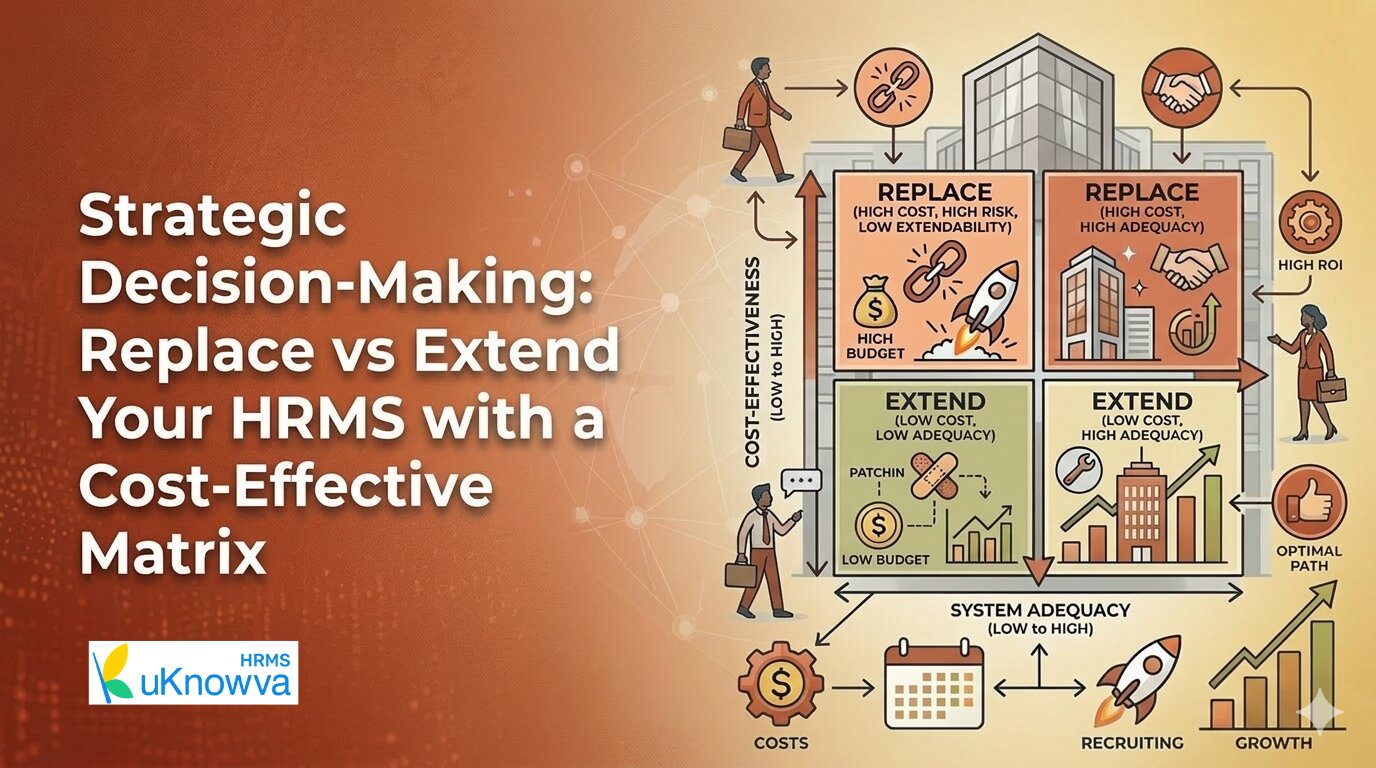
The purpose of this article is to discuss a decision matrix and provide a 5-year Total Cost of Ownership (TCO) comparison model to consider when determining whether to replace or extend your HRMS.
Prior to discussing the decision matrix, let’s talk about the hidden costs of replacement. These hidden costs include:
Data Migration: You will need to migrate the data from your old HRMS to your new system. This is a timely and costly process that requires not only the transfer of data but also validating that it was done correctly.
Productivity Dips: Regardless of the system, there is always a learning curve when implementing something new. This means your employees will be less productive during the implementation phase.
Training Costs: In order to get your employees up to speed on the new HRMS, you will need to train them on the system. Many companies forget to factor in the cost of training in their overall budget.
Integration Rebuilds: If you have other systems integrated with your current HRMS, such as recruitment, performance management, or time tracking software, you will need to rebuild those integrations when implementing a new HRMS. This is a hidden cost that is commonly overlooked and also time-consuming.
Key considerations should be factored into a decision matrix to make a comprehensive decision as an executive. The decision matrix should include:
Tech Debt Score: What is the level of technical debt in your HRMS? This includes outdated technology, process inefficiency, or customizations that hinder future upgrades.
Integration Complexity: How deep is your HRMS integrated into other systems? If integration complexity is high, this might suggest a preference for extending rather than replacing the HRMS.
Compliance Gaps: Do your HRMS systems meet current regulatory and compliance requirements? If there are significant gaps, it may be necessary to replace the HRMS to meet these requirements.
User Adoption Index: What is the current level of user adoption among your employees? A high user adoption index may indicate that you should extend the HRMS with new features rather than replace it entirely.
A 5-year TCO comparison model can also be used to better visualize the costs associated with the decision of extending, replacing, or a hybrid approach to modernizing your HRMS. There are three options to consider.
Extend: This option requires enhancing the current HRMS by adding new capabilities or modules. Costs associated with this option include minor enhancements, ongoing maintenance, and possibly some additional end-user training. This option tends to be the least expensive if the HRMS is not broken and is meeting the majority of the business requirements.
Replace: This option requires the purchase and implementation of a new HRMS. Costs associated with this option include the license purchase price, data migration, training, and integration rebuilds. You may need to consider this option if your HRMS is significantly out of date or non-compliant.
Hybrid Modernization: This option may be the best of both worlds. It involves a combination of extend and replace. For example, you may want to upgrade a few modules but completely replace others. This may provide the perfect balance between cost and functionality. You may be able to modernize the areas of the product you need without having to endure a full replacement.
Mitigating Emotional Biases
It is crucial for executives to remain objective throughout the replace vs extend your HRMS process. Avoid making an emotional decision because you believe that new is better. Base your decision on the financial model and decision matrix discussed above.
In addition, make sure to include various stakeholders from different parts of the organization in your analysis. This will ensure you are making a decision that supports the overall direction of the company and the needs of all end-users.
Replace vs extend your HRMS is not a simple question. There are a lot of factors that must be included in your analysis in order to make the best decision for your organization. Make sure to account for the hidden cost of your HRMS, leverage a decision matrix, and perform a thorough analysis of your HRMS to determine the total cost of ownership. 5-year TCO comparison, executives are able to make decisions that align with their business strategy.
The end result is a cost-efficient solution that improves HR processes and serves to promote future success.
1. What does “replace vs extend HRMS” mean?
“Replace vs extend HRMS” refers to the strategic decision organizations make between completely replacing their existing HR system or enhancing it with additional modules, integrations, or upgrades.
2. When should a company consider replacing its HRMS?
A company should consider replacing its HRMS when the system is outdated, lacks scalability, has limited integration capabilities, or cannot support modern HR functions like analytics, automation, and employee experience.
3. When is extending an existing HRMS a better option?
Extending an HRMS is beneficial when the current system still meets core requirements but needs additional features such as advanced analytics, recruitment tools, performance management, or employee engagement modules.
4. What is a cost-effective HRMS decision matrix?
A cost-effective HRMS decision matrix is a framework that helps organizations evaluate whether to replace or extend their HR system based on factors like cost, scalability, performance, integrations, and long-term business goals.
5. What factors should be included in an HRMS decision matrix?
Key factors include implementation cost, maintenance expenses, scalability, system performance, user experience, integration capabilities, security, and future workforce requirements.
6. How does replacing an HRMS impact business operations?
Replacing an HRMS can improve efficiency, automation, and analytics capabilities, but it may also require migration planning, training, and change management to ensure smooth adoption.
7. What are the benefits of extending an existing HRMS?
Extending an HRMS allows organizations to add new capabilities without disrupting existing workflows. It can be more cost-effective and quicker than implementing a completely new system.