








 Aditi Sharma
Table of Content
If you work in HR or people operations right now, you can feel the ground shifting. Not in the fluffy "AI will change everything" way, but in a much more specific, practical way: tools are starting to stop asking us what to do and just do it.
That’s essentially what MCP intelligent HR systems are about. And it’s a bigger leap than most slide decks admit.
For years, we've lived with informational chatbots. They sit in your HR portal, politely answering questions like, "What’s our parental leave policy?" or "Where can I find my payslip?" Helpful, sure. But they’re like interns who know where the files are and still need you to sign every form, send every email, and log every change manually. Now we're stepping into something more uncomfortable and more powerful: agentic, action-taking AI that doesn’t just answer questions, it takes end-to-end action inside your HR stack. And that has real consequences for how you design work, risk, and trust in your organization.
Let me make this concrete. An informational bot can say, “You have 12 days of leave left.” Useful. But you still have to go into the HR system, choose dates, route for approval, email your manager, maybe ping a colleague to step in.
With MCP intelligent HR systems, the flow looks very different. An employee says, “Book my leave for next Friday and put Cynthia down as my backup.” In plain language. No dropdowns. No forms. Behind the scenes, the AI:
All of that happens without a human manually stitching it together. The sharp insight here: this isn’t just “better UX.” It’s a shift from decision-support to decision-execution. That difference sounds subtle. It’s not. One helps people work faster. The other quietly becomes part of how work gets done at all. Once you see that, the question is no longer “Should we use AI in HR?” It’s, “Where do we allow AI to take action on behalf of employees, and under what conditions?”
Here’s the part that should be highlighted: the technology to do this has been ahead of the governance for a while. You can absolutely wire an AI to take actions in payroll, benefits, performance systems, and your calendar. The hard part is letting it do so in a way that wouldn’t make your CHRO, CFO, and Head of Legal uncomfortable.
That’s why strong permissioning and audit trails aren’t “nice-to-have features” in MCP intelligent HR systems. They are essential. At a minimum, you need:
Think of it this way: in the old world, a bad HR decision could be traced back to a human. It might be painful, but at least there was accountability. In the new world, if you can’t answer, “Why did the system do that?” you have a governance problem, not a technology problem.
The strategic advantage for leaders who get this right is simple: you can move faster with less fear. When every AI-driven action is traceable, reviewable, and reversible, you can safely push more work to automation without feeling like you’ve put the company on autopilot.
Despite the hype, the most interesting use cases today are not dramatic. They’re almost boring. But they compound. One common low-risk example: that natural-language leave request is already in play. HR teams have rolled this out and watched ticket volumes drop while employee satisfaction ticks up. People don’t care that it’s “AI-powered.” They care that they can type one sentence and get on with their day.
Other quiet but powerful plays for MCP intelligent HR systems:
Here’s the uncomfortable comparison: traditional HR tech mostly made the old work slightly faster. MCP intelligent HR systems change who does the work at all. In the old model, HR business partners and operations teams were the “glue” — chasing approvals, nudging managers, cleaning data, reconciling systems. Valuable, but invisible. Entire teams have burned out doing this.
In the new model, you can push that glue work to an AI layer and let HR people do what only humans can: reading context, coaching leaders, designing organization structures, shaping culture. Why does this work strategically? Because power in HR isn’t just information, it’s cycle time. The speed at which you can move from “we think we might have a retention issue in this team” to “we’ve tested three interventions and here’s what changed” is a competitive advantage. When the admin layer is handled by something that doesn’t sleep, that cycle compresses.
And yes, it also forces a tougher conversation: if 30–40% of HR’s historic workload can be done by MCP intelligent HR systems, what’s the new charter for your HR org? The best CXOs are leaning into that question now, not waiting for the budget cycle to answer it for them.
The next wave is already peeking through. Once you have MCP intelligent HR systems acting reliably with good guardrails, the natural next step is predictive, not just reactive support. Imagine:
The insight here: the real win isn’t that AI will “replace HR.” It’s that HR becomes one of the most data-informed, strategically embedded functions in the business — if you design for it. This brings us back to the key question. One can treat all this as another tech upgrade, or see it as it truly is: a chance to redraw who does what work, how decisions get made, and how fast an organization can adapt.
Perhaps the more honest question is: where are systems currently comfortable acting on behalf of people — and what would it take to expand that comfort zone, without losing confidence? Because that, more than the algorithms, will separate the companies that talk about intelligent HR from the ones that quietly build it into how they operate.
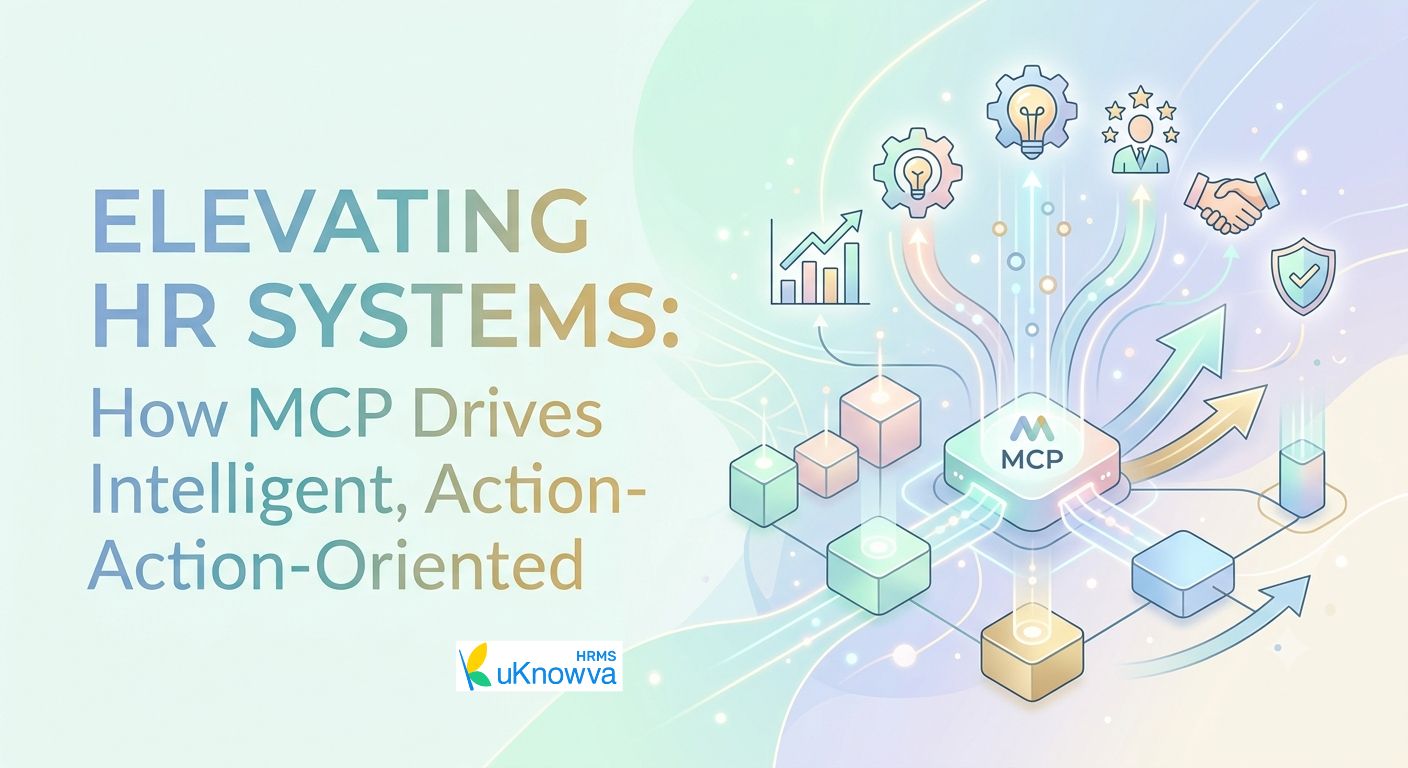
HR technology is entering a new era where systems no longer just store information—they understand context, reason intelligently, and take meaningful action. The Model Context Protocol (MCP) represents a significant step toward this transformation by enabling AI models to securely connect with enterprise applications, interpret organizational data, and execute workflows with minimal human intervention.
For HR leaders, this means moving beyond traditional HRMS capabilities toward intelligent platforms that proactively support recruitment, employee engagement, performance management, compliance, learning, and workforce planning.
As organizations continue to embrace AI, MCP will become a foundational layer for building scalable, secure, and interoperable HR ecosystems.
Platforms like uKnowva HRMS are well-positioned to leverage these advancements by combining robust HR functionality with intelligent automation, helping businesses create more connected, efficient, and employee-centric workplaces.
1. What is the Model Context Protocol (MCP)?
Model Context Protocol (MCP) is an open standard that enables AI models to securely connect with enterprise systems, access relevant business data, and perform tasks across multiple applications using a standardized interface.
2. How does MCP improve HR systems?
MCP enables HR platforms to understand organizational context, retrieve real-time information, automate workflows, and execute HR tasks intelligently instead of simply responding to user queries.
3. Can MCP integrate with existing HR software?
Yes. MCP is designed to work alongside existing HR systems, payroll platforms, collaboration tools, CRMs, and enterprise applications without requiring complete infrastructure replacement.
4. Is MCP secure for handling employee data?
Yes. MCP supports secure authentication, permission-based access, and controlled data sharing, allowing organizations to maintain compliance while enabling AI-powered automation.
5. What HR processes benefit the most from MCP?
Recruitment, onboarding, leave management, employee support, performance management, learning and development, payroll assistance, compliance tracking, and workforce analytics can all benefit significantly.
6. How is MCP different from traditional API integrations?
Traditional APIs connect systems individually, while MCP provides a standardized communication layer that allows AI models to interact with multiple enterprise tools more intelligently and with greater contextual awareness.
7. Does MCP replace an HRMS?
No. MCP complements an HRMS by making it more intelligent. The HRMS remains the system of record, while MCP enables AI to access data, automate processes, and perform cross-platform actions.
8. Can small and medium-sized businesses benefit from MCP?
Absolutely. SMBs can leverage MCP to automate repetitive HR tasks, improve employee experiences, reduce administrative workload, and make better decisions without significantly increasing operational costs.
9. How can uKnowva HRMS leverage MCP?
uKnowva HRMS can utilize MCP to enable AI-driven employee assistance, intelligent workflow automation, contextual reporting, automated approvals, personalized HR recommendations, and seamless integration with enterprise applications.
10. What is the future of MCP in HR technology?
As AI adoption grows, MCP is expected to become a core standard for intelligent enterprise systems, enabling HR platforms to evolve from data repositories into proactive, decision-support ecosystems that drive productivity and business outcomes.