






 Aditi Sharma
Table of Content
The Indian business is on its knees. Due to the scaled nature of business, the hybrid work setting is becoming the new standard, business compliances are increasing, and the demands of talent are evolving, but one fact is becoming more apparent than ever:
HR cannot operate spreadsheets to manage its future.
However, thousands of Indian rising businesses continue to have HR functions, such as attendance, payroll preparation, leave tracking, appraisals, employee engagement, onboarding, operating on Excel sheets or disjointed systems. What begins as a handy tool, soon becomes a hindrance to growth, accuracy, compliance and experience of employees.
That is where Unified Human Capital Management (HCM) systems come in. They are substituting the disjointed spreadsheet tools and old methods with a unified digital foundation that drives hiring, paying, managing, developing and retaining people.
And it is no longer a choice to Indian enterprises so far as this shift is the key to the actual HR transformation.

Spreadsheets were constructed to keep simple records- not to run multi-layered HR functions in dispersed staff.
What can be good with 10 employees fails with 100, and completely fails with 500. The contemporary Indian business is faced with:
HR tracking of remote workforces, offices across states, contractors, and gig workers is complicated.
ESI, PF, Income Tax, Shops and Establishments Act, CLRA- compliance has become dynamic and state specific.
Staff records, time sheets, documents, performance indicators, spreadsheets are not capable of the richness.
This is not what leadership desires with dashboards, files mailed on a monthly basis.
Gen Z and millennial workers demand transparency, mobile connectivity and speed which spreadsheets do not offer.
Consequently, the HR teams become overwhelmed with manual work:
HR will not be able to transform when 80 percent of their time is spent on fire fighting in the administration desk.
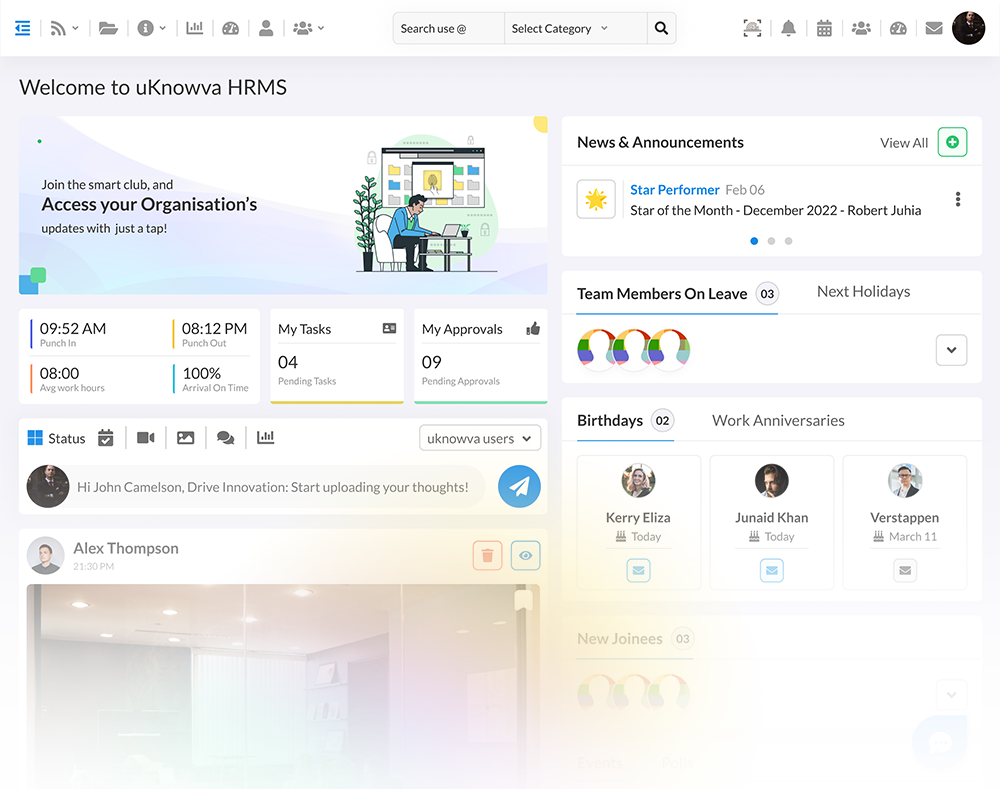
A Unified HCM unites all HR functions into a single network, engages in the automation of workflows, aligns data, and provides managers and employees with a single source of truth.
A powerful HRMS such as uKnowva incorporates:
Why is Unified HCM transformative to spreadsheets?
Capability Spreadsheets United HCM.
The Indian firms today are suffering the complicated situations:
One omitted formula or misplaced cell may cost lakhs, particularly in statutory calculations.
PF, PT, LWFC, and CLRA rules vary among states. Spread sheets just cannot do the job.
Delays, errors that are often performed manually cause employees to tune out.
It is not possible to find data in disseminated sheets.
Any user can edit a file, delete a tab or overwrite formulas.
Decision-makers are working in the dark without having real-time performance and workforce insights.
The expense of dependency on spreadsheets cannot be seen--but it is enormous.
Companies that adopt integrated HCM systems such as uKnowva HRMS enjoy the transformation of HR as an administrative role to a strategic benefit.
Gathering trends, performance indicators, recruitment channels, retention issues--all are visual and ready to act.
CXOs do not wait till HR ready reports, they can see live analytics at any time.
Personal service, fast orders, open policy, mobile-first access to it-employees are empowered.
Statutory rules are automatically updated, which minimizes the possibility of penalties.
Automation liberates HR managers to strategise, and not to pursue signatures.
The economy of India is growing at a rate that the traditional HR systems are not able to cope with.
India has one of the most diverse workforces in the world whether on the factory floors or remote engineers. It is impossible to manage them by means of static files.
Each of the states possesses its own labour laws. The complexity is automated in HCM platforms.
The cycles of attrition become shorter; the businesses require real-time data to control talent preparedness.
Distributed teams cannot track their attendance or leaves manually.
The Indian firms are embracing the use of OKRs, 360deg reviews, continuous feedback, which are systems that are not supported by spreadsheets.
Unified HCM suits well in this dynamic environment.
We can divide into process-by-process:
Payroll Processing
Unified HCM: Automatically synchronized with attendance, leaves, shifts, incentives and compliance.
Performance Appraisals
Unified HCM: 360 degree reviews, automated scorecards, goal-setting, PMS dashboards.
Unified HCM: Virtual/biometric logs, geo-fencing, real-time tracking, auto-policies.
Onboarding
Unified HCM: Web-enabled onboarding module, automation, virtual check-ins.
Unified HCM: Announcements, recognitions, HR feeds, polls.
Enterprises report:
40-60% faster HR operations
Repetitive manual work is done away with through automation.
70-90% fewer payroll errors
Real-time data that is clean is less corrected.
50% increased employee satisfaction.
Trust is enhanced by self-service and transparency
100% audit-ready records
There are no lost records or incomplete data.
Centralised HR governance
Single platform, single source of truth.
The users of uKnowva HRMS are inclined to mention ROI within 3-6 months due to time alone saved, the number of errors minimized, and the accuracy of compliance.
What makes uKnowva HRMS stand out?
uKnowva grows without problems, whether the company has 50 employees or 50,000. This puts it as a favorite HRMS among fast developing Indian businesses that are to modernize without complications.
HR will change radically in the coming decade. Companies will adopt:
Spread sheets do not only belong to the past, but they are also obstructions to advancement.
Single HCM systems such as uKnowva HRMS enable enterprises to be future-proofed, agile, and intelligent.
To become efficient in terms of scaling, hiring the best performers, and creating high-performance cultures, HR should stop using manual tools and move to smart ones.
Digitization of HR does not begin with payroll or recruitment, but when everything is brought together into a single HCM ecosystem.
Spreadsheets might have been good over the years but it is not configured to handle the dynamics and precision of the contemporary Indian enterprises.
Unified HCM is not a luxury.
It is the basis of enterprise excellence.
And software systems such as uKnowva HRMS are helping Indian companies take this jump- seamlessly, strategically and sustainably.
In India, the HR transformation is ceasing to be digitisation but rather unification. With the growth of enterprises, diversification, and the realities of a complex workforce, the necessity of having one, intelligent, and integrated HCM ecosystem cannot be ignored anymore. Spreadsheets can be used in data recordings, but it is not applicable to strategic decisions, employee experience, and supporting business agility in real-time.
A unified HCM solution such as uKnowva HRMS will enable organisations to outgrow their manual processes, adopt an automated future-focused HR capability, based on compliance, analytics and staff centricity. To the Indian businesses which want to expand exponentially within the upcoming ten years, the initial and most crucial action is mere:
Go beyond spreadsheets to an integrated HCM and free the potential of your human resource.
1. Why should Indian companies move away from spreadsheets for HR?
Spreadsheets were never designed for real-time HR workflows, compliance, or large-scale data. They cause manual errors, slow approvals, and poor employee experience. A unified HCM automates these processes, reduces risks, and improves accuracy and speed.
2. What exactly is a unified HCM?
A unified Human Capital Management (HCM) system integrates all HR functions—attendance, payroll, leave, onboarding, appraisals, engagement—into a single platform. It creates one source of truth and eliminates fragmented tools.
3. How does a unified HCM improve productivity?
Automation reduces repetitive tasks, managers get real-time insights, and employees access everything through self-service. This frees HR to focus on strategy rather than admin tasks.
4. Is a unified HCM suitable for Indian regulatory needs?
Yes. Platforms like uKnowva HRMS come with built-in Indian labour law compliance (PF, PT, ESI, LWFC, TDS, and state rules). This reduces compliance errors and audit stress.
5. Can SMEs and mid-sized companies also use unified HCM systems?
Absolutely. Unified HCM platforms scale easily for 10 employees or 10,000. SMEs benefit the most because they eliminate manual work early and build structured HR processes.
6. How does a unified HCM improve employee experience?
Employees can apply for leave, mark attendance, access payslips, request approvals, and track performance digitally—without emailing HR. Transparency and speed massively increase satisfaction.
7. What problems do spreadsheets cause during audits?
Missing files, overwritten formulas, inconsistent versions, and no audit trails make spreadsheets unreliable. HCM systems store complete, time-stamped histories for all actions.
8. How long does it take to implement a unified HCM like uKnowva HRMS?
Most companies go live within 2–6 weeks, depending on modules and complexity. Cloud deployment makes the process fast and smooth.
9. Is it expensive to adopt unified HCM software?
Unified HCM solutions offer a high ROI by reducing errors, saving time, lowering compliance penalties, and improving productivity. For most enterprises, the cost is far lower than the cost of manual HR operations.
10. Why is unified HCM considered the foundation of HR transformation?
Because transformation starts with structure. Without centralised data, automation, and analytics, HR cannot evolve into a strategic function. Unified HCM provides the backbone for scalable, modern, and people-focused HR.