








 Aditi Sharma
Table of Content
Automation of HR is at the heart of future work evolution as the latter is changing at an unprecedented rate. The world is spending on HR tech trends 2025 to become more efficient, better employees, and make smarter workforce decisions.
What previously was confined to payroll automation has now been expanded into the area of AI in human resources, predictive analytics, chatbots, onboarding solutions, and digital transformation strategies that affect all employee lifecycle phases.
This blog will discuss the understanding of what HR automation is, why it is important in the year 2025 and the top 10 HR automation trends that are trending in the future of HR technology.
An HR trend is a new practice, approach or direction in human resources, which is emerging to be popular or used widely by organizations.
Such trends are characteristics of the changing workplaces due to the changes in the fields of technology, workforce expectations, laws, and business requirements.
To illustrate, recent trends in remote work, AI in recruiting, employee welfare, people analytics, and HR automation demonstrate how HR is transforming towards being less of an administrative profession and more of a strategic, technologically oriented and people-oriented career.
In plain words: HR trends can be defined as the most recent changes, which influence the way companies organize, nurture, and communicate with their employees.
The reason why business needs to be at par with the recent trends in HR in 2026 is that it has direct effects on the ability of an organisation to attract, retain and manage talent effectively. The expectations, technology, and laws at work are rapidly evolving, companies that do not keep pace may lose employees who are skilled, become outpaced by their competitors and have difficulty with compliance.
By adhering to the trends in HR, business organizations can:
To the point, the trendiness of HR will keep any business dynamic, innovative, and in line with the ever-changing demands of the market and the employees.
Three forces are converging to make HR leaders more inclined towards automation than ever.
Automation saves up to 60 percent of redundant manual operations such as processing payroll, clearing leaves, claims and monitoring timesheets. This will enable freed HR teams to concentrate on more strategic areas like talent management, workforce planning, and employee engagement.
The AI and bot-based modern HR automation systems have real-time analytics that allow HR leaders to make better decisions. To predict attrition or identify the skills gaps, data-driven insights enhance accuracy and speed in decision-making.
Employees have a greater command of their work experience through self-service portals, digital onboarding platforms and AI-based learning tools. This empowerment enhances satisfaction, less reliance on HR to get routine queries and a more engaged workforce is achieved.
Manual HR processes prove to be incapable of supporting the growing workforce needs in companies as they grow. Automation enables HR operations to grow without interruption and compliance and accuracy between locations.
The HR automation of workflows reduces operational costs due to minimisation of errors, lessen paperwork and time management on administrative office tasks. This gives the businesses to plan on how to allocate resources more effectively.
As the labour legislation and data protection regulations change and develop, automation guarantees proper record-keeping, a timely reporting process, and adherence to the statutory regulations- helping businesses to escape the legal risks.
Digital workplaces require agility in the year 2025. HR automation fosters the model of hybrid and remote working, collaborates with collaboration tools, and provides a continuous experience of employees across geographies.
These shifting trends in Digital HR make automation not an option, but a requirement to gain a competitive edge. Efficiency, analytics, and employee experience are three aspects of one eco-system that companies that are based on intelligent HRMS platforms, such as uKnowva HRMS, are keeping ahead.
Smart Hiring with AI Tools
One of the HR functions that are the most resource-intensive is recruitment. By 2025, AI will transform the human resource sector and revolutionise the hiring process by automating screening of resumes, matching skills, and arranging interviews.
AI-driven platforms assist in predicting future success of the candidate and eliminate bias during the hiring process, whereas the HR bots for enterprise 2025 carry out the first-level interactions with the applicant.
Automated Onboarding.
The new tools of employee onboarding simplify all the processes of digital document signing and e-signatures to online training. Automated onboarding saves on the administrative time wastage, and the new hires can feel a part and parcel of the company on the first day- a key aspect in hybrid and remote workforces.
Workforce Planning and Retention Predictive Analytics.
People analytics and AI allow the HR department to anticipate the risk of attrition, pinpoint areas of skills shortages, and strategize future needs of the workforce. Predictive models provide leaders with practical knowledge to enhance their retention rates, the distribution of labor, and successions.
Automation in Performance Management and Feedback.
Continuous and automated feedback systems are replacing the traditional performance reviews. HR automation software keeps track of goals, productivity, and allows real-time check-ins, employees get immediate feedback, and performance dashboards powered by AI are at the disposal of managers.
Compliance and Risk Management HR Automation.
Multinationals encounter complicated labor regulations. The HR automation software 2025 also makes sure that in 2025, the tax laws, labor regulations, and compliance reporting are updated automatically. The records based on blockchain also enable transparency and decrease the risks of compliance.
Automated Payroll and Benefits Management.
Mistakes in the payroll may damage the trust and morale. Automation will provide the correct payment of salaries, calculation of benefits, and adherence to laws of the tax systems of different countries. Payroll cycles are made more secure and fast with cloud-based HR automation software.
Smart HR Chatbots and Virtual Assistants.
HR automation systems such as chatbots are intelligent and respond to questions, take employees through their HR policy, and help them with other tasks, such as filling leave requests. ChatGPT in human resources is one of the areas that are significantly involved in developing conversational AI to assist employees on a one-on-one basis.
Artificial Intelligence Learning and Upskilling.
Under Generative AI in HR, employees get customized learning materials depending on skills, aspirations, and trends in the industry. Learning Experience Platforms (LXP) are used to automate course recommendations and tracking of progress in order to help organizations bridge skills gaps more quickly.
Web-based Survey of Employees and Employee Sentiment.
The experience of employees has taken the center stage in business success. Real-time employee morale is monitored by automated surveys and sentiment analysis applications. Companies can use intelligent HR tools to take action beforehand to enhance engagement and retention.
AI for HR Documents
AI automates the creation of HR documents, starting as much as job descriptions should be drafted and as far as offer letters and policy updates should be generated. This minimizes redundancy and creates continuity and consistency as well as provides the HR leaders with more time to concentrate on strategic issues.
Businesses can successfully adopt HR automation by following these steps:
Determine existing HR pain areas and determine where automation can be useful.
Choose the appropriate HR automation software in line with business objectives.
Invest in employee and managerial training to reduce the adoption costs.
Enforce data security and compliance at the implementation.
Promote change management by defining the advantages of automation.
By following these steps, businesses can create a future-ready HR ecosystem that saves time, reduces costs, and enhances employee engagement.
HR automation is not just a concept anymore—it’s transforming the way businesses function across industries. From reducing paperwork to enhancing decision-making with analytics, organisations are seeing measurable improvements in efficiency, employee experience, and compliance.
According to results from a Lano global payroll system implementation, a financial institution improved compliance by cutting interdepartmental data exchanges by 30% and reducing payroll errors by 11%. The automation streamlined multi-country payroll processes, enabling more accurate reporting and operational efficiency across departments.
One global engineering company employed automation to integrate payroll operations in 20 countries. The company became able to make payroll management quicker and more dependable with the central platform of Lano, which allowed shortening the time required to analyse and approve payroll reports by 80 %.
One of the companies utilizing Applicant Tracking System (ATS) to automate the recruiting process automated the screening of resumes and job postings. Consequently, their time-to-hire was reduced by approximately 40 percent and allowed recruiters with the additional bandwidth to carry out the engagement with the candidate.
A multinational supply chain firm implemented the pymetrics AI-based tests as a way of screening candidates more effectively. This saved 59 percent on the time-to-hire, 31 percent on the application completion rate and saved the recruiter thousands of hours by eliminating the correct candidates at the beginning of the funnel.
One of the well-known large-scale manufacturing companies with operations in more than 40 countries used Truerix to automatize and standardise payrolls. The outcome included a 40 percent efficiency improvement in payroll functions, and the reporting schedules were reduced to only a few days instead of weeks, and compliance was dealt with more precisely.
With the rapid evolution of digital HR, organisations are relying on advanced platforms to streamline processes, improve decision-making, and enhance employee experiences. These tools combine automation, AI, and analytics to deliver smarter, faster, and more scalable HR solutions.
The following are some of the smartest HR tools and platforms that may be the most promising in 2025:
Efficiency is no longer the only aspect of HR automation, but it is transformation. To remain competitive, organizations will have to adopt AI in the field of human resources as they progress to digital HR trends, including human resources, HR bots 2025, generative AI in HR and intelligent HR automation tools.
By 2025, automation in HR will result in increased employee engagement, cost reductions, and improved business performance for leaders of organizations that adopt it.
HR is becoming increasingly digital, intelligent, and people-centric in the future, and automation is the driving force behind this shift.
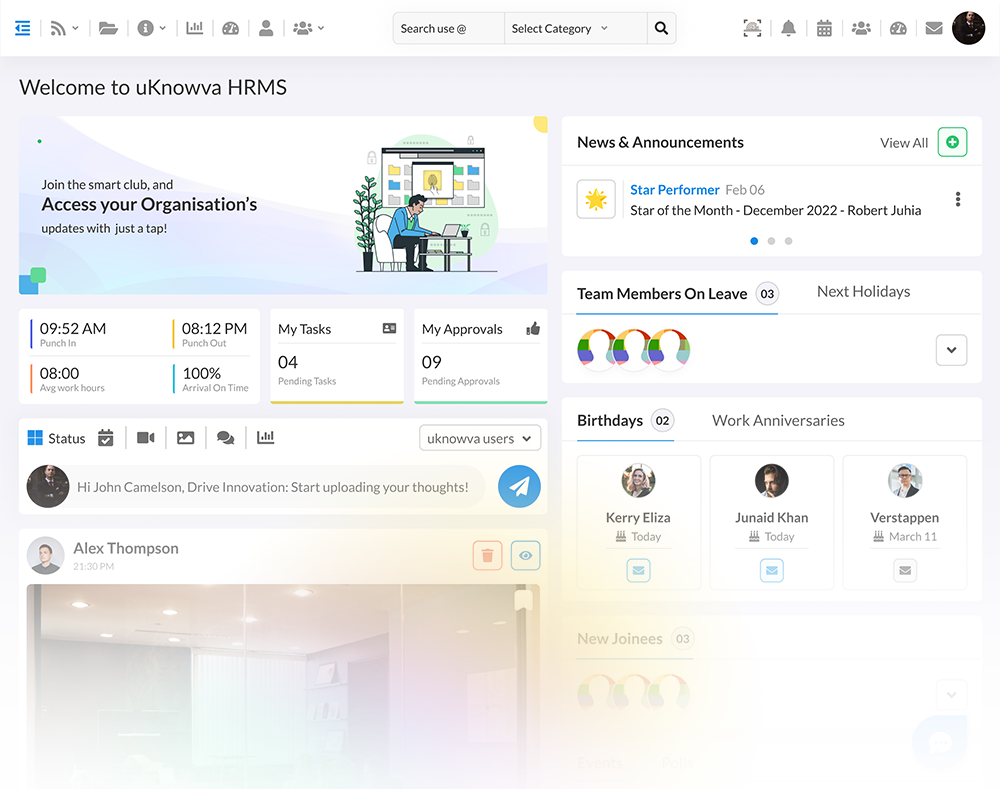
HR automation tools are software solutions designed to streamline and automate repetitive, rules-based HR tasks such as payroll processing, leave approvals, attendance tracking, and employee data management. They reduce manual effort, save time, and improve accuracy.
Investing in HR automation helps companies save time, minimize errors, improve compliance, and enhance employee experience through self-service portals. It also provides data-driven insights that support better workforce planning and decision-making.
The best HR automation tools for SMEs in 2025 include uKnowva HRMS, Zoho People, GreytHR, Keka HR, and BambooHR. These platforms simplify payroll, leave, onboarding, and compliance while being affordable and easy to scale for growing businesses.
No. These tools don’t replace HR professionals but empower them. By handling repetitive administrative work, automation allows HR teams to focus on strategic initiatives like employee engagement, talent development, and organizational culture.
Yes, most modern platforms such as uKnowva HRMS integrate with CRMs, ERPs, payroll, and accounting systems to create a seamless ecosystem. Integration eliminates duplicate data entry and ensures smoother operations across departments.
Absolutely. HR automation is not just for large enterprises. Platforms like uKnowva HRMS are scalable and cost-effective, making them suitable for startups and SMEs that want to modernize HR without heavy investment.
HR automation can cover a wide range of processes including recruitment, onboarding, attendance management, payroll, performance reviews, employee engagement, compliance tracking, and even wellness monitoring.
Security is a top priority. Reliable tools use encryption, role-based access, and compliance-ready features to protect sensitive employee data, contracts, and payroll information.