








 Aditi Sharma
Table of Content
Let’s be honest, most “AI HR assistants” today are glorified FAQ trees with a chat bubble painted on top. You’ve probably seen the demo: a chat widget appears, an employee asks, “What’s our parental leave policy?”, and the bot simply returns a link to a PDF. The vendor calls it “conversational AI.” Your people call it “yet another place I can’t get a straight answer.”
That gap, between what’s marketed and what actually helps employees, is where the Multi-Client Platform (MCP) model gets interesting. Not as a buzzword, but as the architecture behind a conversational HR experience that feels, well, almost human. It may not be perfect, but it can offer a far more useful experience than navigating rigid, menu-based HR support.
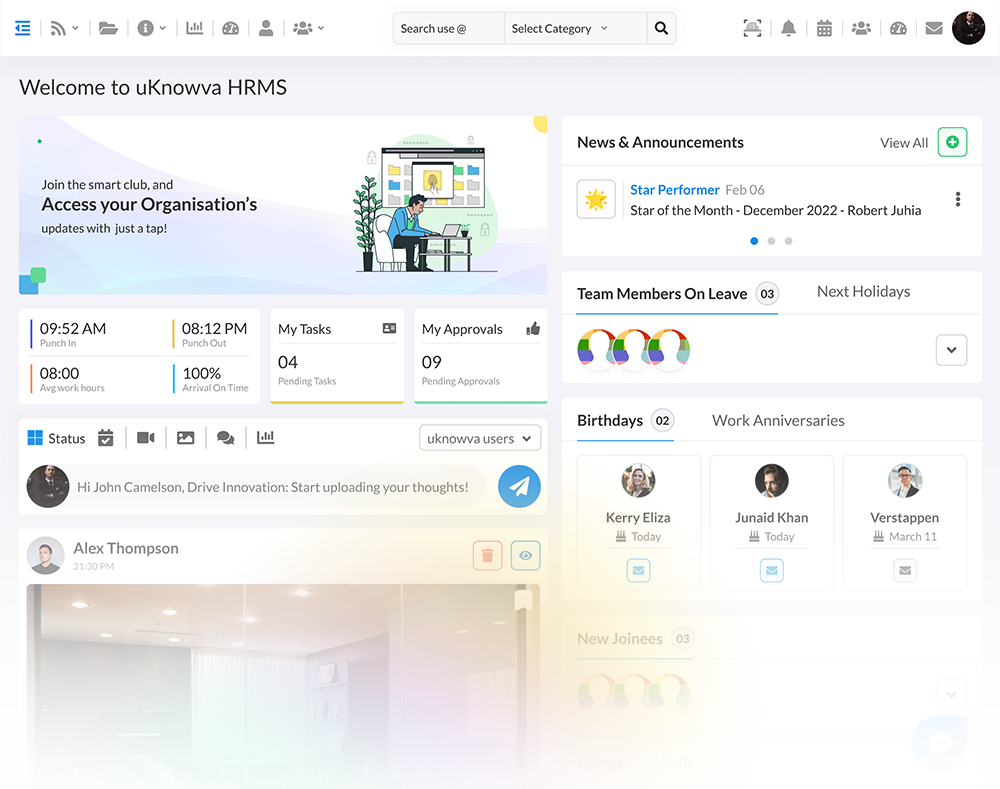
You can explore how uKnowva HRMS brings HR processes, employee self-service, automation, and workforce management together in one HR environment.
Let me draw a sharp line here, because this is where a lot of implementations go off the rails. Decision-tree bots essentially function as interactive flowcharts: if the employee says X, show Y; if they say Z, route them to a human. It’s brittle, it’s linear, and the second someone asks, “Hey, can I use commuter benefits while I’m on leave and working part-time from another state?” the whole thing collapses.
An MCP-based conversational HR experience works differently because of the host-client-server design:
Here’s the non-obvious insight: separating “the brain” from “the mouth” is what lets you create one consistent, context-aware HR assistant that can show up everywhere without fragmenting your experience or your data.
In practical terms, this separation allows the intelligence layer to remain consistent while the employee-facing interface can appear across different channels without creating separate experiences or disconnected data.
In other words, your employee can start a chat about a promotion path on their laptop at home and continue it from their phone in the elevator, and the system remembers who they are, what they’ve asked before, and what matters to them. That’s not a script. That’s an architectural choice.
Let me unpack this in plain language, because this is where evaluators often nod politely and then sign the contract with the slickest UI. This is where organizations can focus too heavily on the employee-facing interface while overlooking the architecture that actually determines how the experience works. The host is your intelligence layer. It’s where:
The clients, your chatbots, voice interfaces, even email responders, are just surfaces. They are the employee-facing interfaces, while the underlying intelligence and information processing happen through the connected architecture. They don’t “know” anything on their own. They call the host, get an answer, present it in a friendly way, and report back what the employee did next.
The server layer glues this together securely. The server layer connects these different components and coordinates how information and requests move between them securely. It manages:
Here’s the strategic piece: when you design around this host-client-server pattern, you’re building for continuous learning. Every time someone asks something, the host learns: what was confusing, what needed escalation, where policies contradict behavior. Over time, your conversational HR experience doesn’t just answer questions better; it quietly exposes where your HR design itself is broken. That’s the part the glossy demos never mention.
uKnowva’s AI-powered HRMS suite can be explored in this context, particularly around AI-powered employee self-service, automation, and intelligent HR operations.
Let’s compare this to the “AI assistant” most vendors still push under the hood.
One quiet but crucial difference: with a decision tree, every edge case is a cost. Each new edge case requires additional branches, testing, maintenance, and another potentially fragile path through the experience. With MCP, edge cases are data. The system learns patterns like: “Remote employees with kids keep asking about school hours flexibility in one region. Maybe that’s not just a one-off question.” That’s not just operational efficiency. That’s a signal for HR strategy.
And that’s why this works: the architecture aligns with how real humans behave, messy, non-linear, repetitive, instead of forcing them into a wizard they didn’t ask for.
The architecture accommodates the messy, non-linear, and repetitive nature of real employee interactions instead of forcing those interactions into rigid, predefined workflows.
Picture this with actual stakes. Consider an employee dealing with several overlapping HR situations at once: partial leave, cross-border relocation, and a change in reporting line. In a typical system, they’d bounce between:
With an MCP-based conversational HR experience, that same employee could say, in plain language: “I’m moving to our Berlin office in October and going down to 60% time. How does that affect my equity vesting, health coverage, and bonus eligibility?”
The assistant, via the host, can:
Is it perfect? No. There will still be edge cases. But instead of a maze of links, they get a guided conversation with answers that feel tailored, not generic.
Instead of making employees navigate multiple disconnected resources, the system can bring relevant information together into a single, context-aware interaction.
The deeper insight here: this level of specificity builds trust. And trust is the real currency when you’re dealing with topics like pay, leave, or performance. When employees receive relevant, transparent, and context-aware responses, confidence in the HR system can increase; when they do not, employees are more likely to seek answers from people they already know in HR. You’ve seen this. It’s been seen. And it never scales.
uKnowva’s UVA — Virtual AI Assistant powered by MCP — is relevant to this model, bringing conversational interaction into HR processes and enabling users to work with HR information and tasks through natural-language requests.
Here’s the part that often gets left on the table, the patterns inside those conversations. Because the host sits at the center, an MCP-driven conversational HR experience becomes a kind of live dashboard of organizational friction:
Instead of looking only at ticket volumes, HR can use recurring conversation patterns to identify where employees are experiencing friction across the organization.
You’re not just counting tickets. You’re seeing, for example, that high performers in one BU keep asking about internal mobility and growth paths while another BU is silent. That’s not noise; that’s a signal.
Why does this matter at the C-level? Because it turns HR from “issue resolution” to “early warning system.” Instead of waiting for periodic engagement surveys or formal escalations, HR can identify emerging employee concerns and areas of confusion as they appear. And you can act on it: update policies, train managers, tweak programs, and then immediately see if the questions drop off. That’s a feedback loop most organizations talk about, but very few actually operationalize.
uKnowva also offers AI Agents for HR operations, supporting the broader shift toward AI-assisted HR workflows and more actionable employee experiences.
If you strip away the hype, MCP isn’t about having a cooler chatbot. It’s about owning the plumbing that lets you build a conversational HR experience that feels consistent, contextual, and frankly, more humane. At its core, MCP is about creating the underlying architecture that allows HR interactions to remain consistent, contextual, and responsive across different employee touchpoints.
Because underneath the tech, employees are asking very human questions: “Am I being treated fairly?” “Can I plan my life around this job?” “Does anyone see what I’m dealing with?”
You can meet those questions with PDFs and ticket portals. Or you can meet them with a system that learns, remembers, and adapts as your people and your policies evolve. Organizations can either continue relying primarily on static documents and ticket-based support or use systems designed to provide more contextual, adaptive interactions as employee needs and policies change. The organizations that get this right won’t be the ones with the fanciest UI. They’ll be the ones whose architecture quietly supports the simple, almost old-fashioned idea that people deserve clear, timely, and honest answers.
The organizations that succeed will be those that use their underlying HR architecture to consistently deliver clear, timely, and transparent answers rather than simply investing in a more attractive interface.
Maybe that’s all a good HR assistant really is, a way to make the company’s promises feel real in the moments that matter.
The future of conversational HR is not simply about adding a chat window to an existing HR platform. It is about building an architecture that can understand context, connect relevant HR data, respect permissions, and deliver consistent experiences across the channels employees already use.
MCP can help organizations move beyond rigid decision trees and static HR information toward more connected, contextual, and actionable employee interactions. But the real value comes when that architecture is connected to the broader HR ecosystem — employee data, attendance, leave, payroll, recruitment, performance, workflows, and analytics.
This is where platforms such as uKnowva can play an important role. With uKnowva HRMS, AI capabilities, AI Agents, and UVA, organizations can explore a more conversational approach to employee self-service and HR operations.
Ultimately, the goal is not to make HR technology sound more human. It is to make HR technology more useful, contextual, accessible, and responsive to the people using it.
MCP enables HR systems to connect AI with relevant employee data, policies, and business systems, creating more contextual and interactive HR experiences.
MCP can help employees receive personalized answers by connecting HR conversations with live information such as leave, payroll, benefits, performance, and employee data.
Traditional chatbots typically rely on predefined decision trees, while MCP-based HR assistants can understand natural-language requests, access connected systems, use context, and support more dynamic interactions.
Conversation patterns can reveal recurring employee concerns, unclear policies, communication gaps, and areas of organizational friction, helping HR leaders identify issues earlier.
UVA, uKnowva’s Virtual AI Assistant powered by MCP, enables employees and HR teams to interact with HR information and processes through natural-language conversations, making HR support more accessible and actionable.