








 Aditi Sharma
Table of Content
If you've been around long enough to remember the on-prem HRMS battles, this moment will feel oddly familiar. Back then, moving to cloud HR wasn't just a tech refresh; it was a generational reset in how HR worked with the business.
We're at that kind of inflection point again. Only this time, the shift is between MCP vs traditional HRMS, and the stakes are higher because AI is now sitting right in the middle of every strategic HR conversation.
The sharpest way it's been framed is: "Are you buying an AI-enabled HR system, or an AI-interoperable platform your own tools can plug into?" That's not a nuance. That's the whole ballgame.
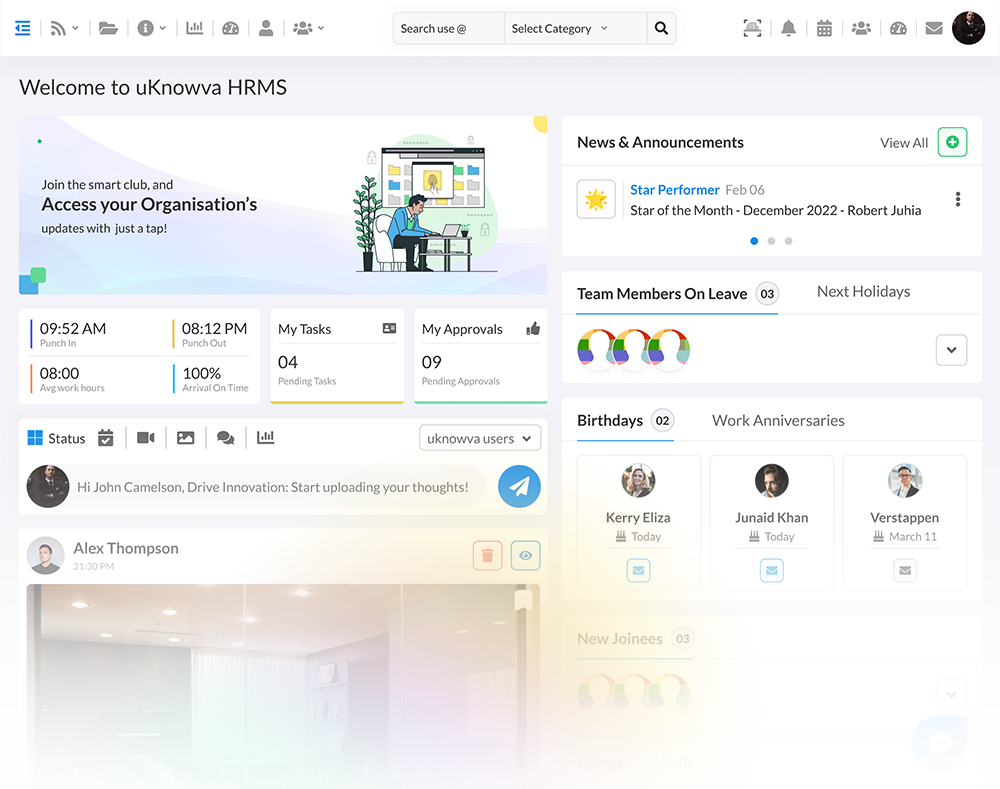
For organizations evaluating a modern HR foundation, uKnowva HRMS provides a broader HR technology platform covering core HR, payroll, recruitment, performance management, employee collaboration, projects, and timesheets.
Let's be honest: most legacy and even many cloud HRMS tools were designed for record-keeping first, decision-making second. They're great at storing data, passable at running workflows, and awkward at everything else.
An MCP (Multidimensional Cloud Platform) flips that order. It assumes your HR environment is messy, global, constantly changing, and dependent on a stack of AI tools that didn't even exist when your current HRMS was built.
Where MCP vs traditional HRMS really diverges is philosophical:
With MCP, your HR system stops being the "system of record" and becomes the "system of coordination," where people's data, AI tools, workflows, and decisions all intersect in real time. Once you see that, it's hard to un-see it.
This shift is closely aligned with the ideas explored in uKnowva's whitepaper, “From Workflows to Systems of Intelligence: The Next Evolution of HR Platforms”, which examines the evolution of HR platforms toward systems of intelligence.
Here's the distinction to put in front of any board or buying committee:
In the context of MCP vs traditional HRMS, most "modern" HR systems are still proudly AI-enabled. It demonstrates well. It ages badly.
MCP is designed to be AI-interoperable from day one, meaning:
You can attach specialized AI for niche tasks (say, internal mobility matching or skills inference) without waiting 18 months for a vendor release. You can run multiple AI engines side by side, compare results, and keep the one that actually works in your context. You can evolve your AI strategy without ripping out your HR core every few years.
Your competitive advantage in people operations will come less from owning data (everyone does) and more from how creatively and quickly you can orchestrate AI around that data. Traditional HRMS was built for static AI sitting inside the product. MCP is built for AI that's constantly changing around it.
For organizations looking at AI capabilities within HRMS, uKnowva's AI platform includes AI Genie, CV Parser, CV Matchmaker, and an AI Chatbot designed to support different HR and employee use cases.
Most HR leaders live with a three- to six-week lag in "truth." Headcount. Attrition. Offer acceptance. Productivity signals. It's all slightly stale.
With MCP, real-time data isn't a tagline; it's the architecture. Events, like a manager changing a comp plan, a candidate dropping out, or a spike in overtime, stream into a single fabric where AI tools and analytics can act immediately.
Seen through the MCP vs traditional HRMS lens, this is the quiet but radical difference:
Traditional HRMS tools answer, "What happened?" MCP keeps asking, "What's happening right now, and what should we do about it?"
And when you can rerun a capacity plan mid-quarter dynamically adjust hiring pipelines based on live acceptance rates or spot burnout patterns from collaboration data before they show up as resignations you're not just "data-driven" anymore.
You're operationally adaptive. Real-time data changes the cadence of HR from quarterly post-mortems to continuous micro-adjustments. Small nudges, early, beat big corrections.
uKnowva's HR analytics and data capabilities support centralized HR data, reporting, dashboards, performance insights, and workforce decision-making.
No CXO wants to be the one explaining a people-data breach to the board, or why a new data residency law blindsided the company again.
One uncomfortable truth in the MCP vs traditional HRMS conversation: legacy systems were built for a slower regulatory world. Security and compliance were things you "updated" a few times a year, not living constraints that change every quarter.
MCP approaches it differently by building:
centralized, policy-driven controls across geographies and entities AI-aware governance (e.g., which AI can touch which data, under what conditions) and automatic propagation of security changes across integrated tools
With traditional HRMS, every new AI tool is a separate security and compliance headache. With MCP, new tools inherit your existing guardrails. Your risk posture scales with your innovation instead of being in constant conflict with it.
The governance dimension is also explored in uKnowva's “Operationalizing Fairness: Bias, Accountability, and Governance in AI-led HR” whitepaper.
If you're comparing MCP vs traditional HRMS purely on upfront cost, you'll almost always justify staying with what you have a little longer. Maybe bolt on a few AI features. Extend the life of the system.
I've watched that movie. It ends with fragmented tools, duplicate data flows, and a migration project in three years that costs 3–5x what you were trying to save.
MCP changes the economics in a less obvious way:
You invest once in a flexible backbone that can outlive individual tools and AI models. You shift spend from big, disruptive replatforming cycles to continuous, smaller upgrades in the tools that sit on top. You can pilot new AI capabilities in contained domains without triggering a full "system change" every time.
Strategically, you decouple your HR and people strategy from any single vendor's product roadmap. You're buying optionality, not just software.
This principle is directly relevant to uKnowva's “Composable HR Architecture: Designing for Change Without Re-Platforming” whitepaper, which discusses modular, API-first and AI-powered HR architecture designed to evolve without replacing the entire technology foundation.
Let me put it side by side, without the vendor gloss:
You want to test an AI model that predicts regrettable attrition. Traditional HRMS: wait for the vendor to offer a module, or build a workaround that lives outside your core. MCP: plug in a third-party or internal model, point it at standardized events and data, test safely, keep it if it works.
New pay transparency rules go live in two key markets. Traditional HRMS: custom configs, spreadsheets, frantic local workarounds. MCP: update policy centrally, propagate to workflows, approvals, and integrated comp tools.
Your CEO wants a single, live view of talent risk across regions.
For a practical view of how a modern HRMS can bring multiple HR functions together, uKnowva's HRMS platform covers recruitment and onboarding, performance management, payroll, employee management, and other workforce processes.
Its AI capabilities also include AI Genie, AI Chatbot, CV Parser and CV Matchmaker.
For performance-focused use cases, uKnowva Performance Management includes AI-generated KRAs, OKRs, 360-degree feedback, scorecards, succession planning and real-time performance insights.
If you're sitting with a roadmap decision over MCP vs traditional HRMS, frame the question this way:
"Do we want an HR system that happens to have some AI in it, or a platform that will let our AI strategy evolve for the next decade without ripping the core out again?"
From there, a practical path looks like:
defining where AI and interoperability genuinely move the needle for your business (not just "cool demos") pressure-testing vendors on AI-interoperability, not just AI buzzwords, and being honest about how often you've already paid for modernization that didn't fundamentally change how HR operates.
Because at some point, this stops being an IT upgrade and becomes a leadership decision Are we building HR for a world where tools change every year, or clinging to architectures built for a world where they changed every decade?
The companies that treat MCP as a strategic shift, not just a new logo on the slide, are the ones that will still recognize their HR stack, and trust it, five years from now. Maybe that's what everyone is really buying here: not just new capabilities, but the confidence that people's systems can finally keep up with the business, instead of always lagging a step behind.
The MCP vs traditional HRMS debate is ultimately not about replacing one piece of HR technology with another. It is about deciding what role an HR platform should play as AI becomes an increasingly important part of how businesses operate.
Traditional HRMS platforms remain valuable for managing structured workforce processes, employee records, payroll, recruitment, performance, and compliance. But as organizations adopt more AI tools, the ability to connect data, workflows, intelligence, and decision-making becomes equally important.
uKnowva is already moving in this direction through its AI-powered HR platform, including AI Genie and AI Chatbot capabilities, while its broader HRMS platform brings together core HR, payroll, recruitment, onboarding, performance management, employee collaboration, and workforce management.
The company's move toward MCP-powered conversational HR is also represented by UVA, uKnowva's MCP-powered conversational AI assistant, designed to enable natural-language interactions across HR workflows.
The question for HR and business leaders, therefore, is no longer simply "Which HRMS has the most features?"
It is:
"Which HR architecture can keep evolving as our workforce, technology, AI strategy, and business requirements change?"
That is the real conversation behind MCP vs traditional HRMS and potentially the next major chapter in the evolution of enterprise HR technology.