








 Aditi Sharma
Table of Content
If you're anywhere near an HR or IT budget right now, you've already heard the pitch: machine learning and cognitive processing will clean up your data mess, predict attrition, fix recruitment, and maybe even answer everyone's PTO questions at 2 a.m.
Some of that is true. Some of it is wishful thinking wrapped in a glossy vendor deck.
The reality is more nuanced: MCP enterprise HR challenges are as much political and operational as they are technical. And if you're sitting in a CHRO, CIO, or COO seat, you don’t get the luxury of being purely optimistic or purely skeptical. You have to live in the uncomfortable middle.
Let's unpack that a bit.
The upside is real. When MCP is done well, it quietly rewires how HR decisions get made. Instead of HR teams wrestling with static dashboards once a quarter, you get constantly updated signals: who's at risk of leaving, where skills are eroding, which teams are burning out. The sharp insight here isn’t “AI predicts turnover” everyone says that. It’s this: the real value is pattern visibility at the team and role level, not at the “enterprise” level.
Enterprise-wide averages are comforting. They’re also useless.
With MCP tools trained on your HCM, performance, learning, and engagement data, you can:
That’s where MCP enterprise HR challenges start turning into strategic levers: HR stops reacting to escalations and starts shaping workforce decisions in near real-time.
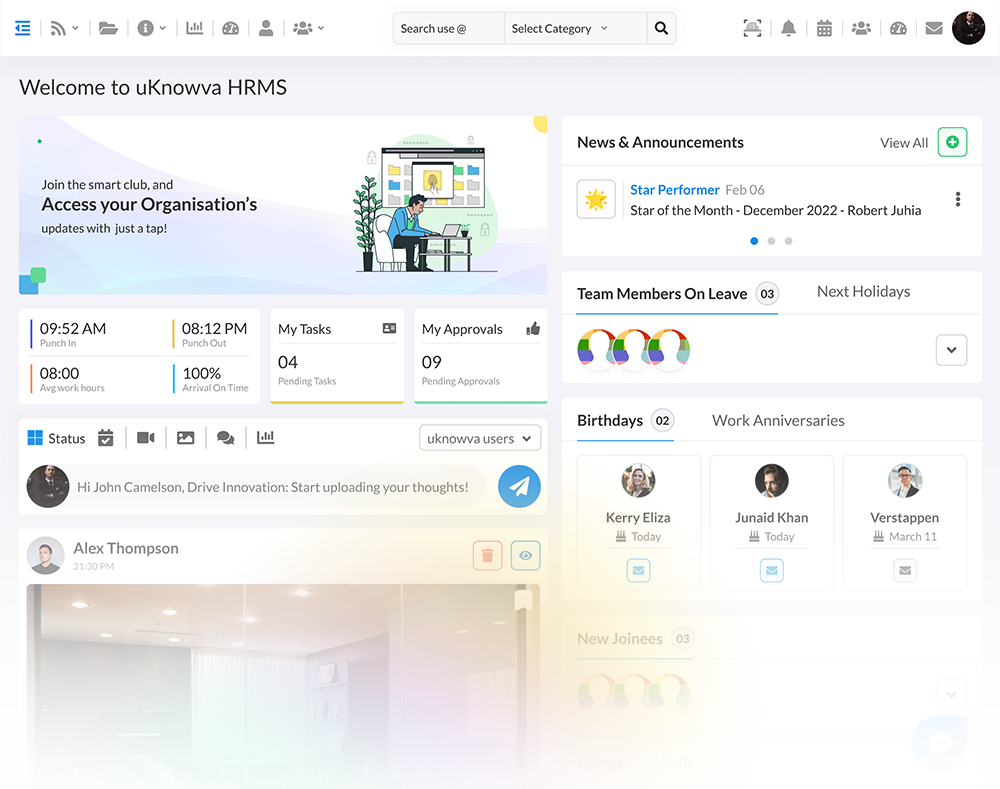
You can explore how uKnowva HRMS brings employee data, performance, workforce management, automation, and analytics together to support more connected HR operations.
Recruitment is similar. MCP-powered screening can take the bottom 50–60% of CVs off your recruiters’ desks and do it more consistently than any human on their fifth coffee. The important comparison here is not between AI and recruiters, but between AI-assisted screening and the rushed, inconsistent triage process recruiters often have to manage manually. One is romantic; the other is what’s actually happening.
Plus, when you wire MCP into your internal talent marketplace, you can finally move beyond the annual “what’s your career path?” performance review ritual. Employees get recommended projects, gigs, and learning paths based on what they actually do and learn, not just what they wrote in a self-review three months ago.
And yes, chatbots and virtual HR assistants can take a shocking amount of administrative pain off your team’s plate. When done right, they don’t just answer questions, they triage. “Is this a policy question, a manager question, or a wellbeing red flag?” That’s not flashy. It simply helps prevent routine requests, important questions, and potential concerns from being overlooked.
This is where tools such as uKnowva’s AI-powered HR suite become relevant, bringing AI capabilities, employee self-service, and AI Agents into everyday HR operations.
Now for the part everyone underplays in conference keynotes.
Standing up MCP in HR isn’t “install and go.” You’re not simply adding another piece of software; you’re taking on requirements around data quality, governance, and organizational readiness.
Analysts are already warning that a meaningful share of agentic AI projects, especially the ambitious, “let’s have AI orchestrate whole workflows” efforts, will be shelved or canceled by 2027. Not because the tech doesn’t work, but because the economics and governance don’t.
In practice: The pilot looks great in a controlled environment. Then it hits real HR data, full of gaps, duplications, and legacy systems that don’t talk to each other. Suddenly your “predictive model” is making calls based on junk, and your legal team starts asking very pointed questions.
This is one of the less obvious MCP enterprise HR challenges: the technology amplifies whatever is already there, including bias, broken processes, and political tension between HR, IT, and the business.
Governance is where things either mature or go off the rails. Without clear governance, an MCP implementation can move from a controlled HR initiative into a source of compliance, accountability, and operational risk. If you don’t have:
...then you’re building a future audit headache.
And let’s not skip the human part. Employees are already nervous about automation. If your first visible move is “the algorithm is screening your CV” or “the chatbot will answer your benefits questions now” without any explanation, expect pushback. Quiet resistance shows up as low adoption, data being withheld, and “shadow processes” continuing in spreadsheets.
So yes, innovation is exciting. But MCP enterprise HR challenges around trust, communication, and perceived fairness will make or break your rollout.
For organizations looking to introduce AI into HR while maintaining structured processes and controls, uKnowva’s AI Agents provide a relevant foundation for exploring AI-driven HR workflows and task execution.
Here’s where a lot of leadership teams get split: IT wants an architecture play. HR wants point solutions that fix immediate pain. Finance wants hard ROI in 12–18 months. All of them are, in their own way, right.
The strategic move, and this is the part many companies miss, is to separate agentic AI moonshots from task-specific MCP that gets quietly embedded into existing systems.
Instead of pursuing large-scale autonomous AI initiatives immediately, organizations can begin with focused MCP capabilities embedded into the HR systems and processes they already use.
You don’t need a grand “AI HR platform” to start. In fact, you probably shouldn’t. Instead:
Why does this work better? Because you’re matching the organization’s emotional risk tolerance, not just its technical readiness. People can live with “the system now gives us better shortlists.” They struggle with “the agent is now orchestrating onboarding end-to-end.”
This is one of those MCP enterprise HR challenges you don’t see on a roadmap slide: change saturation. HR has already survived HCM migration, hybrid work policies, and two rounds of org redesign. Another “big bang” AI initiative is a hard sell.
So work in layers:
This approach may attract less attention than a large-scale AI announcement, but it is more likely to remain practical and sustainable in day-to-day operations.
uKnowva’s broader AI-powered HR ecosystem can support this gradual approach by bringing AI capabilities into existing HR processes rather than treating AI as a completely separate layer.
If you’re looking at your own MCP enterprise HR challenges and wondering where to even start, here’s the simplest framing that has worked with executive teams:
First, decide what not to automate: High-stakes decisions like terminations, promotions to critical roles, and sensitive ER cases should stay human-led, with MCP as input, not judge and jury.
High-stakes decisions such as terminations, critical-role promotions, and sensitive employee-relations cases should remain human-led, with MCP providing supporting information rather than making the final decision.
Second, pick two or three “boring but brutal” pain points: think frontline recruiting volume, skills visibility, or case triage and ask, “What would ‘less painful’ look like in 12 months?”
Third, align HR, IT, and legal around a shared principle: “If we can’t explain it to employees, we don’t deploy it.”
That last one is more powerful than it sounds. It filters out half-baked experiments and keeps you honest.
Will MCP transform HR? In parts, yes. But not the way vendors promise. The future is more likely to consist of multiple smaller, well-governed AI capabilities integrated across the existing HR technology stack than a single system managing every aspect of the workforce.
Maybe that’s the real opportunity, not to chase a sci-fi version of HR, but to chip away at the dull, manual, error-prone stuff so your people leaders can do the work only humans can do — listen, interpret, negotiate, decide.
Maybe the real opportunity is to reduce the repetitive, manual, and error-prone work that consumes HR teams’ time, allowing people leaders to focus on work that depends on human judgment — listening, interpreting, negotiating, and deciding.
And if MCP can help win back even 10–15% of that time at scale, with governance that you can defend to your board and employees?
That’s not hype. That’s a business case.
For organizations exploring what MCP-enabled, action-oriented HR can look like in practice, UVA — uKnowva’s Virtual AI Assistant powered by MCP — provides a practical example.
UVA brings conversational AI into HR operations, allowing employees and HR teams to interact with HR information and processes through natural-language requests. Its role fits directly into the broader shift discussed in this article: moving from systems that simply provide information toward systems that can help execute HR tasks.
With AI Agents and MCP capabilities integrated into the HR environment, the opportunity is not simply to add another chatbot. It is to make HR processes more accessible, connected, and actionable while keeping organizational permissions, policies, and approval structures central to how work gets done.
MCP is not a shortcut around the hard parts of enterprise HR transformation. It does not eliminate the need for clean data, strong governance, employee trust, clear ownership, or thoughtful change management.
What it can do is create a new layer of intelligence and action across HR processes.
The organizations that benefit most will not necessarily be the ones deploying the most ambitious AI systems first. They will be the ones that identify meaningful HR problems, introduce AI within clearly defined boundaries, measure outcomes, build trust, and expand responsibly.
For CHROs, CIOs, and COOs, the opportunity is therefore bigger than simply adopting another HR technology. It is about deciding where AI should assist, where it can act, and where human judgment must remain firmly in control.
That balance is what can turn MCP from an emerging technology into a practical enterprise HR capability.