







 Aditi Sharma
Table of Content
An inverse leadership crisis is happening throughout the businesses.
The organizations are urging managers to prepare less than ever and promote them faster than ever.
The new leadership issue is no longer a one-dimensional one in which it is necessary to identify high-potential talent. It is regarding increasing the speed of real-world leadership at scale.
The CHROs of today find themselves in an organizational misfit:
| Business Reality | Leadership Readiness Gap |
| Accelerated organizational change | Decelerated acquisition of leadership skills. |
| Combination and dispersed teams | Limited experience in real-world management. |
| Business models that are AI-based | Older leadership development programs |
| Unceasing upheaval | Stability-trained leaders. |
In this study, the researchers assert that according to the Global Leadership Development Study, 2025, by Harvard Business Impact, the development of leadership capabilities remains one of the least modernized aspects of enterprise learning.
In the meantime, according to Gallup, the use of AI at the workplace has increased by almost two times since 21 percent of respondents said they were using AI at work in 2019.
This is implied:
The leadership development programs constructed at the pace of yesterday, are not able to prepare leaders to the complexity of tomorrow.
Here, AI-based leadership development is a strategic necessity.
The leadership experience gap is the widening gap between:
The leadership issues that managers experience.
The practical training they are being given.
The ability to perform leadership is not developed by theory.
It is developed with the repeated exposure to:
But the majority of managers are promoted even before they have substantially exercised these situations.
| Leadership Development Challenge | Enterprise Impact |
| Managers that are unprepared first-time managers | decreased the productivity of the team. |
| Delays in making decisions with confidence | Delay in actual implementation. |
| Poor coaching skills | Increase in attrition. |
| Ineffective conflict management | Culture erosion. |
| Minimal strategic exposure | Lack of pipelines of succession. |
This is the gap in capabilities that many CHROs are now having to deal with.
There are a number of structural changes that are fuelling this crisis of the capability of leaders.
1. Workforce Transformation
Organizations are changing at an accelerated rate than the leaders.
A survey of Workers Hopes and Fears Survey 2025 by PwC discovered that over the last one year, 54% of the workers have used AI in their work.
This alters the leadership requirements in a drastic manner.
It is time that managers lead:
This was not developed in the traditional leadership development programs.
2. Flattening Organizational Structures
The reduction of middle-management ranks implies that leaders do not get as much developmental apprenticeship.
Managers are supposed to work with minimal observation, coaching or guided practice.
3. Shorter Promotion Cycles
Organisations are speeding up internal mobility.
The result:
Promotion tends to be ahead of maturity of capabilities.
4. Increased Leadership Complexity
The contemporary leaders need to be able to juggle:
That needs further practical training.
Leadership is more of a behavior
Passive consumption of the content cannot develop leadership.
Studies have always indicated that adults can learn leadership through:
Experience → Reflection → Feedback → Repetition
This is the reason why the programs of leadership development that are heavy in classes frequently under-deliver.
There is no development of conflict resolution capability through reading about conflict resolution.
Experience
This is the place that AI learning simulations generate transformational value.
The vast majority of the development of leadership in the enterprises nevertheless depends on:
Such ways bring awareness. They seldom develop behavioral capability.
| Classic Model | Reasons It is ineffective |
| One-size-fits-all material | Ignore the context of learners |
| Rare workshops | None reinforced |
| Minimal practice situations | Poor transfer of behavior |
| Generic coaching | Scalability is not possible |
| Slow feedback loops | Slowness of improvement |
The report on AI at Work by the BCG (2025) indicates that the ability to adopt capabilities is much higher among employees who receive structured AI-assisted coaching and training.
The future of the AI-based talent development transforms the knowledge transfer to the simulation of capabilities.
This model uses:
This is not taking over human coaching.
It is scaling up developmental experience.
1. AI Learning Personalization
AI examines the behavior of learners, and adjusts developmental directions.
As opposed to all leaders being supplied with the same content, learning becomes:
Example:
A newly promoted engineering manager will have simulations with an emphasis on:
A sales director is simulated around:
This is AI learning personalization at work.
2. AI Learning Simulations
The greatest innovation perhaps.
Some of the realistic leadership scenarios developed by AI include:
| Type of Simulation | Capability developed |
| Discussion of employee burnout | Empathy + coaching |
| Stakeholder conflict of high stakes | Negotiation |
| Announcement of restructuring of the team | Change leadership |
| Dilemma of decision ethically | Judgment |
| Intercultural group conflict | Inclusion leadership |
The leaders rehearse over time in low risk settings.
Feedback can be given instantly thereby increasing the learning process.
3. AI Coaching Leaders
The benefits of AI coaching platforms are:
Benefits include:
This renders AI to develop employees as very feasible.
4. Continuous Capability Measurement
AI can successfully assist in the evaluation of dynamic leadership abilities.
Rather than yearly assessments, organizations are able to gauge:
This brings about a living leadership capability strategy.
It is not just an L&D upgrade. It is a workforce transformation lever that is strategic. The AI-powered talent strategy can help CHROs:
Develop Future-Ready Pipelines of Leadership
Develop leaders for:
Democratize High-Quality Development
In the past, high quality coaching was only offered to the top managers.
This is extended to: AI-powered learning experiences.
Improve Internal Mobility
Higher preparation to leadership facilitates quicker promotion assurance.
Phase 1: Diagnose Capability Gaps
Assess:
Key questions:
In what ways do new managers find it hard?
What are the predictors of success in terms of capabilities?
Where does it have attrition manager?
Phase 2: Choose AI Coaching Platforms
Evaluate vendors on:
| Criteria | Reason Why It Matters |
| Realism in simulation | Transfer behavior |
| Personalization engine | Relevance |
| Rights to privacy of data | Compliance |
| Integration capability | Scalability |
| Analytics depth | Measurement |
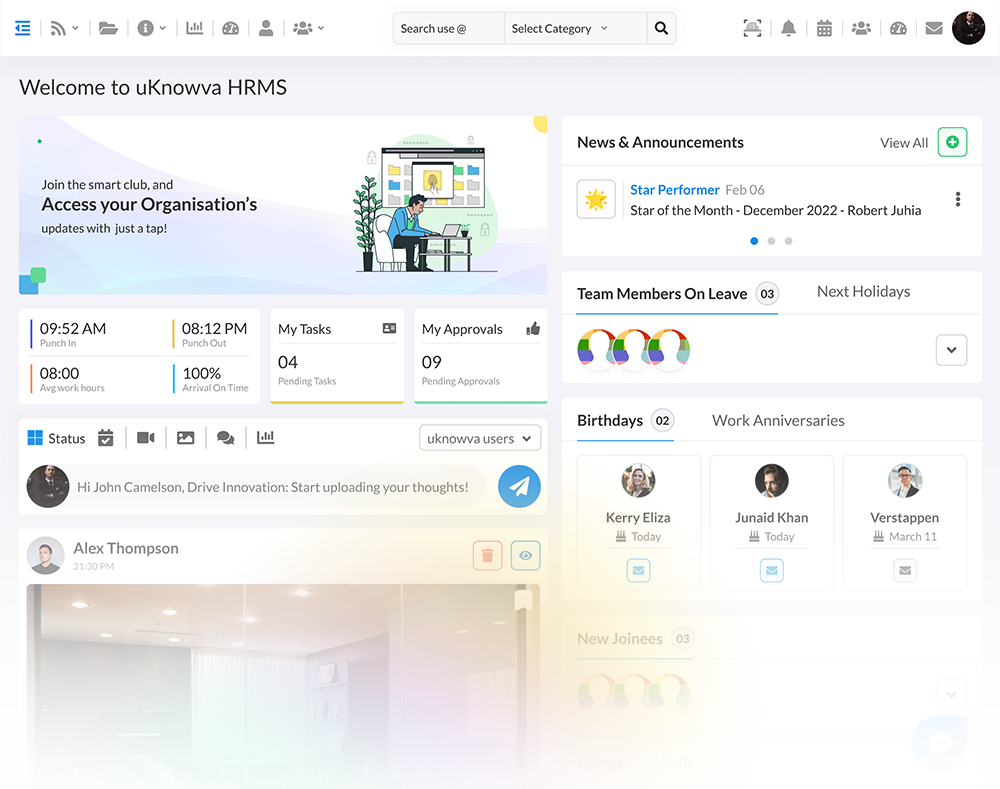
The timber workforce intelligence alignment is enhanced with platforms that are integrated with uKnowva HRMS.
Phase 3: Pilot Critical Manager Cohort Pilot
Best starting groups:
Measure:
Phase 4: Scale With HRMS Integration
A unified platform is essential.
With uKnowva HRMS, organizations can connect:
This creates a complete AI-enabled leadership development program.
How people view the new system can impact adoption success
Leaders may see AI learning as:
CHROs need to present it in the right way.
Mark AI as Augmentation, Not Replacement
AI enhances leadership coaching
It does not take the place of human coaching
Start with High-Value Use Cases
Examples include:
Deliver Early Wins
Measure and share results:
Regulating the development process with AI should be handled with care.
| Principle | CHRO Priority |
| Transparency | Explain AI decision-making logic |
| Privacy | Keep leadership information confidential |
| Fairness | Prevent algorithmic discrimination |
| Human Oversight | Maintain the coach's judgment |
| Auditability | Allow for auditing |
As AI becomes central to HR tech trends, strong governance is essential.
It will be immersive, personalized, and ongoing.
Rapid Growth in: is expected.
The leadership gap today is not about talent—it's about lack of real-world experience.
AI-powered leadership development bridges this gap by delivering scalable, personalized, and experiential learning that traditional programs cannot.
For CHROs, this is a strategic shift—from training leaders to truly building capability at scale. With platforms like uKnowva HRMS, organizations can seamlessly integrate AI-driven insights, learning, and workforce data to create future-ready leaders faster and more effectively.